Zhang Jin-Tao, Yao Yuan-Wei, Potenza Marc N, Xia Cui-Cui, Lan Jing, Liu Lu, Wang Ling-Jiao, Liu Ben, Ma Shan-Shan, Fang Xiao-Yi
State Key Laboratory of Cognitive Neuroscience and Learning and IDG/McGovern Institute for Brain Research, Beijing Normal University, Beijing 100875, China; Center for Collaboration and Innovation in Brain and Learning Sciences, Beijing Normal University, Beijing 100875, China.
State Key Laboratory of Cognitive Neuroscience and Learning and IDG/McGovern Institute for Brain Research, Beijing Normal University, Beijing 100875, China.
Neuroimage Clin. 2016 Sep 9;12:591-599. doi: 10.1016/j.nicl.2016.09.004. eCollection 2016.
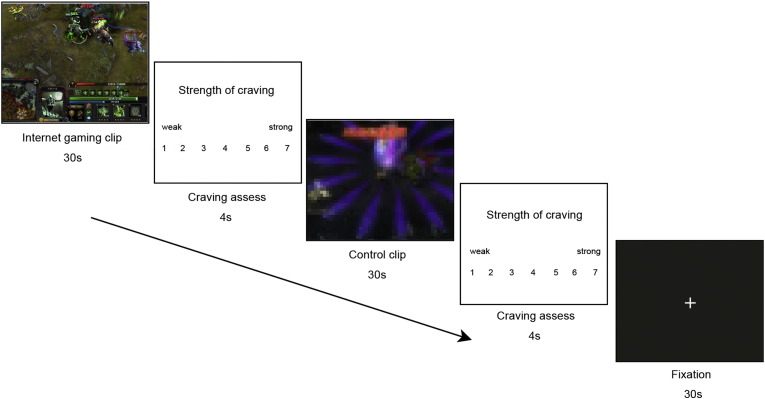
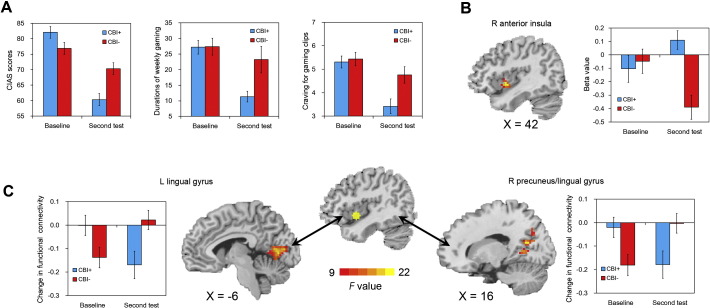
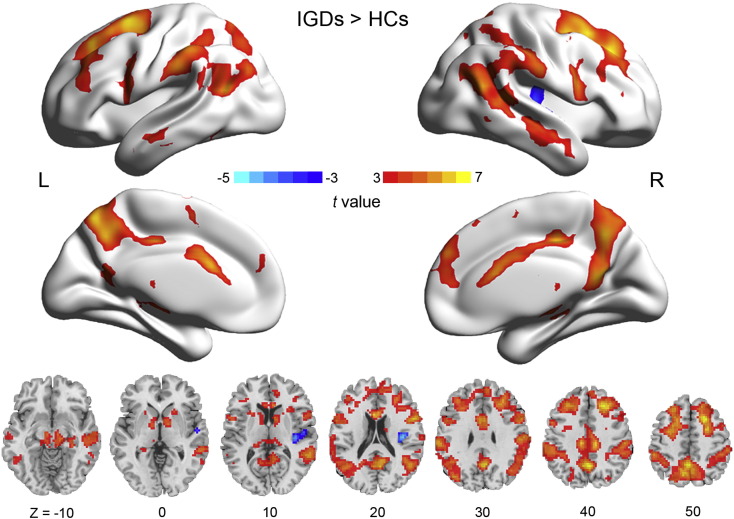
Internet gaming disorder (IGD) is characterized by high levels of craving for online gaming and related cues. Since addiction-related cues can evoke increased activation in brain areas involved in motivational and reward processing and may engender gaming behaviors or trigger relapse, ameliorating cue-induced craving may be a promising target for interventions for IGD. This study compared neural activation between 40 IGD and 19 healthy control (HC) subjects during an Internet-gaming cue-reactivity task and found that IGD subjects showed stronger activation in multiple brain areas, including the dorsal striatum, brainstem, substantia nigra, and anterior cingulate cortex, but lower activation in the posterior insula. Furthermore, twenty-three IGD subjects (CBI + group) participated in a craving behavioral intervention (CBI) group therapy, whereas the remaining 17 IGD subjects (CBI - group) did not receive any intervention, and all IGD subjects were scanned during similar time intervals. The CBI + group showed decreased IGD severity and cue-induced craving, enhanced activation in the anterior insula and decreased insular connectivity with the lingual gyrus and precuneus after receiving CBI. These findings suggest that CBI is effective in reducing craving and severity in IGD, and it may exert its effects by altering insula activation and its connectivity with regions involved in visual processing and attention bias.
网络成瘾障碍(IGD)的特征是对在线游戏及相关线索有强烈的渴望。由于与成瘾相关的线索可引起参与动机和奖赏处理的脑区激活增加,并可能引发游戏行为或导致复发,因此改善线索诱发的渴望可能是IGD干预的一个有前景的靶点。本研究比较了40名IGD患者和19名健康对照(HC)受试者在网络游戏线索反应任务期间的神经激活情况,发现IGD患者在多个脑区表现出更强的激活,包括背侧纹状体、脑干、黑质和前扣带回皮质,但后岛叶的激活较低。此外,23名IGD患者(CBI +组)参与了渴望行为干预(CBI)团体治疗,而其余17名IGD患者(CBI -组)未接受任何干预,所有IGD患者在相似的时间间隔内接受扫描。CBI +组在接受CBI后,IGD严重程度和线索诱发的渴望降低,前岛叶激活增强,岛叶与舌回和楔前叶的连接减少。这些发现表明,CBI在降低IGD的渴望和严重程度方面是有效的,并且它可能通过改变岛叶激活及其与参与视觉处理和注意偏差的区域的连接来发挥作用。