Department of Psychiatry, SMG-SNU Boramae Medical Center, Seoul, 07061, Republic of Korea.
Emotion, Cognition and Behavior Research Group, Korea Brain Research Institute, Daegu, 41062, Republic of Korea.
Transl Psychiatry. 2021 May 1;11(1):258. doi: 10.1038/s41398-021-01375-x.
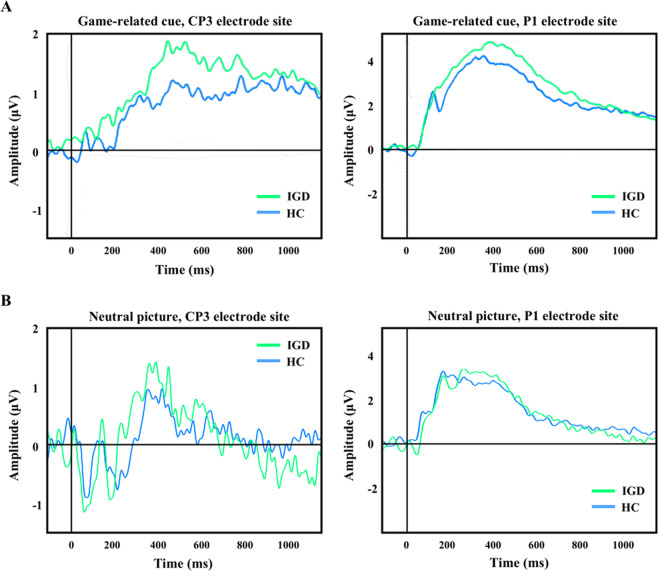
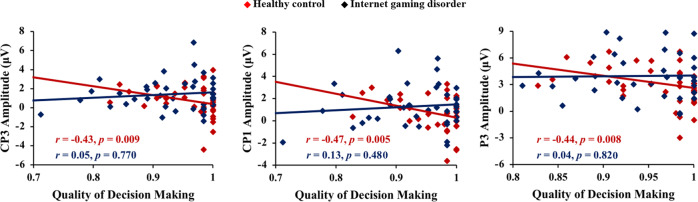
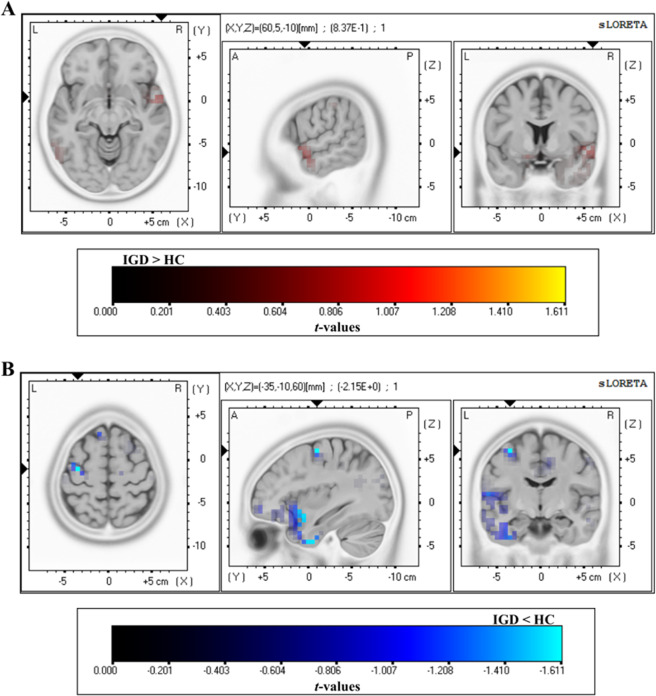
This study investigated attentional bias toward game-related cues in Internet gaming disorder (IGD) using electrophysiological markers of late positive potential (LPP) and identifying the sources of LPP. In addition, the association between LPP and decision-making ability was investigated. The IGD (n = 40) and healthy control (HC; n = 39) participants viewed a series of game-related and neutral pictures, while their event-related potentials (ERPs) were recorded. LPPs were calculated as the mean amplitudes between 400 and 700 ms at the centro-parietal (CP3, CP1, Cpz, CP2, and CP4) and parietal (P3, P1, Pz, P2, and P4) electrode sites. The source activations of LPP were estimated using standardized low-resolution brain electromagnetic tomography (sLORETA). In addition, decision-making ability was evaluated by the Cambridge Gambling Task. Higher LPP amplitudes were found for game-related cues in the IGD group than in the HC group. sLORETA showed that the IGD group was more active in the superior and middle temporal gyri, which are involved in social perception, than in the HC group, whereas it was less active in the frontal area. Individuals with IGD have deficits in decision-making ability. In addition, in the HC group, the lower the LPP when looking at the game-related stimuli, the better the quality of decision-making, but not in the IGD group. Enhanced LPP amplitudes are associated with emotional arousal to gaming cues and decision-making deficits in IGD. In addition, source activities suggest that patients with IGD perceive game-related cues as social stimuli. LPP can be used as a neurophysiological marker of IGD.
本研究采用事件相关电位(ERP)晚期正电位(LPP)的电生理标记物,探讨了网络成瘾障碍(IGD)个体对游戏相关线索的注意偏向,并确定了 LPP 的来源。此外,还研究了 LPP 与决策能力之间的关系。IGD(n=40)和健康对照组(HC;n=39)参与者观看了一系列游戏相关和中性图片,同时记录了他们的事件相关电位(ERP)。LPP 被定义为 CP3、CP1、Cpz、CP2 和 CP4 及 P3、P1、Pz、P2 和 P4 电极位置的 400 到 700ms 之间的平均振幅。使用标准化低分辨率脑电磁层析成像(sLORETA)估计 LPP 的源激活。此外,通过剑桥赌博任务评估决策能力。IGD 组对游戏相关线索的 LPP 振幅高于 HC 组。sLORETA 显示,IGD 组在颞上和中回的活跃度高于 HC 组,而在额区的活跃度较低,这些区域与社会知觉有关。IGD 个体在决策能力方面存在缺陷。此外,在 HC 组中,观看游戏相关刺激时 LPP 越低,决策质量越好,但在 IGD 组中则不然。增强的 LPP 振幅与对游戏线索的情绪唤醒和 IGD 中的决策缺陷有关。此外,源活动表明,IGD 患者将游戏相关线索视为社会刺激。LPP 可作为 IGD 的神经生理标志物。