Warmbier-Wytykowska Ewelina, Williams Ashley Peter, Rozanski Jacek, Fischer Peter, Lutz-Bueno Viviane, Handschin Stephan, Baraldi Laura, Warmbier Jarosław, Wagner Patrycja, Różańska Sylwia
Institute of Chemical Technology and Engineering, Faculty of Chemical Technology, Poznan University of Technology, ul. Berdychowo 4, PL 60-965 Poznan, Poland.
Laboratory for Neutron Scattering and Imaging, Paul Scherrer Institut, 5232 Villigen, Switzerland.
Langmuir. 2025 Feb 11;41(5):3561-3571. doi: 10.1021/acs.langmuir.4c04689. Epub 2025 Jan 29.
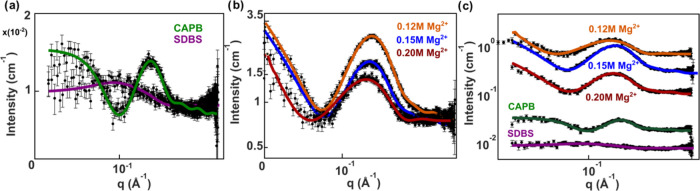
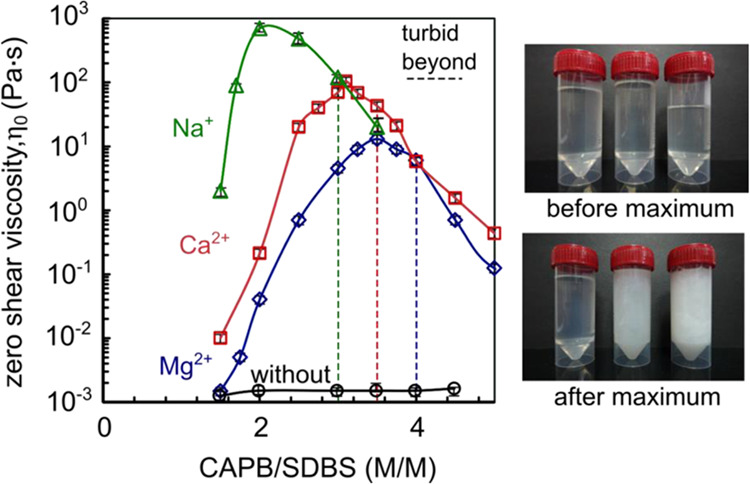
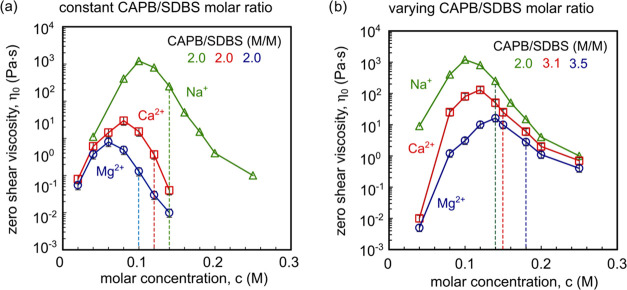
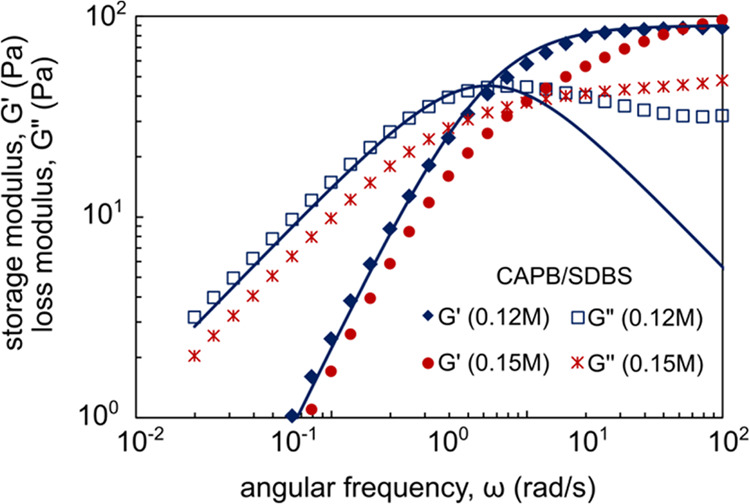
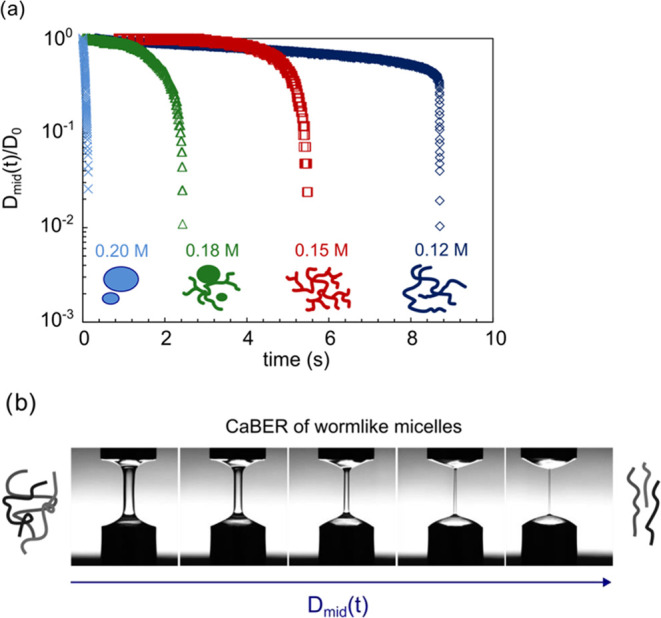
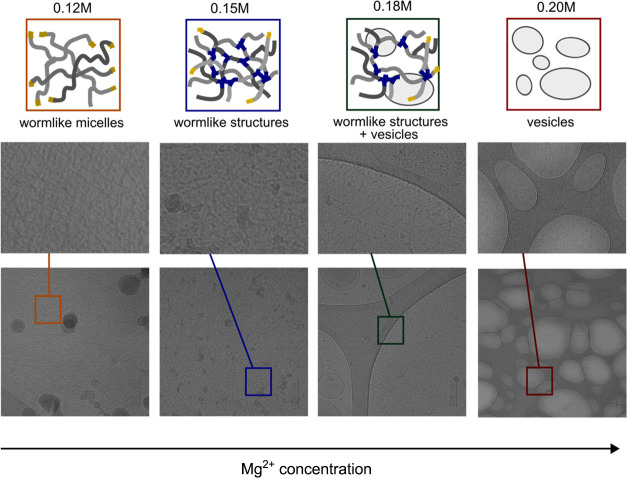
Despite extensive research on the use of salts to enhance micellar growth, numerous questions remain regarding the impact of ionic exchange and molecular structure on charge neutralization. This study looks into how certain cations (Na, Ca, and Mg) affect the structure of a cocamidopropyl betaine CAPB and sodium dodecylbenzenesulfonate SDBS surfactant mixture, aiming toward applications in targeted delivery systems. The mixture consists of a zwitterionic surfactant, cocamidopropyl betaine (CAPB), and an anionic surfactant, sodium dodecylbenzenesulfonate (SDBS), combined in varying molar ratios at a total concentration of 200 mM. We characterized the macroscale properties through rheological measurements and obtained detailed structural insights using small-angle X-ray scattering (SAXS) and cryogenic electron microscopy (cryo-EM). The findings reveal that increasing the concentration of cations in the CAPB/SDBS mixture induces the formation of peaks in the zero-shear viscosity as a function of salt concentration (salt curve). Analysis through cryo-EM and SAXS showed that these viscosity peaks are related to the change of micellar assemblies from entangled worm-like micelles to branched worm-like micelles and then to bilayer structures (vesicles). The specific cation concentration at which the zero-shear viscosity peak occurs, as well as the maximum viscosity, is strongly influenced by the type of cation present in the CAPB/SDBS solutions, a phenomenon explained by the Hofmeister series. Notably, the differing affinities of cations for the carboxylate COO and sulfite SO groups and the partial dehydration of micelles contribute to the lower concentration of magnesium cations required to reach the viscosity peak compared to calcium cations.
尽管对使用盐来促进胶束生长进行了广泛研究,但关于离子交换和分子结构对电荷中和的影响仍存在许多问题。本研究探讨了某些阳离子(钠、钙和镁)如何影响椰油酰胺丙基甜菜碱(CAPB)和十二烷基苯磺酸钠(SDBS)表面活性剂混合物的结构,目标是应用于靶向递送系统。该混合物由两性离子表面活性剂椰油酰胺丙基甜菜碱(CAPB)和阴离子表面活性剂十二烷基苯磺酸钠(SDBS)组成,以不同的摩尔比混合,总浓度为200 mM。我们通过流变学测量表征了宏观性质,并使用小角X射线散射(SAXS)和低温电子显微镜(cryo-EM)获得了详细的结构见解。研究结果表明,在CAPB/SDBS混合物中增加阳离子浓度会导致零剪切粘度随盐浓度(盐曲线)形成峰值。通过cryo-EM和SAXS分析表明,这些粘度峰值与胶束聚集体从缠结的蠕虫状胶束变为分支的蠕虫状胶束,然后变为双层结构(囊泡)的变化有关。零剪切粘度峰值出现时的特定阳离子浓度以及最大粘度,受到CAPB/SDBS溶液中存在的阳离子类型的强烈影响,这一现象由霍夫迈斯特序列解释。值得注意的是,阳离子对羧酸盐COO和亚硫酸盐SO基团的不同亲和力以及胶束的部分脱水,导致与钙阳离子相比,达到粘度峰值所需的镁阳离子浓度较低。