Friedewald Sarah M, Sieniek Marcin, Jansen Sunny, Mahvar Fereshteh, Kohlberger Timo, Schacht David, Bhole Sonya, Gupta Dipti, Prabhakara Shruthi, McKinney Scott Mayer, Caron Stacey, Melnick David, Etemadi Mozziyar, Winter Samantha, Saensuksopa Thidanun, Maciel Alejandra, Speroni Luca, Sevenich Martha, Agharwal Arnav, Zhang Rubin, Duggan Gavin, Kadowaki Shiro, Kiraly Atilla P, Yang Jie, Mustafa Basil, Matias Yossi, Corrado Greg S, Tse Daniel, Eswaran Krish, Shetty Shravya
Feinberg School of Medicine, Northwestern University, 420 E Superior St, Chicago, IL, 60611, USA.
Lynn Sage Comprehensive Breast Center, Room 4-2304 250 E. Superior St., Chicago, IL, 60657, USA.
Breast Cancer Res Treat. 2025 May;211(1):1-10. doi: 10.1007/s10549-025-07616-7. Epub 2025 Jan 29.
Many breast centers are unable to provide immediate results at the time of screening mammography which results in delayed patient care. Implementing artificial intelligence (AI) could identify patients who may have breast cancer and accelerate the time to diagnostic imaging and biopsy diagnosis.
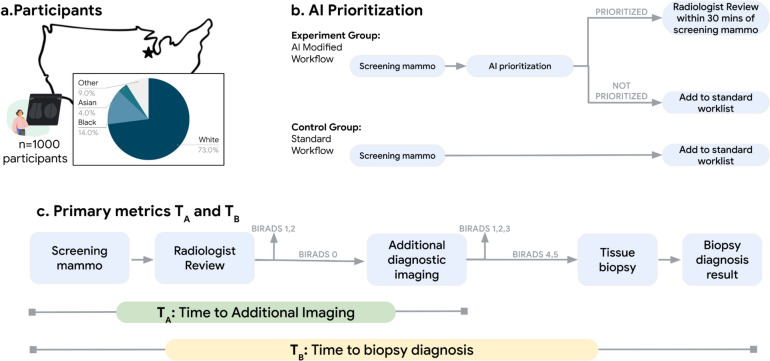
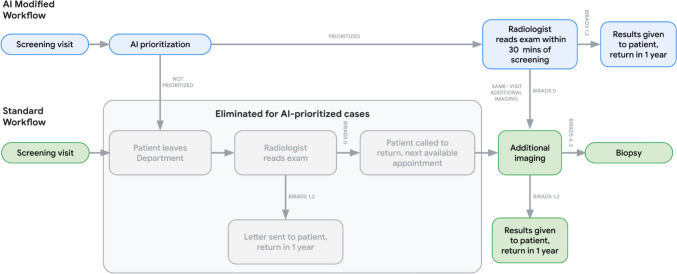
In this prospective randomized, unblinded, controlled implementation study we enrolled 1000 screening participants between March 2021 and May 2022. The experimental group used an AI system to prioritize a subset of cases for same-visit radiologist evaluation, and same-visit diagnostic workup if necessary. The control group followed the standard of care. The primary operational endpoints were time to additional imaging (T) and time to biopsy diagnosis (T).
The final cohort included 463 experimental and 392 control participants. The one-sided Mann-Whitney U test was employed for analysis of T and T. In the control group, the T was 25.6 days [95% CI 22.0-29.9] and T was 55.9 days [95% CI 45.5-69.6]. In comparison, the experimental group's mean T was reduced by 25% (6.4 fewer days [one-sided 95% CI > 0.3], p<0.001) and mean T was reduced by 30% (16.8 fewer days; 95% CI > 5.1], p=0.003). The time reduction was more pronounced for AI-prioritized participants in the experimental group. All participants eventually diagnosed with breast cancer were prioritized by the AI.
Implementing AI prioritization can accelerate care timelines for patients requiring additional workup, while maintaining the efficiency of delayed interpretation for most participants. Reducing diagnostic delays could contribute to improved patient adherence, decreased anxiety and addressing disparities in access to timely care.
许多乳腺中心在乳腺筛查钼靶检查时无法提供即时结果,这导致患者护理延迟。应用人工智能(AI)可以识别可能患有乳腺癌的患者,并加快进行诊断性成像和活检诊断的时间。
在这项前瞻性随机、非盲、对照实施研究中,我们在2021年3月至2022年5月期间招募了1000名筛查参与者。实验组使用人工智能系统对一部分病例进行优先级排序,以便放射科医生在同一就诊时进行评估,必要时进行同一就诊时的诊断检查。对照组遵循标准护理流程。主要操作终点是进行额外成像的时间(T)和活检诊断的时间(T)。
最终队列包括463名实验组参与者和392名对照组参与者。采用单侧曼-惠特尼U检验分析T和T。在对照组中,T为25.6天[95%置信区间22.0 - 29.9],T为55.9天[95%置信区间45.5 - 69.6]。相比之下,实验组的平均T减少了25%(少6.4天[单侧95%置信区间> 0.3],p < 0.001),平均T减少了30%(少16.8天;95%置信区间> 5.1],p = 0.003)。实验组中由人工智能进行优先级排序的参与者时间减少更为明显。所有最终被诊断为乳腺癌的参与者都被人工智能列为优先级。
实施人工智能优先级排序可以加快需要进一步检查的患者的护理流程,同时保持大多数参与者延迟解读的效率。减少诊断延迟有助于提高患者的依从性、减轻焦虑并解决及时就医方面的差异。