Liu Qianyi, Li Xinyu, Xu Hui, Luo Ying, Cheng Lin, Liang Junbin, He Yuelin, Liu Haiying, Fang Jianpei, Huang Junjiu
MOE Key Laboratory of Gene Function and Regulation, State Key Laboratory of Biocontrol, School of Life Sciences, Sun Yat-Sen University, Guangzhou, 510275, Guangdong, China.
Department of Pediatrics, Sun Yat-Sen Memorial Hospital, Sun Yat-Sen University, No.107, West Yan Jiang Road, Guangzhou, 510120, Guangdong, China.
Adv Biotechnol (Singap). 2025 Jan 2;3(1):2. doi: 10.1007/s44307-024-00053-5.
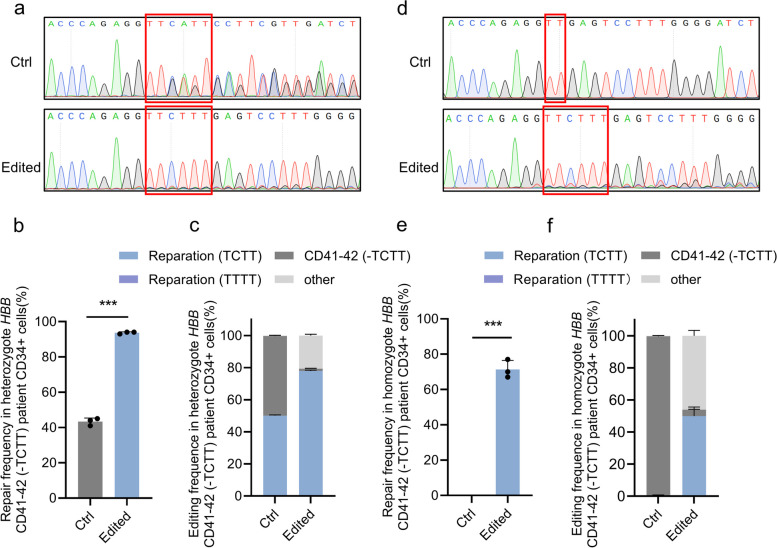
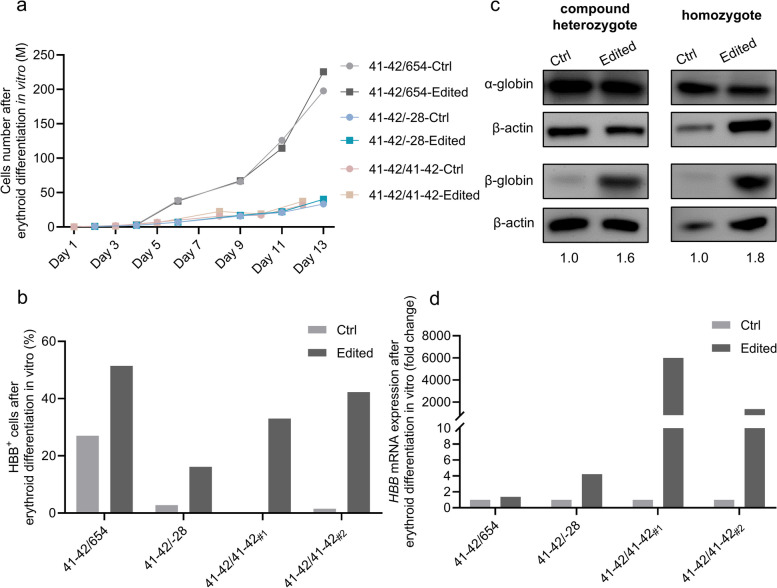
Β-thalassemia is one of the global health burdens. The CD41-42 (-TCTT) mutation at HBB is the most prevalent pathogenic mutation of β-thalassemia in both China and Southeast Asia. Previous studies focused on repairing the HBB CD41-42 (-TCTT) mutation in β-thalassemia patient-specific induced pluripotent stem cells, which were subsequently differentiated into hematopoietic stem and progenitor cells (HSPCs) for transplantation. In this study, we directly applied the CRISPR/Cas9-based gene editing therapy to correct the HBB CD41-42 (-TCTT) mutation in patient-derived HSPCs. The effective editing induced by Cas9:sgRNA ribonucleoprotein and single-stranded oligodeoxynucleotides (ssODNs) was confirmed in HUDEP-2 cell lines harboring the HBB CD41-42 (-TCTT) mutation. Further correction of heterozygote and homozygote HBB CD41-42 (-TCTT) mutations in patient-derived HSPCs resulted in a 13.4-40.8% increase in the proportion of HBB-expressing (HBB +) cells following erythroid differentiation in vitro. At 16 weeks post-xenotransplantation of the edited HSPCs into coisogenic immunodeficient mice, the reparation efficiency in engrafted bone marrow was 17.21% ± 3.66%. Multiparameter flow cytometric analysis of the engrafted bone marrow showed an increase in the percentage of HBB + cells without impairing the ability of engraftment, self-renewal, and multilineage hematopoietic repopulation of HSPCs. For the safety evaluation, 103 potential off-target sites were predicted by SITE-seq and CRISPOR, with one site displaying significant off-target editing. Since this off-target site is located in the intergenic region, it is presumed to pose minimal risk. Taken together, our study provides critical preclinical data supporting the safety and efficacy of the gene therapy approach for HBB CD41-42 (-TCTT) mutation.
β地中海贫血是全球健康负担之一。HBB基因的CD41-42(-TCTT)突变是中国和东南亚β地中海贫血最常见的致病突变。以往的研究集中在修复β地中海贫血患者特异性诱导多能干细胞中的HBB CD41-42(-TCTT)突变,随后将其分化为造血干细胞和祖细胞(HSPCs)用于移植。在本研究中,我们直接应用基于CRISPR/Cas9的基因编辑疗法来纠正患者来源的HSPCs中的HBB CD41-42(-TCTT)突变。在携带HBB CD41-42(-TCTT)突变的HUDEP-2细胞系中证实了Cas9:sgRNA核糖核蛋白和单链寡脱氧核苷酸(ssODNs)诱导的有效编辑。进一步纠正患者来源的HSPCs中的杂合子和纯合子HBB CD41-42(-TCTT)突变,导致体外红系分化后表达HBB(HBB+)细胞的比例增加了13.4%-40.8%。将编辑后的HSPCs异种移植到同基因免疫缺陷小鼠体内16周后,植入骨髓的修复效率为17.21%±3.66%。对植入骨髓的多参数流式细胞术分析显示,HBB+细胞的百分比增加,而不损害HSPCs的植入、自我更新和多谱系造血重建能力。对于安全性评估,通过SITE-seq和CRISPOR预测了103个潜在的脱靶位点,其中一个位点显示出显著的脱靶编辑。由于该脱靶位点位于基因间区域,推测其风险最小。综上所述,我们的研究提供了关键的临床前数据,支持针对HBB CD41-42(-TCTT)突变的基因治疗方法的安全性和有效性。