Yu Wei, Li Xiao-Juan, Lv Zhen, Yang Li-E, Peng De-Li
School of Life Sciences, Yunnan Normal University, Kunming, 650000, China.
Guangxi Institute of Botany, Guangxi Zhuang Autonomous Region and Chinese Academy of Sciences, Guilin, 541000, China.
BMC Genomics. 2025 Jan 30;26(1):93. doi: 10.1186/s12864-025-11276-8.
Pseudogalium is a new monotypic genus with two subspecies in China and one in Japan, which holds a distinctive phylogenetic position and ecological significance within the tribe Rubieae. Chloroplast genomes contain abundant information for resolving phylogenetic relationships. To investigate the phylogenetics of P. paradoxum and its related genera, we first sequenced, assembled, and annotated the chloroplast genome of two subspecies of P. paradoxum in China and reconstructed the phylogenetic trees. Due to the lack of samples of P. paradoxum subsp. franchetianum from Japan, this study only analyzed and discussed P. paradoxum subsp. paradoxum and P. paradoxum subsp. duthiei.
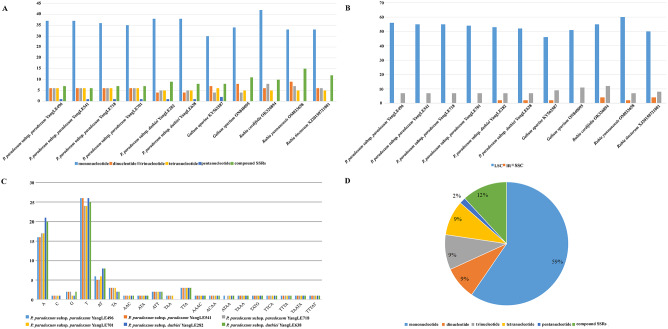
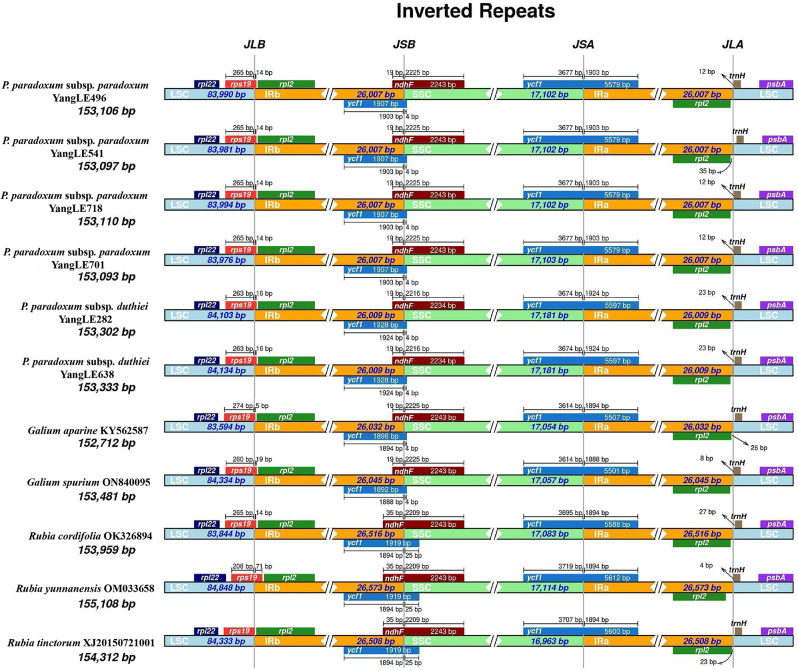
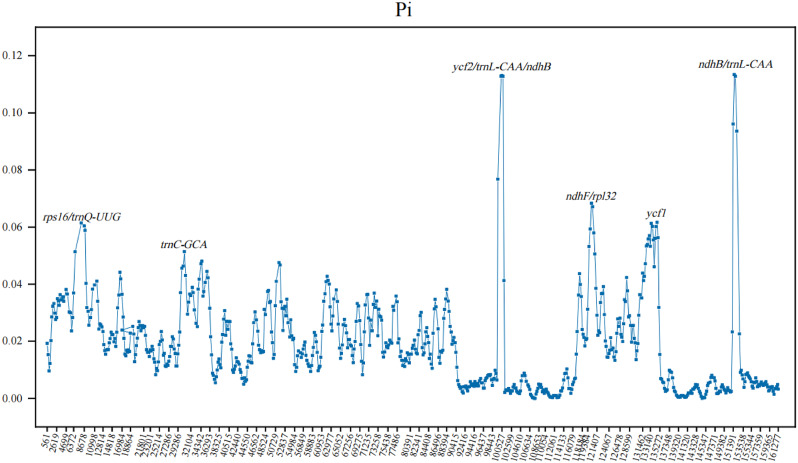
This study had shown that the complete chloroplast genomes of Pseudogalium ranged from 153,093 bp to 153,333 bp in length with 130 genes in total, all of which had typical circular structures consisting of a large single-copy region, a small single-copy region and a pair of inverted repeat regions. The comparative analysis showed that the chloroplast genome of P. paradoxum was conserved in the inverted repeat regions. Additionally, we identified 60 dispersed repeat sequences, 61-63 simple sequence repeats, and 30 codons within the 82 protein-coding genes that exhibited RSCU values greater than one. Furthermore, we detected highly divergent regions that hold potential as new DNA barcodes for species identification. Compared with Pseudogalium, the gene number, gene length, and GC content in the chloroplast genomes of Galium and Rubia exhibited differential characteristics, and the dispersed repeat sequences and SSRs in Galium and Rubia were significantly different. Phylogenetic analysis based on the whole chloroplast genomes showed that Pseudogalium can be treated as a new genus, with P. paradoxum subsp. paradoxum and P. paradoxum subsp. duthiei considered as two distinct subspecies of P. paradoxum.
The complete chloroplast genomes of P. paradoxum were first reported in this study, which provided a new insight into phylogeny and taxonomy of this genus. Phylogenetic analyses strongly supported the following proposals: (1) P. paradoxum can be isolated as a genus closely related to Galium; (2) P. paradoxum subsp. paradoxum and P. paradoxum subsp. duthiei form distinct clades, both of which can be considered as subspecies of P. paradoxum.
假拉拉藤属是一个新的单型属,在中国有两个亚种,在日本有一个亚种,在茜草族中具有独特的系统发育地位和生态意义。叶绿体基因组包含丰富的信息,可用于解析系统发育关系。为了研究异叶假拉拉藤及其近缘属的系统发育,我们首先对中国异叶假拉拉藤两个亚种的叶绿体基因组进行了测序、组装和注释,并重建了系统发育树。由于缺乏来自日本的异叶假拉拉藤弗兰奇亚种的样本,本研究仅分析和讨论了异叶假拉拉藤原亚种和异叶假拉拉藤杜氏亚种。
本研究表明,假拉拉藤属的完整叶绿体基因组长度在153,093 bp至153,333 bp之间,共有130个基因,均具有典型的环状结构,由一个大单拷贝区域、一个小单拷贝区域和一对反向重复区域组成。比较分析表明,异叶假拉拉藤的叶绿体基因组在反向重复区域是保守的。此外,我们在82个编码蛋白基因中鉴定出60个分散重复序列、61 - 63个简单序列重复以及30个相对同义密码子使用度(RSCU)值大于1的密码子。此外,我们还检测到了具有作为物种鉴定新DNA条形码潜力的高度分化区域。与假拉拉藤属相比,拉拉藤属和茜草属叶绿体基因组中的基因数量、基因长度和GC含量表现出不同的特征,拉拉藤属和茜草属中的分散重复序列和简单序列重复也存在显著差异。基于整个叶绿体基因组的系统发育分析表明,假拉拉藤属可作为一个新属看待,异叶假拉拉藤原亚种和异叶假拉拉藤杜氏亚种被视为异叶假拉拉藤的两个不同亚种。
本研究首次报道了异叶假拉拉藤的完整叶绿体基因组,为该属的系统发育和分类学提供了新的见解。系统发育分析有力地支持了以下提议:(1)异叶假拉拉藤可作为与拉拉藤属密切相关的一个属分离出来;(2)异叶假拉拉藤原亚种和异叶假拉拉藤杜氏亚种形成不同的分支,均可被视为异叶假拉拉藤的亚种。