Biben Vitriana, Arisanti Farida, Fitriana Efi, Maklun Erika, Miguna Vindy Margaretha, Alviani Nabilla Fikria
Physical Medicine and Rehabilitation Department, Faculty of Medicine, Universitas Padjadjaran/Dr. Hasan Sadikin General Hospital, Bandung, West Java, Indonesia.
Faculty of Psychology, Universitas Padjadjaran, Bandung, West Java, Indonesia.
Health Qual Life Outcomes. 2025 Jan 31;23(1):9. doi: 10.1186/s12955-025-02336-4.
The assessment of Health-Related Quality of Life (HRQoL) is essential in clinical outcomes, focusing on the subjective perception of individuals regarding the physical, mental, and social aspects of health status. However, conducting a large-scale HRQoL assessment poses various challenges that necessitate the development of a non-burdensome instrument. One promising solution is adapting Patient-Reported Outcomes Measurement Information System (PROMIS) Global Health Scale v1.2 through translation, validation, and cross-cultural testing for non-English populations. Therefore, this study aimed to evaluate the validity and reliability of the Indonesian version of PROMIS Global Health Scale for comprehensive HRQoL assessment.
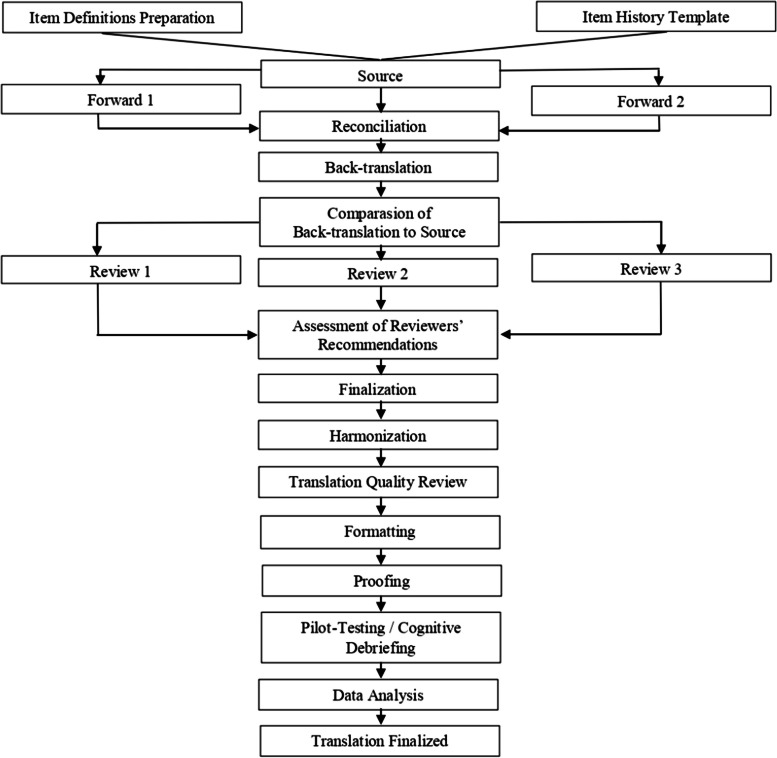
This cross sectional study involved a total of 343 participants, comprising patients, caregivers, and residents of Physical Medicine and Rehabilitation. PROMIS Global Health Scale v1.2 was subjected to translation and cultural adaptation using the Functional Assessment of Chronic Illness Therapy (FACIT) method. Content validity was tested by five experts using the Scale-Content Validity Index (S-CVI), and structural validity was evaluated through Confirmatory Factor Analysis (CFA). Internal consistency and test-retest reliability were examined using Cronbach's Alpha and intraclass correlation coefficient (ICC), respectively.
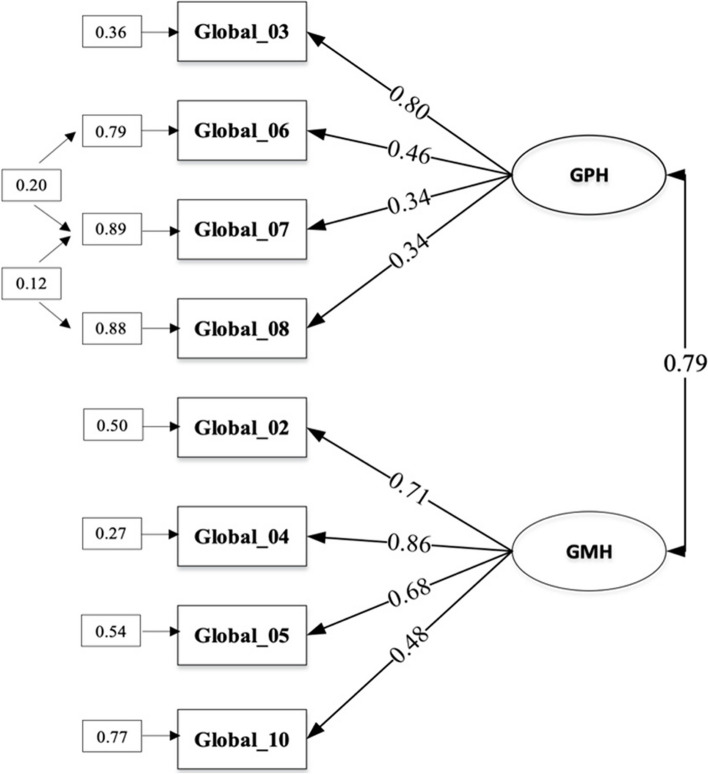
The Indonesian version of PROMIS Global Health Scale v1.2 showed strong validity and reliability. Content validity analysis produced a S-CVI/Universal Agreement of 0.90 with item analysis factor loading's of > 0.3. Structural validity results were χ2/df (1.53), RMSEA (0.04), RMR (0.03), and CFI (0.99). The reliability results showed that Cronbach's Alpha for Global Physical Health (GPH) and Global Mental Health (GMH) was 0.61 and 0.77, respectively. Test-retest reliability assessment performed using intraclass correlation coefficients generated values of 0.72 for GPH (95% CI, [0.65,0.78])and 0.70 (95% CI [0.63,0.76]) for GMH.
The Indonesian version of PROMIS Global Health Scale v1.2 showed sufficient content validity, structural validity, internal consistency, and reliability, which supported the application of this tool for HRQoL assessment in clinical and research settings.
健康相关生活质量(HRQoL)评估在临床结果中至关重要,它关注个体对健康状况的身体、心理和社会方面的主观感受。然而,进行大规模的HRQoL评估面临各种挑战,这就需要开发一种不增加负担的工具。一个有前景的解决方案是通过翻译、验证和跨文化测试,使患者报告结果测量信息系统(PROMIS)全球健康量表v1.2适用于非英语人群。因此,本研究旨在评估印度尼西亚语版PROMIS全球健康量表在全面HRQoL评估中的有效性和可靠性。
这项横断面研究共纳入343名参与者,包括患者、护理人员以及物理医学与康复科的住院患者。采用慢性病治疗功能评估(FACIT)方法对PROMIS全球健康量表v1.2进行翻译和文化调适。由五位专家使用量表内容效度指数(S-CVI)测试内容效度,并通过验证性因子分析(CFA)评估结构效度。分别使用克朗巴哈系数(Cronbach's Alpha)和组内相关系数(ICC)检验内部一致性和重测信度。
印度尼西亚语版PROMIS全球健康量表v1.2显示出较强的有效性和可靠性。内容效度分析得出S-CVI/全体一致为0.90,项目分析因子载荷>0.3。结构效度结果为χ2/df(1.53)、RMSEA(0.04)、RMR(0.03)和CFI(0.99)。信度结果显示,全球身体健康(GPH)和全球心理健康(GMH)的克朗巴哈系数分别为0.61和0.77。使用组内相关系数进行的重测信度评估得出,GPH的值为0.72(95%CI,[0.65,0.78]),GMH的值为0.70(95%CI[0.63,0.76])。
印度尼西亚语版PROMIS全球健康量表v1.2显示出足够的内容效度、结构效度、内部一致性和可靠性,这支持了该工具在临床和研究环境中用于HRQoL评估。