Alten Rieke, Behar Claire, Merckaert Pierre, Afari Ebenezer, Vannier-Moreau Virginie, Ohayon Anael, Connolly Sean E, Najm Aurélie, Juge Pierre-Antoine, Liu Gengyuan, Rai Angshu, Elbez Yedid, Lozenski Karissa
Schlosspark-Klinik University, Berlin, Germany.
Tulsy, Paris, France.
Arthritis Res Ther. 2025 Feb 1;27(1):20. doi: 10.1186/s13075-025-03484-0.
The incorporation of machine learning is becoming more prevalent in the clinical setting. By predicting clinical outcomes, machine learning can provide clinicians with a valuable tool for refining precision medicine approaches and improving treatment outcomes.
This was a post hoc analysis of pooled patient-level data from the global, real-world ACTION and ASCORE trials in patients with rheumatoid arthritis (RA) initiating abatacept. Patient demographic and disease characteristics were input across 10 machine learning models used to predict 12-month treatment retention. Retention was defined as treatment for > 365 days or ≤ 365 days in patients who achieved remission or major clinical response (based on European Alliance of Associations for Rheumatology response criteria). The pooled dataset was split into a training/validation cohort for model development and a test cohort for an unbiased evaluation of performance. SHapley Additive exPlanation (SHAP) values determined the level of importance and directionality for key patient features predicting abatacept retention.
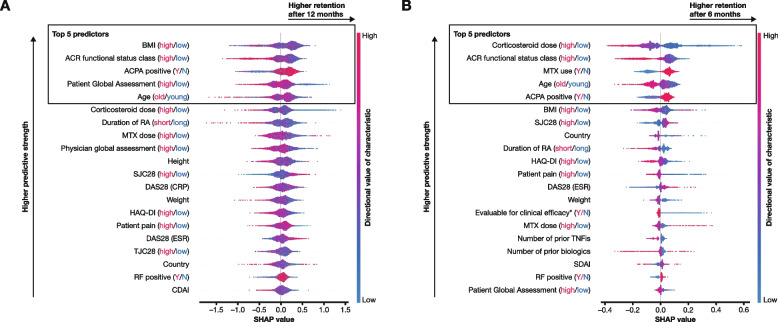
The pooled ACTION and ASCORE dataset included 5320 patients with RA (mean [standard deviation] age 57.7 [12.7] years; 79% female). The 12-month abatacept retention rate was 61% (n = 3236) with a discontinuation rate of 39% (n = 2037). In the training set (n = 4218), the gradient-boosting classifier model demonstrated the best performance (testing accuracy: 62%). This model had an area under the receiver operating characteristic curve (95% confidence interval) of 0.620 (0.586, 0.653) and F1 score of 0.659 (0.625, 0.689) in the test set of patients (n = 1055). Using this model, the five most important variables predicting 12-month abatacept retention were low body mass index (BMI), low American College of Rheumatology functional status class, anti-citrullinated protein antibody (ACPA) positivity, low Patient Global Assessment, and younger age.
The gradient-boosting classifier model identified key patient features predictive of abatacept retention from this large, real-world study population. The SHAP values conveyed the directionality and importance of BMI, functional status, ACPA serostatus, Patient Global Assessment, and age for abatacept retention. Findings are consistent with previous observations and help validate the machine learning approach for predictive modelling in RA treatment, and may help inform clinical decision making.
NCT02109666 (ACTION), NCT02090556 (ASCORE).
机器学习在临床环境中的应用越来越普遍。通过预测临床结果,机器学习可以为临床医生提供一个有价值的工具,以完善精准医学方法并改善治疗结果。
这是一项对来自全球真实世界的ACTION和ASCORE试验中开始使用阿巴西普治疗的类风湿关节炎(RA)患者的汇总患者水平数据进行的事后分析。将患者人口统计学和疾病特征输入到10个用于预测12个月治疗保留率的机器学习模型中。保留定义为在达到缓解或主要临床反应(基于风湿病协会联盟反应标准)的患者中治疗超过365天或≤365天。汇总数据集被分为用于模型开发的训练/验证队列和用于性能无偏评估的测试队列。SHapley加性解释(SHAP)值确定了预测阿巴西普保留的关键患者特征的重要性水平和方向性。
汇总的ACTION和ASCORE数据集包括5320例RA患者(平均[标准差]年龄57.7[12.7]岁;79%为女性)。阿巴西普12个月的保留率为61%(n = 3236),停药率为39%(n = 2037)。在训练集(n = 4218)中,梯度提升分类器模型表现最佳(测试准确率:62%)。该模型在患者测试集(n = 1055)中的受试者工作特征曲线下面积(95%置信区间)为0.620(0.586,0.653),F1分数为0.659(0.625,0.689)。使用该模型,预测阿巴西普12个月保留率的五个最重要变量是低体重指数(BMI)、低美国风湿病学会功能状态等级、抗瓜氨酸化蛋白抗体(ACPA)阳性、低患者整体评估得分和较年轻的年龄。
梯度提升分类器模型从这个大型真实世界研究人群中识别出了预测阿巴西普保留的关键患者特征。SHAP值传达了BMI、功能状态、ACPA血清学状态、患者整体评估得分和年龄对阿巴西普保留的方向性和重要性。研究结果与先前的观察结果一致,有助于验证机器学习方法在RA治疗预测建模中的应用,并可能有助于为临床决策提供参考。
NCT02109666(ACTION),NCT02090556(ASCORE)。