Poudel Suresh, Shrestha Him, Pan Yue, Li Qian, Li Kendrick, Im Cindy, Dixon Stephanie B, Ehrhardt Matthew J, Mulrooney Daniel A, Zhou Suiping, Tan Haiyan, High Anthony A, Burridge Paul W, Bhatia Smita, Jefferies John L, Ness Kirsten K, Hudson Melissa M, Robison Leslie L, Armstrong Gregory T, Peng Junmin, Ky Bonnie, Yasui Yutaka, Sapkota Yadav
St. Jude Children's Research Hospital, Memphis, Tennessee, USA.
University of Minnesota, Minneapolis, Minnesota, USA.
JACC CardioOncol. 2024 Dec 3;7(1):56-67. doi: 10.1016/j.jaccao.2024.10.004. eCollection 2025 Jan.
Anthracyclines, a highly effective chemotherapy for many pediatric malignancies, cause cardiomyopathy, a major late effect in adult survivors. Biomarkers are needed for early detection and targeted interventions for anthracycline-associated cardiomyopathy.
The aim of this study was to determine if serum proteins and/or metabolites in asymptomatic childhood cancer survivors can discriminate symptomatic cardiomyopathy.
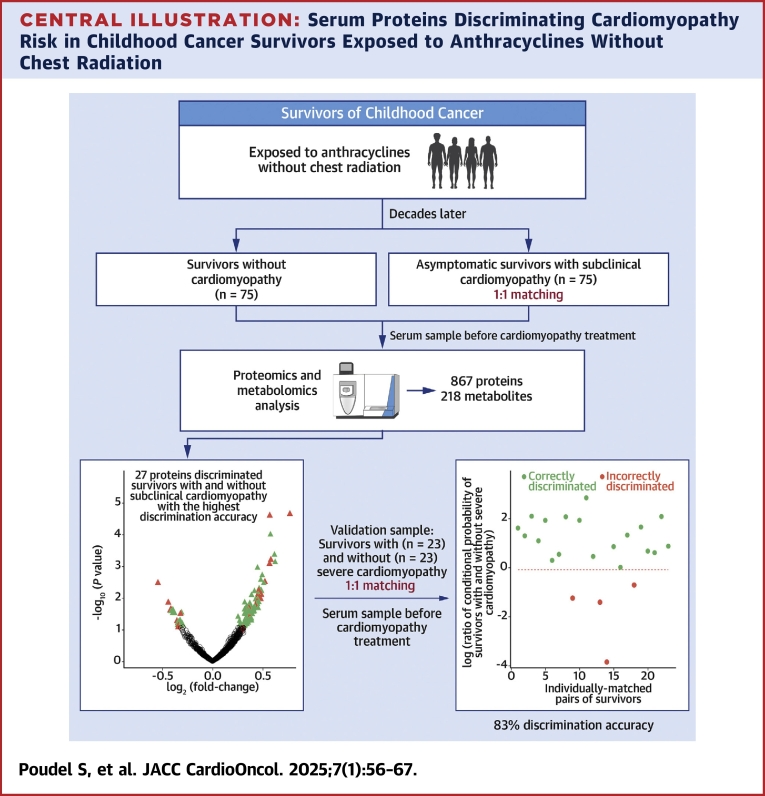
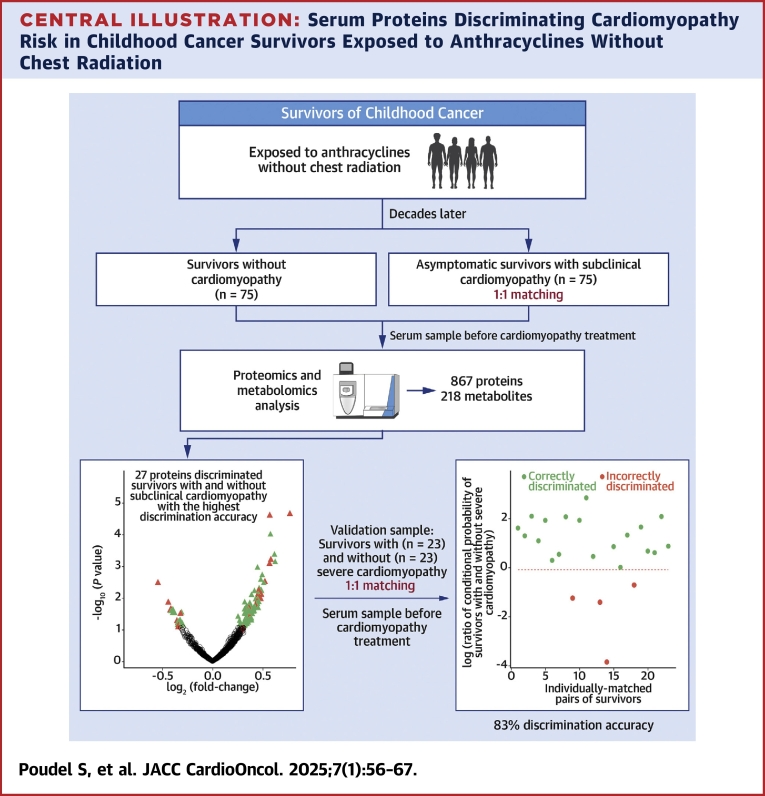
Using an untargeted mass spectrometry-based approach, 867 proteins and 218 metabolites were profiled in serum samples of 75 asymptomatic survivors with subclinical cardiomyopathy and 75 individually matched survivors without cardiomyopathy from SJLIFE (St. Jude Lifetime Cohort Study). Models were developed on the basis of the most influential differentially expressed proteins and metabolites, using conditional logistic regression with a least absolute shrinkage and selection operator penalty. The best performing model was evaluated in 23 independent survivors with severe or symptomatic cardiomyopathy and 23 individually matched cardiomyopathy-free survivors.
A 27-protein model identified using conditional logistic regression with a least absolute shrinkage and selection operator penalty discriminated symptomatic or severe cardiomyopathy requiring heart failure medications in independent survivors; 19 of 23 individually matched survivors with and without cardiomyopathy were correctly discriminated with 82.6% (95% CI: 71.4%-93.8%) accuracy. Pathway enrichment analysis revealed that the 27 proteins were enriched in various biological processes, many of which have been linked to anthracycline-related cardiomyopathy.
A risk model was developed on the basis of the differential expression of serum proteins in subclinical cardiomyopathy, which accurately discriminated the risk for severe cardiomyopathy in an independent, matched sample. Further assessment of these proteins as biomarkers of cardiomyopathy risk should be conducted in external larger cohorts and through prospective studies.
蒽环类药物是治疗多种儿童恶性肿瘤的高效化疗药物,但会导致心肌病,这是成年幸存者的主要晚期效应。需要生物标志物来早期检测和针对性干预蒽环类药物相关的心肌病。
本研究旨在确定无症状儿童癌症幸存者的血清蛋白和/或代谢物是否能够区分有症状的心肌病。
采用基于非靶向质谱的方法,对来自圣犹大终身队列研究(SJLIFE)的75名患有亚临床心肌病的无症状幸存者和75名个体匹配的无心肌病幸存者的血清样本中的867种蛋白质和218种代谢物进行了分析。基于最具影响力的差异表达蛋白质和代谢物,使用带有最小绝对收缩和选择算子惩罚的条件逻辑回归建立模型。在23名患有严重或有症状心肌病的独立幸存者和23名个体匹配的无心肌病幸存者中评估了表现最佳的模型。
使用带有最小绝对收缩和选择算子惩罚的条件逻辑回归确定的一个包含27种蛋白质的模型,能够区分独立幸存者中需要使用心力衰竭药物治疗的有症状或严重心肌病;在23对个体匹配的有心肌病和无心肌病的幸存者中,有19对被正确区分,准确率为82.6%(95%CI:71.4%-93.8%)。通路富集分析表明,这27种蛋白质在各种生物学过程中富集,其中许多过程与蒽环类药物相关的心肌病有关。
基于亚临床心肌病患者血清蛋白的差异表达建立了一个风险模型,该模型在独立匹配样本中准确区分了严重心肌病的风险。应在外部更大的队列中并通过前瞻性研究进一步评估这些蛋白质作为心肌病风险生物标志物的作用。