Naveed Siddiqui Araj, Musharaf Imshaal, Gulumbe Bashar Haruna
Jinnah Sindh Medical University, Karachi, Sindh, Pakistan.
Department of Microbiology, Faculty of Science, Federal University Birnin-Kebbi, PMB, 1157, Birnin Kebbi, Kebbi State, Nigeria.
Ther Adv Infect Dis. 2025 Jan 30;12:20499361251314763. doi: 10.1177/20499361251314763. eCollection 2025 Jan-Dec.
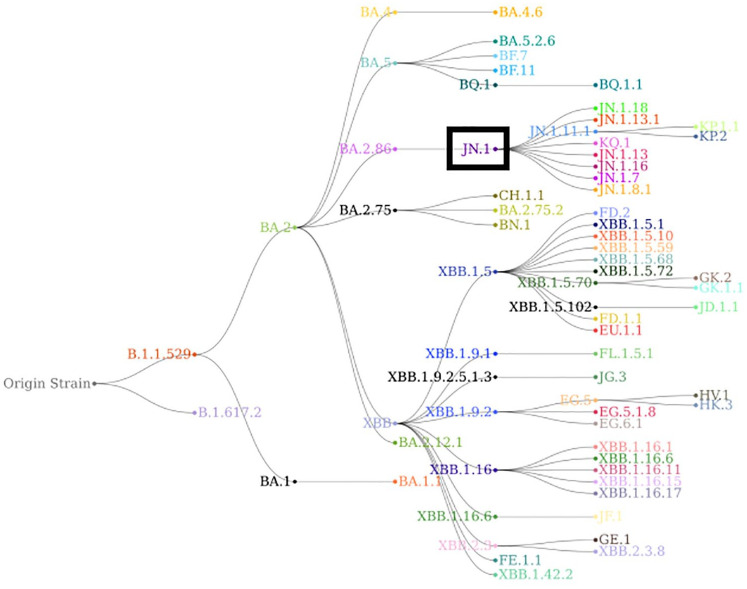
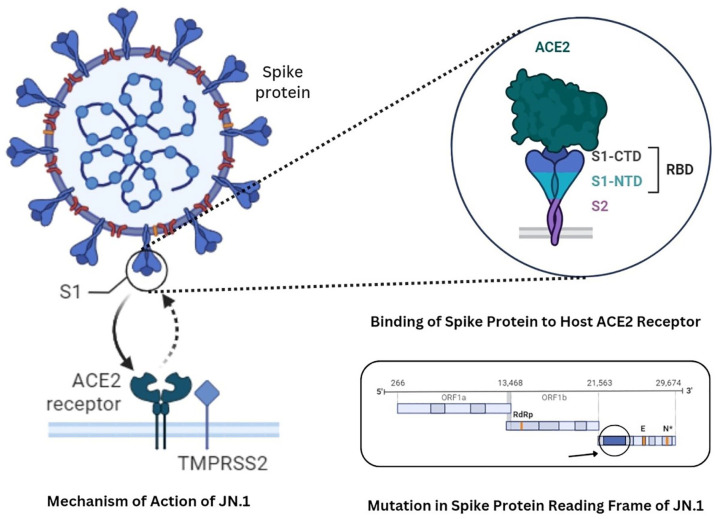
The emergence of the COVID-19 JN.1 variant has raised global health concerns as it gains prevalence in several regions worldwide. First identified in August 2023, JN.1 evolved from the Omicron lineage's BA.2.86 subvariant. Patients infected with JN.1 commonly exhibit symptoms such as sore throat, fever, dry cough, nausea, and vomiting. While the World Health Organization has labeled JN.1 a Variant of Interest, it currently presents a low global health risk. However, its increased transmissibility, particularly in cold, dry climates, is concerning. This review provides a comprehensive overview of JN.1's biological characteristics, epidemiology, transmissibility, immune evasion, and the efficacy of existing antiviral treatments and vaccination strategies. A literature search across key databases targeted studies from January 2023 to August 2024, emphasizing recent insights into JN.1's spread and clinical impact. Findings reveal that JN.1 exhibits higher infectivity and immune evasion than previous variants, largely due to the L4555 mutation. From November 2023 to March 2024, JN.1 showed an increasing trend in transmission. Previously approved antivirals, including Paxlovid, Veklury, and Lagevrio, demonstrate effectiveness against JN.1, and current vaccines still protect against severe illness from this variant. However, vaccination rates remain low. Monitoring efforts include genomic assessments, wastewater surveillance, and digital tracking to contain the variant's spread. It is essential to encourage the public to maintain vaccination and preventive measures to reduce JN.1's impact. Continued research is critical for understanding and managing the evolving landscape of COVID-19 and its emerging variants.
新冠病毒JN.1变体的出现引发了全球对健康问题的关注,因为它在全球多个地区日益流行。JN.1于2023年8月首次被发现,是从奥密克戎谱系的BA.2.86亚变体演变而来。感染JN.1的患者通常会出现喉咙痛、发热、干咳、恶心和呕吐等症状。虽然世界卫生组织已将JN.1列为“关注变体”,但目前它在全球范围内带来的健康风险较低。然而,其传播性的增加,尤其是在寒冷干燥气候下的传播性增加,令人担忧。本综述全面概述了JN.1的生物学特征、流行病学、传播性、免疫逃逸以及现有抗病毒治疗和疫苗接种策略的效果。通过在关键数据库中进行文献检索,重点关注了2023年1月至2024年8月的研究,强调了对JN.1传播和临床影响的最新见解。研究结果表明,JN.1比以前的变体表现出更高的传染性和免疫逃逸能力,这在很大程度上归因于L4555突变。从2023年11月到2024年3月,JN.1的传播呈上升趋势。先前批准的抗病毒药物,包括帕罗韦德、瑞德西韦和莫诺拉韦,对JN.1显示出有效性,并且目前的疫苗仍然可以预防该变体导致的重症。然而,疫苗接种率仍然很低。监测工作包括基因组评估、废水监测和数字追踪,以遏制该变体的传播。鼓励公众持续接种疫苗并采取预防措施以降低JN.1的影响至关重要。持续的研究对于理解和应对不断演变的新冠病毒及其新出现变体的形势至关重要。