Traore Adriana, Charniga Kelly, Grellet Sophie, Terpant Garance, Da Cruz Héléna, Lamy Anais, Thomas Nathalie, Gbaguidi Gwladys, Mercier Alizé, Prudhomme Julie, Visseaux Benoit, Vieillefond Vincent, Haim-Boukobza Stéphanie, Giannoli Jean-Marc, Castro-Alvarez Javier, Kouamen Alain-Claude, Rameix-Welti Marie-Anne, Beirrera-Ibraim Samar, Destras Gregory, Josset Laurence, Cauchemez Simon, Lina Bruno, Coignard Bruno, Schaeffer Justine, Enouf Vincent, Bal Antonin
Direction des Maladies Infectieuses, Santé publique France, Saint-Maurice, France.
Mathematical Modelling of Infectious Diseases Unit, Institut Pasteur, Université Paris Cité, CNRS UMR 2000, Paris, France.
Euro Surveill. 2025 Jan;30(1). doi: 10.2807/1560-7917.ES.2025.30.1.2400293.
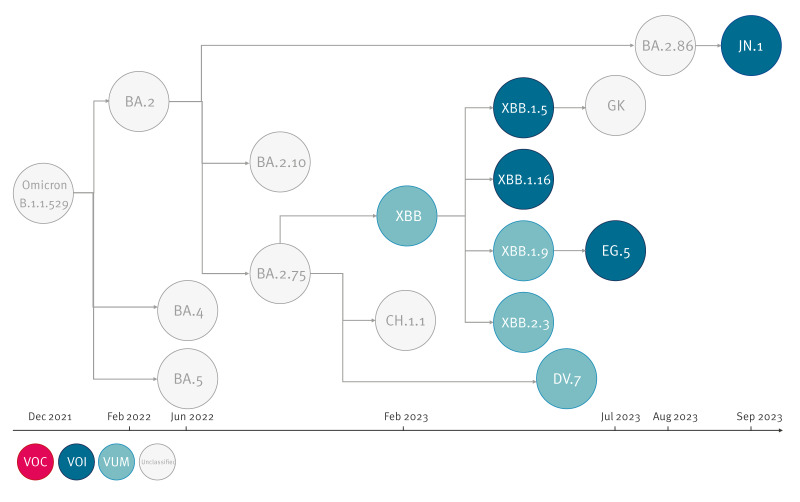
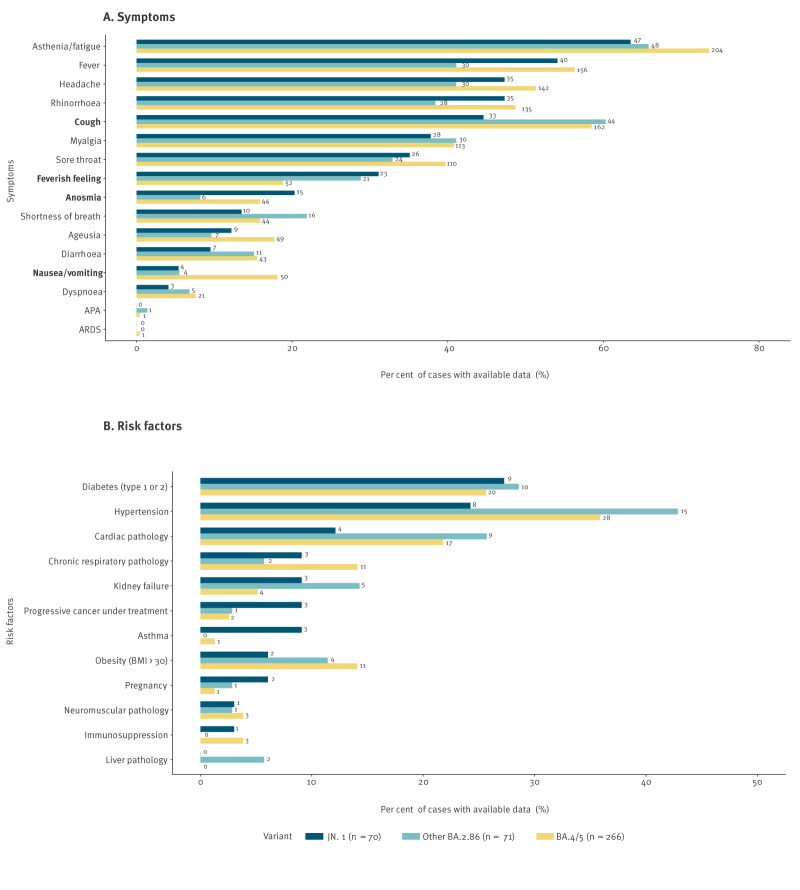
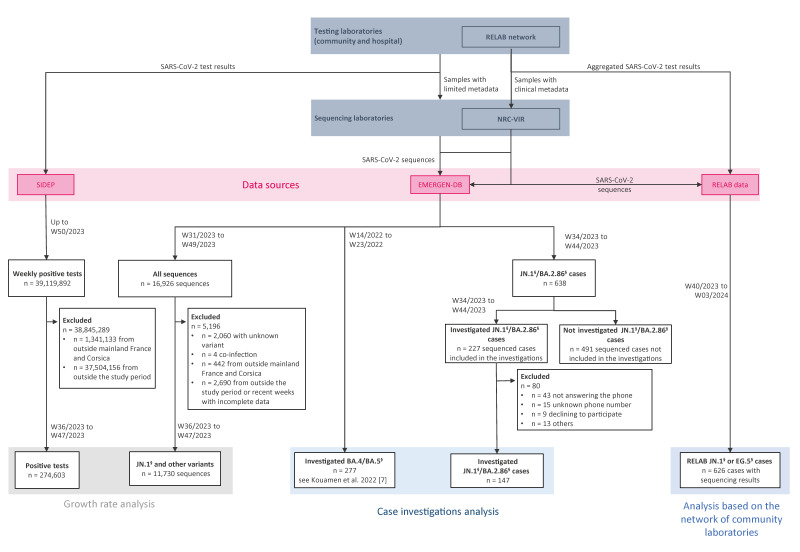
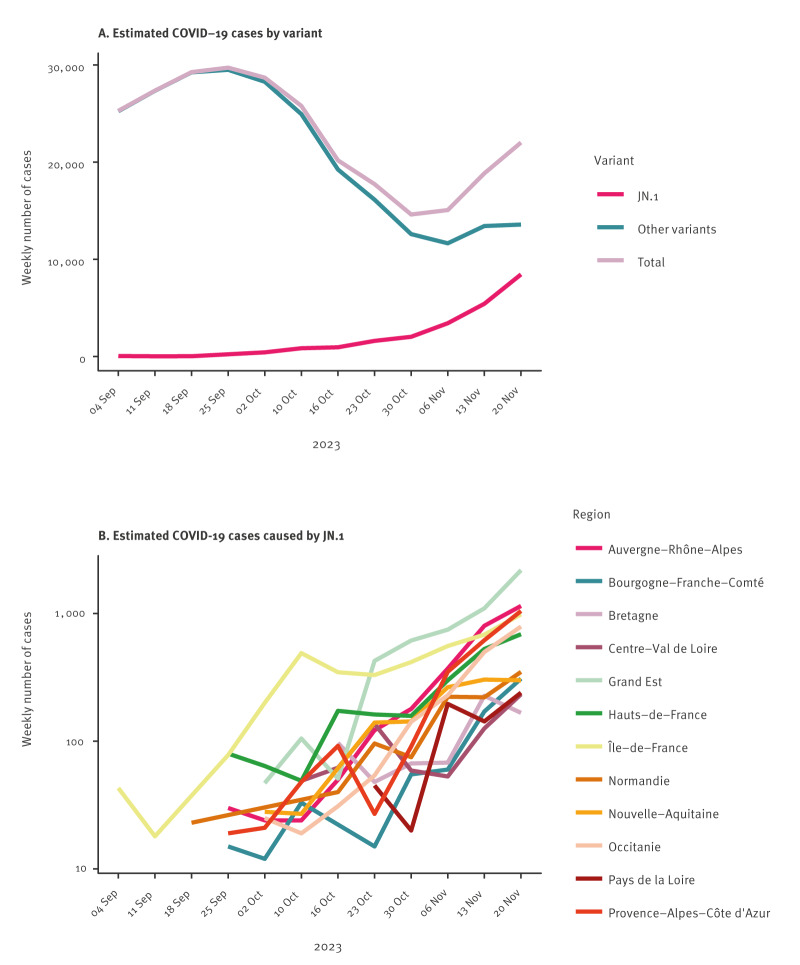
BackgroundEarly detection and characterisation of SARS-CoV-2 variants have been and continue to be essential for assessing their public health impact. In August 2023, Santé publique France implemented enhanced surveillance for BA.2.86 and sub-lineage JN.1 because of their genetic divergence from other variants and increased prevalence.AimTo detail how combining epidemiological and laboratory data sources, targeted investigations and modelling enabled comprehensive characterisation of sub-lineage JN.1.MethodsData were collected from epidemiological investigations using a standardised questionnaire and from routine and novel (RELAB network) surveillance systems. JN.1 cases were compared with cases infected with previously circulating variants, such as EG.5, BA.4/BA.5 and other BA.2.86 sub-lineages. The growth rate and doubling time of JN.1 were estimated.ResultsJN.1 was first detected in September 2023 in the Île-de-France region, France, and spread widely across the country. By late November, doubling time was estimated to be 8.6 to 26.4 days depending on the region. For all data sources, cases infected by JN.1 showed similar demographics, rates of hospitalisation and RT-PCR cycle threshold values compared with those infected by previous variants. JN.1 cases also had older median age (54 years; 40-71 vs 47 years; 30-59), more frequent reports of feverish feeling and less frequent cough or nausea compared with BA.4/BA.5 cases. JN.1 cases had significantly higher frequency of anosmia compared with other BA.2.86 cases.ConclusionCombining different data sources played a key role in detecting emerging variant JN.1, for which no evidence of increased public health impact was found despite its genetic divergence.
背景
严重急性呼吸综合征冠状病毒2(SARS-CoV-2)变异株的早期检测和特征描述对于评估其对公众健康的影响一直并将继续至关重要。2023年8月,法国公共卫生部门对BA.2.86及其亚谱系JN.1实施了强化监测,因为它们与其他变异株存在基因差异且流行率上升。
目的
详细说明如何通过结合流行病学和实验室数据来源、有针对性的调查以及建模来全面描述JN.1亚谱系的特征。
方法
使用标准化问卷从流行病学调查中收集数据,并从常规和新型(RELAB网络)监测系统中收集数据。将JN.1病例与感染先前流行变异株(如EG.5、BA.4/BA.5和其他BA.2.86亚谱系)的病例进行比较。估计了JN.1的增长率和倍增时间。
结果
JN.1于2023年9月在法国法兰西岛地区首次被检测到,并在全国广泛传播。到11月底,根据地区不同,估计倍增时间为8.6至26.4天。对于所有数据来源,与感染先前变异株的病例相比,感染JN.1的病例在人口统计学特征、住院率和逆转录聚合酶链反应(RT-PCR)循环阈值方面表现相似。与BA.4/BA.5病例相比,JN.1病例的中位年龄也更大(54岁;40 - 71岁,而BA.4/BA.5为47岁;30 - 59岁),发热感觉的报告更频繁,咳嗽或恶心的报告则较少。与其他BA.2.86病例相比,JN.1病例嗅觉丧失的频率显著更高。
结论
结合不同的数据来源在检测新兴变异株JN.1方面发挥了关键作用,尽管JN.1存在基因差异,但未发现其对公众健康影响增加的证据。