Konputtar Adithep, Nam Nguyen Hoai, Rerkyusuke Sarinya, Thamrongyoswittayakul Chaiyapas, Seesupa Suvaluk, Yossapol Montira, Sukon Peerapol
Veterinary Science Program, Faculty of Veterinary Medicine, Khon Kaen University, Khon Kaen, 40002, Thailand.
Department of Animal Surgery and Theriogenology, Faculty of Veterinary Medicine, Vietnam National University of Agriculture, Trauqui, Gialam, Hanoi, Vietnam.
Vet World. 2024 Dec;17(12):2811-2828. doi: 10.14202/vetworld.2024.2811-2828. Epub 2024 Dec 18.
Cattle are the reservoir host of , a causative agent of Q fever. Pooling herd-level prevalence data from individual studies would help determine the global prevalence of in cattle herds. This study aimed to estimate the global herd-level seroprevalence and molecular prevalence of in cattle, explore sources of heterogeneity, and determine trends and cumulative evidence of the pooled prevalence over time.
Relevant studies were retrieved from PubMed, Scopus, and Web of Science and then screened for possible inclusion. A random-effects model was used for all meta-analyses. Subgroup meta-analysis and meta-regression were used to explore some sources of heterogeneity associated with the pooled prevalence and to determine the trends of in cattle herds over the study years (1961-2020). A cumulative meta-analysis was used to determine the cumulative evidence of the pooled prevalence over the publication years.
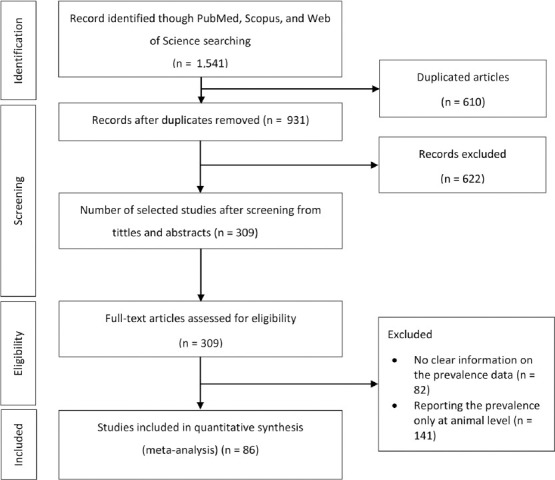
Of the 1541 citations, 86 studies with 38,057 cattle herds from 42 countries on six continents were included in the meta-analysis. The global herd-level seroprevalence of in cattle was estimated to be 44.4% (95% confidence interval [CI], 37.9%-51.1%), with high heterogeneity among the included studies. The herd-level seroprevalence was significantly higher in dairy than in beef cattle herds (49.0% [95% CI: 41.9%-56.2%] vs. 14.5% [95% CI: 5.8%-32.1%], respectively). The global herd-level molecular prevalence of in cattle was estimated to be 32.3% (95% CI: 25.3%-40.01%), with high heterogeneity among the included studies. Herd-level molecular prevalence was significantly different among continents. The herd-level molecular prevalence ranged from 12.8% (95% CI: 7.1%-21.9%) in Asia to 70.0% (95% CI: 36.3%-90.5%) in North America. Regarding trends, the herd-level seroprevalence of in cattle did not change significantlyover the study years.
The global herd-level seroprevalence and herd-level molecular prevalence of in cattle were high, estimated at 44% and 32%, respectively. The herd-level seroprevalence trend did not significantly change over time. This result indicates that cattle remain a major reservoir host for and pose a potential risk to human health.
牛是Q热病原体伯氏考克斯氏体的储存宿主。汇总来自各项独立研究的畜群水平流行率数据,将有助于确定全球牛群中伯氏考克斯氏体的流行情况。本研究旨在估计全球牛群中伯氏考克斯氏体的畜群水平血清阳性率和分子流行率,探索异质性来源,并确定汇总流行率随时间的趋势和累积证据。
从PubMed、Scopus和Web of Science检索相关研究,然后筛选可能纳入的研究。所有荟萃分析均采用随机效应模型。亚组荟萃分析和荟萃回归用于探索与汇总流行率相关的一些异质性来源,并确定研究期间(1961 - 2020年)牛群中伯氏考克斯氏体的趋势。累积荟萃分析用于确定汇总流行率在发表年份的累积证据。
在1541篇文献中,来自六大洲42个国家的38057个牛群的86项研究被纳入荟萃分析。估计全球牛群中伯氏考克斯氏体的畜群水平血清阳性率为44.4%(95%置信区间[CI],37.9% - 51.1%),纳入研究之间存在高度异质性。奶牛群的畜群水平血清阳性率显著高于肉牛群(分别为49.0%[95%CI:41.9% - 56.2%]和14.5%[95%CI:5.8% - 32.1%])。估计全球牛群中伯氏考克斯氏体的畜群水平分子流行率为32.3%(95%CI:25.3% - 40.01%),纳入研究之间存在高度异质性。畜群水平分子流行率在各大洲之间存在显著差异。畜群水平分子流行率在亚洲为12.8%(95%CI:7.1% - 21.9%),在北美为70.0%(95%CI:36.3% - 90.5%)。关于趋势,在研究期间,牛群中伯氏考克斯氏体的畜群水平血清阳性率没有显著变化。
全球牛群中伯氏考克斯氏体的畜群水平血清阳性率和畜群水平分子流行率较高,分别估计为44%和32%。畜群水平血清阳性率趋势随时间没有显著变化。这一结果表明,牛仍然是伯氏考克斯氏体的主要储存宿主,对人类健康构成潜在风险。