Benaissa Mohammed H, Ansel Samir, Mohamed-Cherif Abdallah, Benfodil Karima, Khelef Djamel, Youngs Curtis R, Kaidi Rachid, Ait-Oudhia Khatima
Scientific and Technical Research Centre for Arid Areas (CRSTRA), Touggourt.
Onderstepoort J Vet Res. 2017 Aug 31;84(1):e1-e7. doi: 10.4102/ojvr.v84i1.1461.
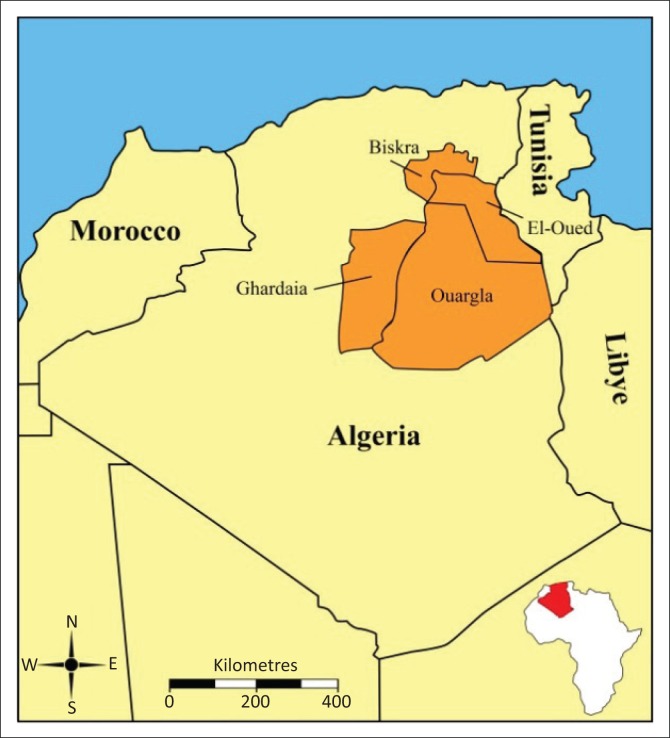
Query (Q) fever is a globally distributed zoonotic disease caused by Coxiella burnetii, a bacterial agent for which ruminants are the most prevalent natural reservoir. Data regarding Q fever infection in camels in Algeria are limited. Therefore, a survey to detect seroprevalence of C. burnetii antibodies was conducted among healthy camel populations in a vast area in southeastern Algeria to determine distribution of the Q fever causative organism and to identify risk factors associated with infection. Between January and March 2016, blood samples were collected from 184 camels and serum samples were subsequently analysed using a commercial Enzyme-Linked Immunosorbent Assay (ELISA) kit. At the time of blood collection, a questionnaire investigating 13 potential predisposing factors associated with C. burnetii seropositivity was completed for every dromedary camel and herd. Results were analysed by a chi-square (χ2) test and multivariate logistic regression. The seroprevalence of C. burnetii at the animal level was 71.2% (95% CI: 65.2-78.3) and 85.3% (95% CI: 72.8-97.8) at the herd level. At the animal level, differences in seroprevalence were observed because of herd size, animal age, animal sex, presence of ticks and contact with other herds. A multivariable logistic regression model identified three main risk factors associated with individual seropositivity: (1) age class > 11 years (OR = 8.81, 95% CI: 2.55-30.41), (2) herd size > 50 head (OR = 4.46, 95% CI: 1.01-19.59) and (3) infestation with ticks (OR 2.2; 95% CI: 1.1-4.5). This study of seroprevalence of C. burnetii infection in camels in Algeria revealed a high seroprevalence of Q fever in camel populations in southeastern Algeria and provided strong evidence that Q fever represents an economic, public health and veterinary concern. Appropriate measures should be taken to prevent the spread of C. burnetii and to reduce the risk of Q fever in farm animals and humans in this agro-ecologically and strategically important region of North Africa.
Q热是一种由伯纳特柯克斯体引起的全球分布的人畜共患病,反刍动物是该细菌病原体最主要的自然宿主。关于阿尔及利亚骆驼Q热感染的数据有限。因此,在阿尔及利亚东南部广大地区的健康骆驼群体中开展了一项检测伯纳特柯克斯体抗体血清阳性率的调查,以确定Q热病原体的分布,并识别与感染相关的风险因素。2016年1月至3月期间,采集了184头骆驼的血样,随后使用商用酶联免疫吸附测定(ELISA)试剂盒对血清样本进行分析。在采血时,为每峰单峰骆驼和每个驼群填写了一份调查与伯纳特柯克斯体血清阳性相关的13个潜在诱发因素的问卷。结果通过卡方(χ2)检验和多因素逻辑回归进行分析。动物层面的伯纳特柯克斯体血清阳性率为71.2%(95%置信区间:65.2 - 78.3),驼群层面为85.3%(95%置信区间:72.8 - 97.8)。在动物层面,观察到血清阳性率因驼群规模、动物年龄、动物性别、蜱的存在以及与其他驼群的接触而有所不同。一个多因素逻辑回归模型确定了与个体血清阳性相关的三个主要风险因素:(1)年龄>11岁(比值比 = 8.81,95%置信区间:2.55 - 30.41),(2)驼群规模>50头(比值比 = 4.46,95%置信区间:1.01 - 19.59),(3)蜱感染(比值比2.2;95%置信区间:1.1 - 4.5)。这项关于阿尔及利亚骆驼伯纳特柯克斯体感染血清阳性率的研究显示,阿尔及利亚东南部骆驼群体中Q热的血清阳性率很高,并提供了有力证据表明Q热是一个经济、公共卫生和兽医方面的问题。应采取适当措施防止伯纳特柯克斯体传播,并降低北非这个农业生态和战略重要地区农场动物和人类感染Q热的风险。