• 文献检索
  • 文档翻译
  • 深度研究
  • 学术资讯
  • Suppr Zotero 插件Zotero 插件
  • 邀请有礼
  • 套餐&价格
  • 历史记录
应用&插件
Suppr Zotero 插件Zotero 插件浏览器插件Mac 客户端Windows 客户端微信小程序
定价
高级版会员购买积分包购买API积分包
服务
文献检索文档翻译深度研究API 文档MCP 服务
关于我们
关于 Suppr公司介绍联系我们用户协议隐私条款
关注我们

Suppr 超能文献

核心技术专利:CN118964589B侵权必究
粤ICP备2023148730 号-1Suppr @ 2026

文献检索

告别复杂PubMed语法,用中文像聊天一样搜索,搜遍4000万医学文献。AI智能推荐,让科研检索更轻松。

立即免费搜索

文件翻译

保留排版,准确专业,支持PDF/Word/PPT等文件格式,支持 12+语言互译。

免费翻译文档

深度研究

AI帮你快速写综述,25分钟生成高质量综述,智能提取关键信息,辅助科研写作。

立即免费体验

南亚骆驼研究趋势:一种文献计量学方法。

Trends in camel research in South Asia: A bibliometric approach.

作者信息

Kandeel Mahmoud

机构信息

Department of Biomedical Sciences, College of Veterinary Medicine, King Faisal University, Al-Ahsa 31982, Saudi Arabia.

Department of Pharmacology, Faculty of Veterinary Medicine, Kafrelsheikh University, Kafrelsheikh 33516, Egypt.

出版信息

Vet World. 2024 Dec;17(12):2763-2773. doi: 10.14202/vetworld.2024.2763-2773. Epub 2024 Dec 13.

DOI:10.14202/vetworld.2024.2763-2773
PMID:39897368
原文链接:https://pmc.ncbi.nlm.nih.gov/articles/PMC11784055/
Abstract

BACKGROUND AND AIM

Camels play a crucial role in South Asia's cultural, economic, and ecological landscape. This study aimed to conduct a systematic bibliometric analysis of camel research from South Asia. This study sought to provide an overview of the topic's development and current and evolving themes by examining publication patterns, citation metrics, authorship trends, and thematic evolutions.

MATERIALS AND METHODS

The data for this study were obtained from the Scopus database. Bibliometric analysis was conducted using VOSviewer and the Bibliometrix package in R Studio to analyze publication trends, author productivity, collaboration patterns, journal impacts, keyword analyses, institutional contributions, and research outputs from individual countries.

RESULTS

The bibliometric analysis of camel research in South Asia identified 1106 documents from 320 sources involving 2443 authors, with an international coauthorship rate of 16.91%. The primary clusters of research topics were camel biology and the veterinary sciences, focusing on the biological and health aspects of camels; camel milk and its products, emphasizing the role of camel milk in human nutrition and health; the genetics and molecular biology of camels; the pathogens and diseases of camels and their control; camel tissues and structures; and the effects of camel products on human health. India and Pakistan are the leading sources of such articles. Trending and evolving topics in camel research in South Asia continue to increase, forming a dynamic landscape. Key themes include growing interest in camel products' nutritional and therapeutic properties, particularly camel milk and bioactive compounds. The antioxidant and anti-inflammatory properties of camel products and their bioactive peptides have also gained research attention. The evolution from traditional studies of camel physiology and disease to molecular and genomic research underscores a shift toward a more detailed, mechanistic understanding of camel biology and health.

CONCLUSIONS

This bibliometric study highlighted the significant growth and diversification of camel research in South Asia over the past decades. The study emphasized the need for continued support and collaboration to gain knowledge of the unique attributes of camels and their regional and global benefits.

摘要

背景与目的

骆驼在南亚的文化、经济和生态格局中发挥着至关重要的作用。本研究旨在对来自南亚的骆驼研究进行系统的文献计量分析。本研究试图通过考察出版模式、引文指标、作者趋势和主题演变,概述该主题的发展以及当前和不断演变的主题。

材料与方法

本研究的数据来自Scopus数据库。使用VOSviewer和R Studio中的Bibliometrix软件包进行文献计量分析,以分析出版趋势、作者生产力、合作模式、期刊影响力、关键词分析、机构贡献以及各个国家的研究产出。

结果

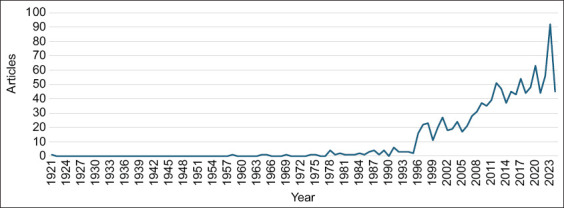
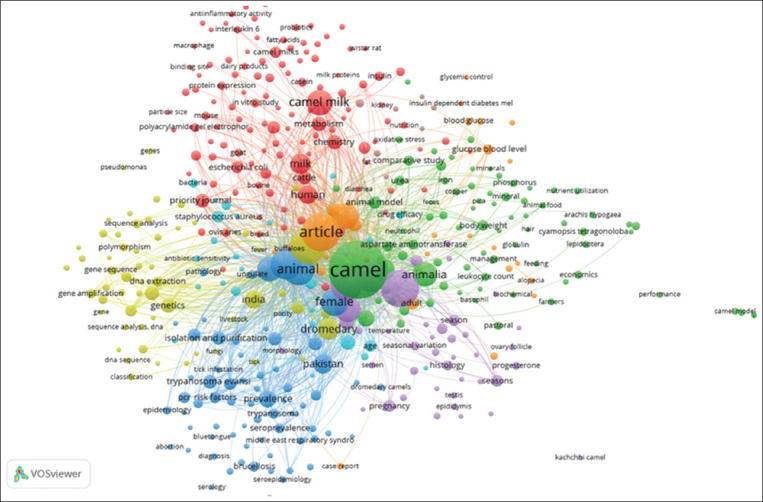
对南亚骆驼研究的文献计量分析共识别出1106篇文献,来自320个来源,涉及2443位作者,国际合作率为16.91%。研究主题的主要聚类包括骆驼生物学和兽医学,侧重于骆驼的生物学和健康方面;骆驼奶及其产品,强调骆驼奶在人类营养和健康中的作用;骆驼的遗传学和分子生物学;骆驼的病原体和疾病及其控制;骆驼组织和结构;以及骆驼产品对人类健康的影响。印度和巴基斯坦是此类文章的主要来源国。南亚骆驼研究中的热门和不断演变的主题持续增加,形成了一个动态格局。关键主题包括对骆驼产品的营养和治疗特性,特别是骆驼奶和生物活性化合物的兴趣日益浓厚。骆驼产品及其生物活性肽的抗氧化和抗炎特性也受到了研究关注。从对骆驼生理学和疾病的传统研究向分子和基因组研究的演变,突显了向更详细、更具机制性地理解骆驼生物学和健康的转变。

结论

这项文献计量研究突出了过去几十年南亚骆驼研究的显著增长和多样化。该研究强调需要持续的支持与合作,以了解骆驼的独特属性及其在区域和全球层面的益处。

https://cdn.ncbi.nlm.nih.gov/pmc/blobs/20fb/11784055/6888832fa2d1/Vetworld-17-2763-g012.jpg
https://cdn.ncbi.nlm.nih.gov/pmc/blobs/20fb/11784055/7b89f08fbb0b/Vetworld-17-2763-g001.jpg
https://cdn.ncbi.nlm.nih.gov/pmc/blobs/20fb/11784055/10c31bb6a1ee/Vetworld-17-2763-g002.jpg
https://cdn.ncbi.nlm.nih.gov/pmc/blobs/20fb/11784055/ae4bcf7056a0/Vetworld-17-2763-g003.jpg
https://cdn.ncbi.nlm.nih.gov/pmc/blobs/20fb/11784055/979dc7f3c7ac/Vetworld-17-2763-g004.jpg
https://cdn.ncbi.nlm.nih.gov/pmc/blobs/20fb/11784055/77cbeb2f638d/Vetworld-17-2763-g005.jpg
https://cdn.ncbi.nlm.nih.gov/pmc/blobs/20fb/11784055/8c2561a24c27/Vetworld-17-2763-g006.jpg
https://cdn.ncbi.nlm.nih.gov/pmc/blobs/20fb/11784055/857089e6fc19/Vetworld-17-2763-g007.jpg
https://cdn.ncbi.nlm.nih.gov/pmc/blobs/20fb/11784055/f42dc48d8c4d/Vetworld-17-2763-g008.jpg
https://cdn.ncbi.nlm.nih.gov/pmc/blobs/20fb/11784055/7f9043e34c19/Vetworld-17-2763-g009.jpg
https://cdn.ncbi.nlm.nih.gov/pmc/blobs/20fb/11784055/4d5adae7d760/Vetworld-17-2763-g010.jpg
https://cdn.ncbi.nlm.nih.gov/pmc/blobs/20fb/11784055/b9ced331fc93/Vetworld-17-2763-g011.jpg
https://cdn.ncbi.nlm.nih.gov/pmc/blobs/20fb/11784055/6888832fa2d1/Vetworld-17-2763-g012.jpg
https://cdn.ncbi.nlm.nih.gov/pmc/blobs/20fb/11784055/7b89f08fbb0b/Vetworld-17-2763-g001.jpg
https://cdn.ncbi.nlm.nih.gov/pmc/blobs/20fb/11784055/10c31bb6a1ee/Vetworld-17-2763-g002.jpg
https://cdn.ncbi.nlm.nih.gov/pmc/blobs/20fb/11784055/ae4bcf7056a0/Vetworld-17-2763-g003.jpg
https://cdn.ncbi.nlm.nih.gov/pmc/blobs/20fb/11784055/979dc7f3c7ac/Vetworld-17-2763-g004.jpg
https://cdn.ncbi.nlm.nih.gov/pmc/blobs/20fb/11784055/77cbeb2f638d/Vetworld-17-2763-g005.jpg
https://cdn.ncbi.nlm.nih.gov/pmc/blobs/20fb/11784055/8c2561a24c27/Vetworld-17-2763-g006.jpg
https://cdn.ncbi.nlm.nih.gov/pmc/blobs/20fb/11784055/857089e6fc19/Vetworld-17-2763-g007.jpg
https://cdn.ncbi.nlm.nih.gov/pmc/blobs/20fb/11784055/f42dc48d8c4d/Vetworld-17-2763-g008.jpg
https://cdn.ncbi.nlm.nih.gov/pmc/blobs/20fb/11784055/7f9043e34c19/Vetworld-17-2763-g009.jpg
https://cdn.ncbi.nlm.nih.gov/pmc/blobs/20fb/11784055/4d5adae7d760/Vetworld-17-2763-g010.jpg
https://cdn.ncbi.nlm.nih.gov/pmc/blobs/20fb/11784055/b9ced331fc93/Vetworld-17-2763-g011.jpg
https://cdn.ncbi.nlm.nih.gov/pmc/blobs/20fb/11784055/6888832fa2d1/Vetworld-17-2763-g012.jpg

相似文献

1
Trends in camel research in South Asia: A bibliometric approach.南亚骆驼研究趋势:一种文献计量学方法。
Vet World. 2024 Dec;17(12):2763-2773. doi: 10.14202/vetworld.2024.2763-2773. Epub 2024 Dec 13.
2
A bibliometric analysis of six decades of camel research in North Africa: Trends, collaboration, and emerging themes.对北非六十年骆驼研究的文献计量分析:趋势、合作及新兴主题
Open Vet J. 2024 Dec;14(12):3505-3524. doi: 10.5455/OVJ.2024.v14.i12.34. Epub 2024 Dec 31.
3
Bibliometric analysis of the use of pathological techniques in camel research.骆驼研究中病理技术应用的文献计量分析。
Open Vet J. 2025 Feb;15(2):1009-1023. doi: 10.5455/OVJ.2025.v15.i2.49. Epub 2025 Feb 28.
4
Advancing the understanding of autoimmune/inflammatory syndrome induced by adjuvants (ASIA): Global research trends, key themes, and emerging frontiers.推进对佐剂诱导的自身免疫性/炎症综合征(ASIA)的理解:全球研究趋势、关键主题及新兴前沿领域
Autoimmun Rev. 2025 Jan 3;24(1):103691. doi: 10.1016/j.autrev.2024.103691. Epub 2024 Nov 14.
5
Finding the new potential research on diabetic kidney disease and hemodialysis in healthcare insurance databases: A bibliometric analysis.在医疗保险数据库中寻找糖尿病肾病和血液透析的新潜在研究:一项文献计量分析。
Narra J. 2024 Dec;4(3):e827. doi: 10.52225/narra.v4i3.827. Epub 2024 Oct 9.
6
Folic acid supplementation and malaria susceptibility and severity among people taking antifolate antimalarial drugs in endemic areas.在流行地区,服用抗叶酸抗疟药物的人群中,叶酸补充剂与疟疾易感性和严重程度的关系。
Cochrane Database Syst Rev. 2022 Feb 1;2(2022):CD014217. doi: 10.1002/14651858.CD014217.
7
Global Insights and Key Trends in Gut Microbiota Research for Premature Infants: A Bibliometric and Visualization Study.早产儿肠道微生物群研究的全球洞察与关键趋势:一项文献计量学与可视化研究
J Multidiscip Healthc. 2024 Oct 4;17:4611-4626. doi: 10.2147/JMDH.S483332. eCollection 2024.
8
A bibliometric analysis of programmed cell death in oral cancer literature: research patterns and emerging trends (2000-2024).口腔癌文献中程序性细胞死亡的文献计量分析:研究模式与新趋势(2000 - 2024年)
Discov Oncol. 2025 Apr 22;16(1):585. doi: 10.1007/s12672-025-02410-9.
9
The evolution of health services research in Austria: a bibliometric exploration of trends, themes, and collaborations.奥地利卫生服务研究的演变:对趋势、主题及合作的文献计量学探索
Front Health Serv. 2025 Mar 13;5:1501035. doi: 10.3389/frhs.2025.1501035. eCollection 2025.
10
Trends, challenges, and research pathways in emerging contaminants: a comprehensive bibliometric analysis.新兴污染物的趋势、挑战及研究路径:一项全面的文献计量分析
Integr Environ Assess Manag. 2025 May 1;21(3):496-506. doi: 10.1093/inteam/vjae036.

引用本文的文献

1
A bibliometric analysis of disability research in Saudi Arabia: Evolving trends, thematic mapping, and gaps.沙特阿拉伯残疾研究的文献计量分析:发展趋势、主题映射及差距
Saudi Med J. 2025 Apr;46(4):406-417. doi: 10.15537/smj.2025.46.4.20240591.

本文引用的文献

1
Molecular binding mechanism and novel antidiabetic and anti-hypertensive bioactive peptides from fermented camel milk with anti-inflammatory activity in raw macrophages cell lines.具有抗炎活性的发酵骆驼乳中降血糖和降血压的生物活性肽的分子结合机制及其新用途
Amino Acids. 2023 Nov;55(11):1621-1640. doi: 10.1007/s00726-023-03335-9. Epub 2023 Sep 25.
2
A century of "Camel Research": a bibliometric analysis.一个世纪的“骆驼研究”:文献计量分析
Front Vet Sci. 2023 Jun 1;10:1157667. doi: 10.3389/fvets.2023.1157667. eCollection 2023.
3
Parasitological, molecular, and epidemiological investigation of Trypanosoma evansi infection among dromedary camels in Balochistan province.
包虫病、分子和流行病学调查在俾路支省的单峰骆驼感染伊氏锥虫。
Parasitol Res. 2023 Aug;122(8):1833-1839. doi: 10.1007/s00436-023-07884-6. Epub 2023 Jun 6.
4
VOSviewer and Bibliometrix.VOSviewer 和 Bibliometrix.
J Med Libr Assoc. 2022 Jul 1;110(3):392-395. doi: 10.5195/jmla.2022.1434.
5
Research Development on Anti-Microbial and Antioxidant Properties of Camel Milk and Its Role as an Anti-Cancer and Anti-Hepatitis Agent.骆驼奶的抗菌和抗氧化特性及其作为抗癌和抗肝炎剂的作用的研究进展
Antioxidants (Basel). 2021 May 17;10(5):788. doi: 10.3390/antiox10050788.
6
Dataset of next-generation sequence reads of nanobody clones in phage display library derived from Indian desert camel ( L.).来自印度沙漠骆驼(L.)的噬菌体展示文库中纳米抗体克隆的下一代测序读数数据集。
Data Brief. 2020 Dec 16;34:106663. doi: 10.1016/j.dib.2020.106663. eCollection 2021 Feb.
7
Camels and Climate Resilience: Adaptation in Northern Kenya.骆驼与气候适应能力:肯尼亚北部的适应情况
Hum Ecol Interdiscip J. 2016;44(6):701-713. doi: 10.1007/s10745-016-9858-1. Epub 2016 Nov 12.
8
One Health research and training and government support for One Health in South Asia.南亚的“同一个健康”研究与培训以及政府对“同一个健康”的支持。
Infect Ecol Epidemiol. 2016 Nov 29;6:33842. doi: 10.3402/iee.v6.33842. eCollection 2016.
9
The camel, new challenges for a sustainable development.骆驼,可持续发展面临的新挑战。
Trop Anim Health Prod. 2016 Apr;48(4):689-92. doi: 10.1007/s11250-016-0995-8. Epub 2016 Feb 27.
10
Genetic diversity and differentiation of dromedarian camel of India.印度单峰骆驼的遗传多样性与分化
Anim Biotechnol. 2007;18(2):81-90. doi: 10.1080/10495390600648741.