Kumar G V Naveen, Wang Rui-Sheng, Sharma Ankit X, David Natalie L, Amorim Tânia, Sinden Daniel S, Doshi Nandini K, Wabitsch Martin, Gingras Sebastien, Ejaz Asim, Rubin J Peter, Maron Bradley A, Fazeli Pouneh K, Steinhauser Matthew L
Aging Institute of UPMC and University of Pittsburgh School of Medicine, Pittsburgh, PA, USA.
Division of Cardiovascular Medicine, Department of Medicine, Brigham and Women's Hospital and Harvard Medical School, Boston, MA, USA.
Nat Commun. 2025 Feb 4;16(1):1330. doi: 10.1038/s41467-025-56613-3.
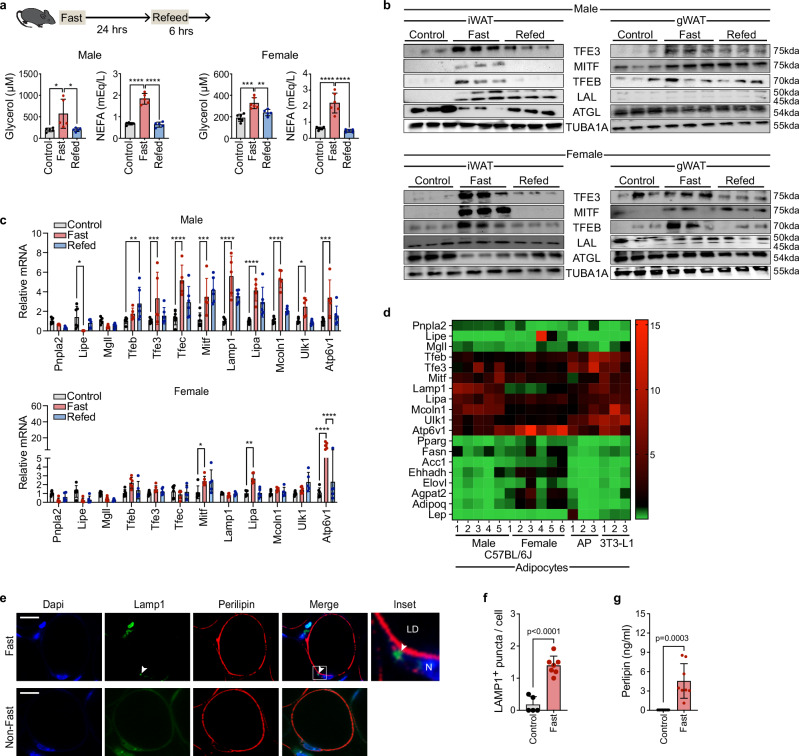
Physiological adaptations to fasting enable humans to survive for prolonged periods without food and involve molecular pathways that may drive life-prolonging effects of dietary restriction in model organisms. Mobilization of fatty acids and glycerol from adipocyte lipid stores by canonical neutral lipases, including the rate limiting adipose triglyceride lipase (Pnpla2/ATGL), is critical to the adaptive fasting response. Here we discovered an alternative mechanism of lipolysis in adipocytes involving a lysosomal program. We functionally tested lysosomal lipolysis with pharmacological and genetic approaches in mice and in murine and human adipocyte and adipose tissue explant culture, establishing dependency on lysosomal acid lipase (LIPA/LAL) and the microphthalmia/transcription factor E (MiT/TFE) family. Our study establishes a model whereby the canonical pathway is critical for rapid lipolytic responses to adrenergic stimuli operative in the acute stage of fasting, while the alternative lysosomal pathway dominates with prolonged fasting.
对禁食的生理适应使人类能够在没有食物的情况下长时间存活,其中涉及的分子途径可能会在模式生物中驱动饮食限制的寿命延长效应。通过包括限速脂肪甘油三酯脂肪酶(Pnpla2/ATGL)在内的经典中性脂肪酶从脂肪细胞脂质储存中动员脂肪酸和甘油,对于适应性禁食反应至关重要。在这里,我们发现了脂肪细胞中一种涉及溶酶体程序的脂解替代机制。我们在小鼠以及小鼠和人类脂肪细胞及脂肪组织外植体培养中,通过药理学和遗传学方法对溶酶体脂解进行了功能测试,确定了其对溶酶体酸性脂肪酶(LIPA/LAL)和小眼畸形/转录因子E(MiT/TFE)家族的依赖性。我们的研究建立了一个模型,即经典途径对于禁食急性期对肾上腺素能刺激的快速脂解反应至关重要,而替代溶酶体途径在长时间禁食时占主导地位。