Myran Daniel T, Pugliese Michael, Harrison Lyndsay D, Solmi Marco, Anderson Kelly K, Fiedorowicz Jess G, Finkelstein Yaron, Manuel Doug, Taljaard Monica, Webber Colleen, Tanuseputro Peter
Ottawa Hospital Research Institute, Ottawa, Ontario, Canada.
Department of Family Medicine, University of Ottawa, Ottawa, Ontario, Canada.
JAMA Netw Open. 2025 Feb 3;8(2):e2457868. doi: 10.1001/jamanetworkopen.2024.57868.
Despite public health concerns that cannabis legalization may increase the number of cases of schizophrenia caused by cannabis, there is limited evidence on this topic.
To examine changes in the population-attributable risk fraction (PARF) for cannabis use disorder (CUD) associated with schizophrenia after liberalization of medical cannabis and legalization of nonmedical cannabis in Canada.
DESIGN, SETTING, AND PARTICIPANTS: This population-based cohort study was conducted in Ontario, Canada, from January 1, 2006, to December 31, 2022, among 13 588 681 people aged 14 to 65 years without a history of schizophrenia.
Diagnosis of CUD in the emergency department or hospital setting (International Statistical Classification of Diseases and Related Health Problems, Tenth Revision, Canada [ICD-10-CA] codes F12x and T40.7).
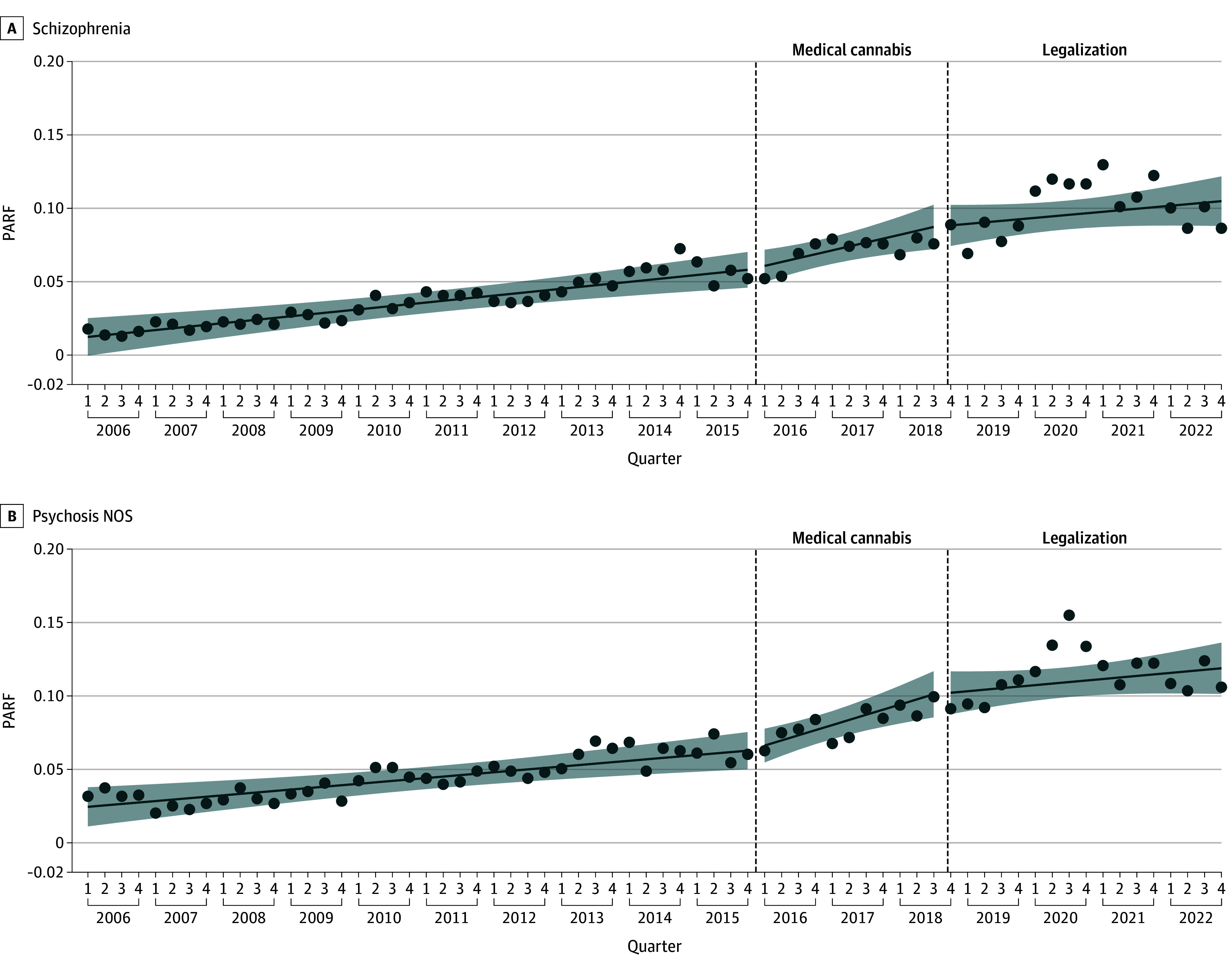
Changes in the PARF for CUD associated with schizophrenia (ICD-10-CA codes F20x and F25x and Diagnostic and Statistical Manual of Mental Disorders [Fourth Edition] [DSM-IV] code 295x) over 3 policy periods: prelegalization (January 2006 to November 2015), liberalization of medical and nonmedical cannabis (December 2015 to September 2018), and legalization of nonmedical cannabis (October 2018 to December 2022). A secondary outcome was diagnosis of psychosis not otherwise specified (NOS) (ICD-10-CA code F29x and DSM-IV code 298x). Segmented linear regression was used to examine changes after the liberalization of medical cannabis in 2015 and the legalization of nonmedical cannabis in 2018.
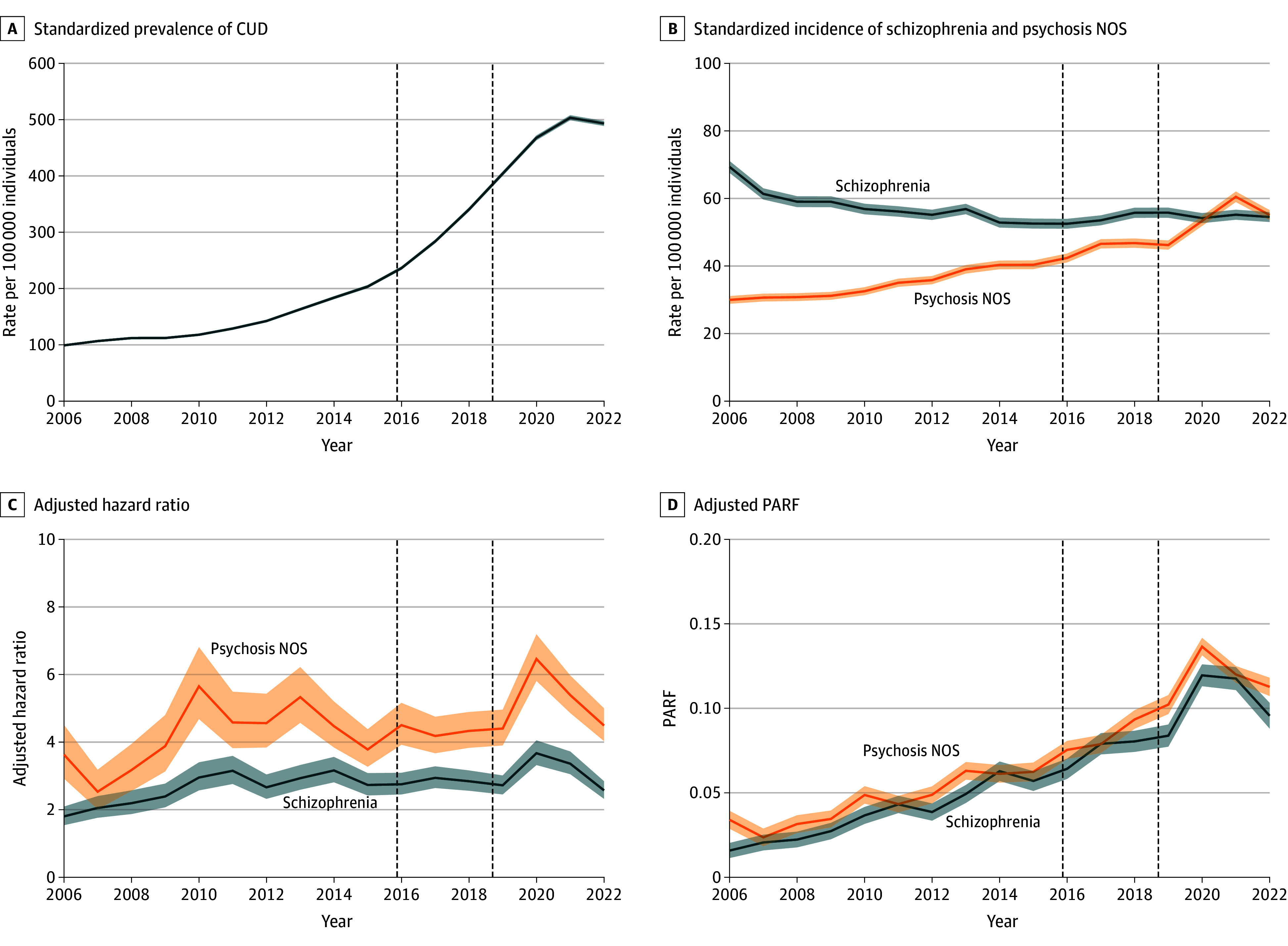
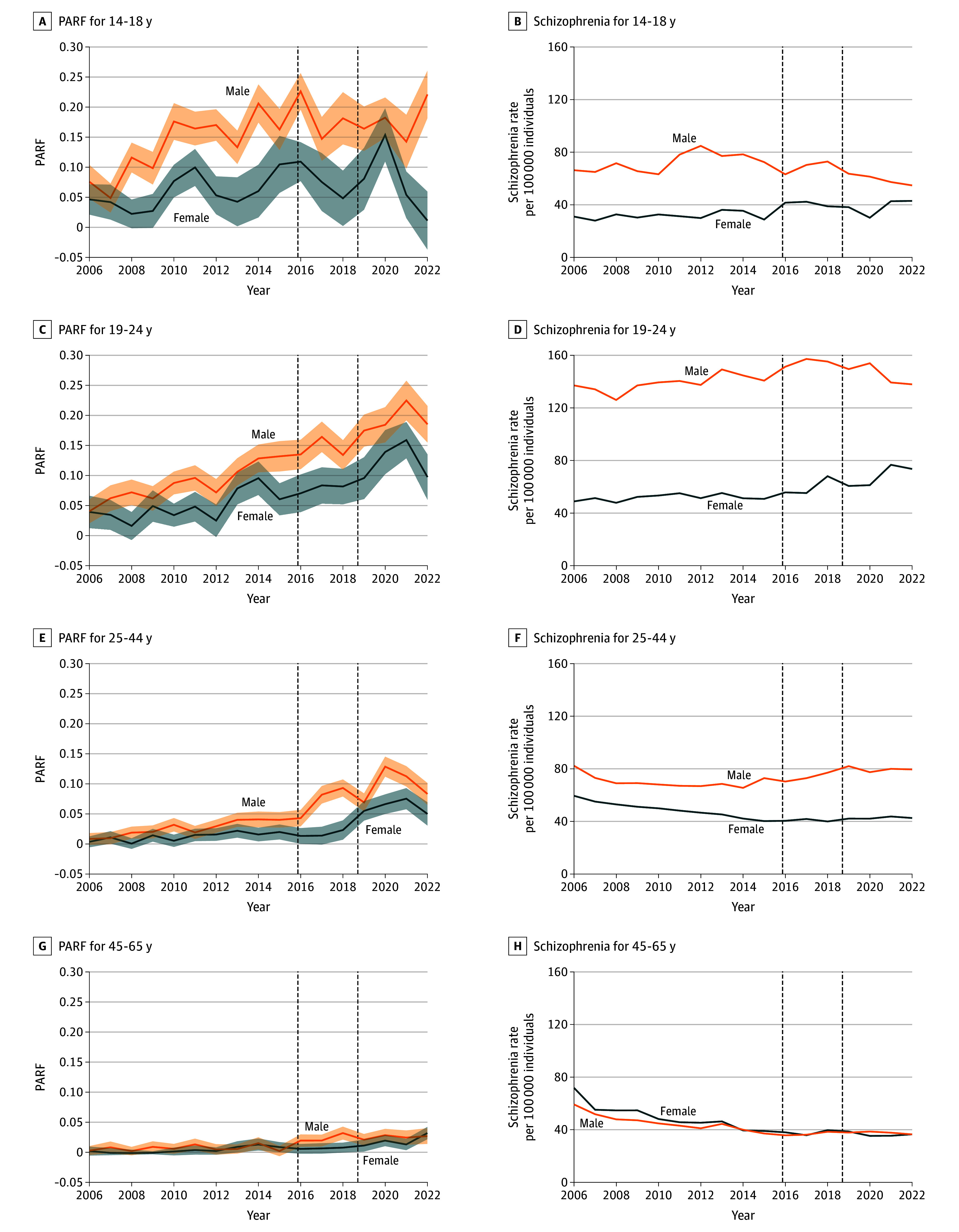
The study included 13 588 681 individuals (mean [SD] age, 39.3 [16.1] years; 6 804 906 males [50.1%]), of whom 118 650 (0.9%) had CUD. A total of 91 106 individuals (0.7%) developed schizophrenia (80 523 of 13 470 031 [0.6%] in the general population without CUD vs 10 583 of 118 650 [8.9%] with CUD). The PARF for CUD associated with schizophrenia almost tripled from 3.7% (95% CI, 2.7%-4.7%) during the prelegalization period to 10.3% (95% CI, 8.9%-11.7%) during the legalization period. The PARF in the postlegalization period ranged from 18.9% (95% CI, 16.8%-21.0%) among males aged 19 to 24 years to 1.8% (95% CI, 1.1%-2.6%) among females aged 45 to 65 years. The annual incidence of schizophrenia was stable over time, while the incidence of psychosis NOS increased from 30.0 to 55.1 per 100 000 individuals (83.7%) in the postlegalization period relative to the prelegalization period. The PARF for CUD associated with schizophrenia increased steadily over the study with no accelerations after cannabis policy changes, while increases in the PARF for CUD associated with psychosis NOS accelerated after medical cannabis liberalization.
In this cohort study of individuals aged 14 to 65 years in Ontario, Canada, the proportion of incident cases of schizophrenia associated with CUD almost tripled during a period of substantial liberalization of cannabis policy. Ongoing research is indicated to understand the long-term associations of cannabis policy with the prevalence of psychotic disorders.
尽管公众健康担忧大麻合法化可能会增加因大麻导致的精神分裂症病例数量,但关于这一主题的证据有限。
研究加拿大医用大麻自由化和非医用大麻合法化后,与精神分裂症相关的大麻使用障碍(CUD)的人群归因风险分数(PARF)的变化。
设计、地点和参与者:这项基于人群的队列研究于2006年1月1日至2022年12月31日在加拿大安大略省进行,研究对象为13588681名年龄在14至65岁且无精神分裂症病史的人。
急诊科或医院环境中CUD的诊断(《国际疾病和相关健康问题统计分类,第十次修订版,加拿大》[ICD - 10 - CA]编码F12x和T40.7)。
在三个政策阶段中,与精神分裂症(ICD - 10 - CA编码F20x和F25x以及《精神障碍诊断与统计手册》[第四版] [DSM - IV]编码295x)相关的CUD的PARF变化:合法化前(2006年1月至2015年11月)、医用和非医用大麻自由化(2015年12月至2018年9月)以及非医用大麻合法化(2018年10月至2022年12月)。次要结局是未另作说明的精神病(NOS)诊断(ICD - 10 - CA编码F29x和DSM - IV编码298x)。采用分段线性回归来研究2015年医用大麻自由化和2018年非医用大麻合法化后的变化。
该研究纳入了13588681名个体(平均[标准差]年龄为39.3[16.1]岁;6804906名男性[50.1%]),其中118650人(0.9%)患有CUD。共有91106人(0.7%)患上精神分裂症(在无CUD的普通人群中,13470031人中有80523人[0.6%],而在患有CUD的118650人中,有10583人[8.9%])。与精神分裂症相关的CUD的PARF从合法化前时期的3.7%(95%置信区间,2.7% - 4.7%)几乎增至合法化时期的10.3%(95%置信区间,8.9% - 11.7%)。合法化后时期的PARF在19至24岁男性中为18.9%(95%置信区间,16.8% - 21.0%),在45至65岁女性中为1.8%(95%置信区间,1.1% - 2.6%)。精神分裂症的年发病率随时间保持稳定,而未另作说明的精神病的发病率在合法化后时期相对于合法化前时期从每10万人30.0例增至55.1例(增加了83.7%)。与精神分裂症相关的CUD的PARF在整个研究过程中稳步上升,在大麻政策变化后没有加速上升,而与未另作说明的精神病相关的CUD的PARF在医用大麻自由化后加速上升。
在这项针对加拿大安大略省14至65岁个体的队列研究中,在大麻政策大幅自由化期间,与CUD相关的精神分裂症新发病例比例几乎增至三倍。需要持续开展研究以了解大麻政策与精神障碍患病率的长期关联。