Colina Armando R, Vosti Stephen A, Jarvis Michael, Engle-Stone Reina, Michuda Aleksandr, Ortiz-Becerra Karen, Adams Katherine P
Department of Agricultural and Resource Economics, UC Davis, Davis, California, USA.
Banco de México, Mexico, Mexico.
Ann N Y Acad Sci. 2025 Feb;1544(1):143-158. doi: 10.1111/nyas.15290. Epub 2025 Feb 5.
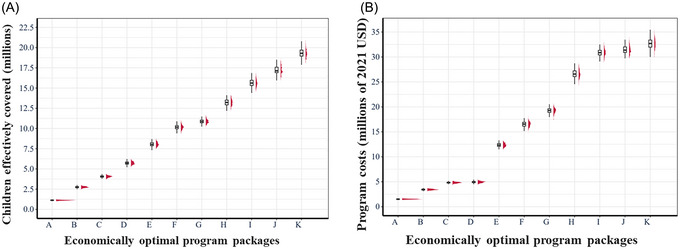
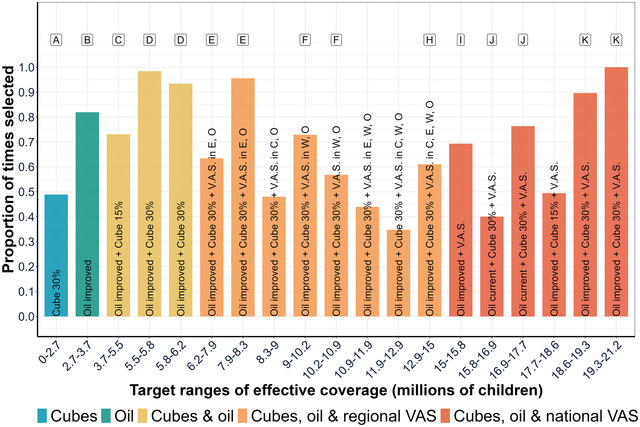
Vitamin A dietary inadequacy remains a serious public health problem among young children 6-59 months of age in Burkina Faso. Planners face several interrelated challenges: Selecting concrete policy objectives regarding vitamin A inadequacy reductions, identifying cost-effective vitamin A intervention programs that can achieve those objectives, and being reasonably sure that proposed intervention programs are robust to uncertainty in program benefits and costs. A 10-year, subnational economic optimization model making use of secondary dietary intake data and program cost data was developed and implemented to address these issues and included the following vitamin A program options: existing or improved edible oils fortification, a pair of hypothetical vitamin A-fortified bouillon programs, and a set of subnational vitamin A supplementation (VAS) programs. The model consistently identified the improved edible oils and bouillon fortification programs as the core national programs upon which the more expensive subnational VAS programs could be layered, depending on policy objectives and available funding. These results were robust to uncertainty in program nutritional benefits and costs. However, even if the most impactful set of modeled programs was implemented, vitamin A inadequacy among children would remain a serious public health problem; hence, additional efforts to address it would be needed.
在布基纳法索,6至59个月大的幼儿中,膳食维生素A摄入不足仍然是一个严重的公共卫生问题。规划者面临几个相互关联的挑战:选择关于减少维生素A摄入不足的具体政策目标,确定能够实现这些目标的具有成本效益的维生素A干预项目,并合理确保拟议的干预项目对项目效益和成本的不确定性具有稳健性。为解决这些问题,开发并实施了一个利用二级膳食摄入数据和项目成本数据的为期10年的次国家级经济优化模型,该模型包括以下维生素A项目选项:现有的或改进的食用油强化项目、一对假设的维生素A强化肉汤项目,以及一组次国家级维生素A补充项目(VAS)。该模型始终将改进的食用油和肉汤强化项目确定为核心国家项目,根据政策目标和可用资金,可以在这些项目之上叠加更昂贵的次国家级VAS项目。这些结果对项目营养效益和成本的不确定性具有稳健性。然而,即使实施了模型中最具影响力的一组项目,儿童维生素A摄入不足仍将是一个严重的公共卫生问题;因此,还需要做出额外努力来解决这一问题。