School of Public Health and Women's Hospital, Zhejiang University School of Medicine, Hangzhou, Zhejiang, China.
Centre for Global Health Research, Usher Institute of Population Health Sciences and Informatics, University of Edinburgh, Edinburgh, Scotland, UK.
J Glob Health. 2023 Aug 11;13:04084. doi: 10.7189/jogh.13.04084.
Vitamin A deficiency (VAD) is widely recognised as a major public health concern in low- and middle-income countries (LMICs). Despite various interventions implemented in many countries, a lack of reliable data is hindering progress. We aimed to consolidate available data and quantify estimates of the prevalence of VAD among children ≤18 years in LMICs.
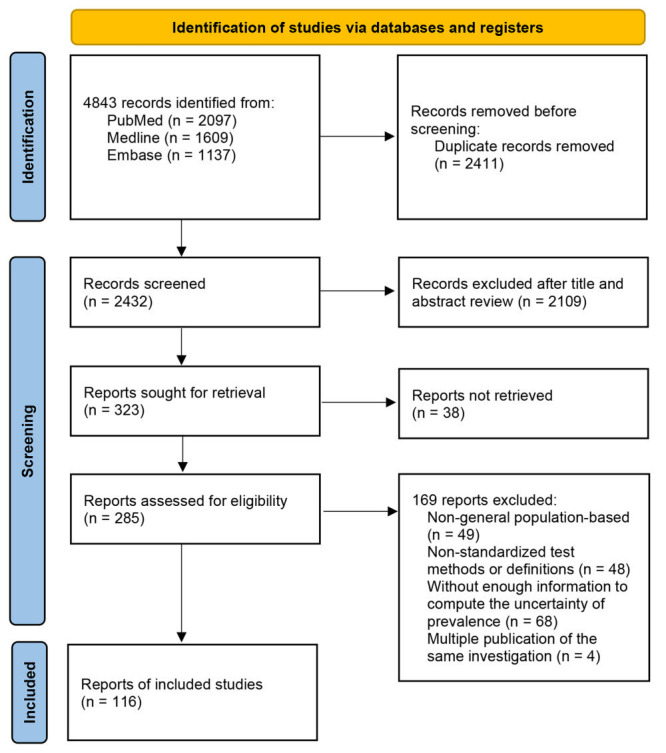
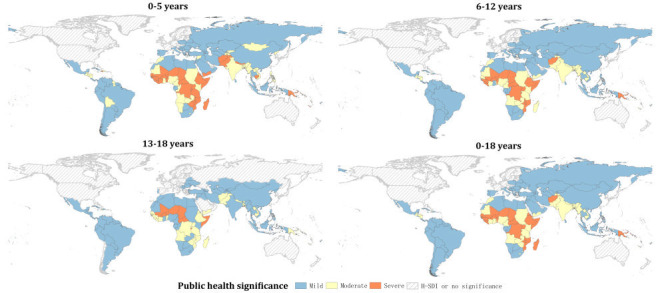
We searched PubMed, Medline and Embase for studies reported the prevalence of VAD or marginal (m)VAD among children. A multilevel mixed-effects meta-regression approach was applied to establish the regression models for VAD and mVAD prevalence. The total numbers of children affected by VAD and mVAD in LMICs in 2019 were separately calculated from the estimated age- and socio-demographic index (SDI)-specific prevalence with their corresponding United Nations Population Division populations projections. We estimated areas of significant public health concern in 165 LMICs using the lower confidence interval (CI) of VAD prevalence.
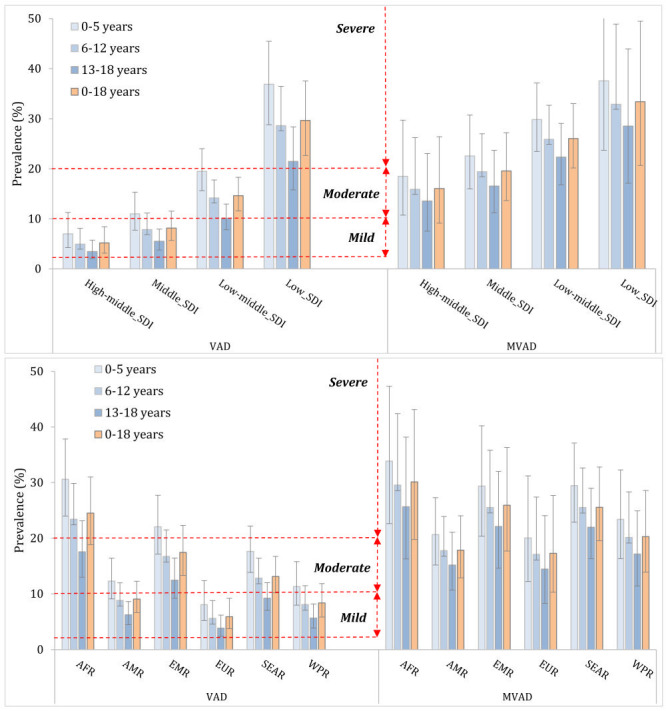
A total of 116 articles from 40 LMICs were retained. In 2019, VAD and mVAD affected 333.95 million (95% CI = 253.00-433.74) and 556.13 million (95% CI = 388.83-767.94) children and adolescents in 165 LMICs, respectively, corresponding to a prevalence of 14.73% (95% CI = 11.16-19.14) and 24.54% (95% CI = 17.15-33.88). The prevalence of both VAD and mVAD was the highest in children aged 0-5 years at 19.53% (95% CI = 15.03-24.91) and 28.22% (95% CI = 20.00-38.24), respectively, with both steadily decreasing to 10.09% (95% CI = 7.44-13.50) and 20.76% (95% CI = 14.16-29.50) in adolescents aged 13-18 years. The prevalence of VAD was significantly higher in the low SDI region at 29.67% (95% CI = 22.67-37.53) compared to 5.17% (95% CI = 3.14-8.43) estimated in the high-middle SDI region. 68 of the 165 LMICs (41.21%) were classified as areas of moderate to severe VAD public health significance.
VAD continues to pose a significant public health concern in many low-income settings. Development in LMICs is a crucial factor for VAD, with a disproportionately higher burden in low SDI regions.
This study protocol was registered with PROSPERO, CRD42020220654.
维生素 A 缺乏症(VAD)在中低收入国家(LMICs)被广泛认为是一个主要的公共卫生问题。尽管许多国家实施了各种干预措施,但缺乏可靠的数据阻碍了进展。我们旨在整合现有数据,并量化 LMICs 中≤18 岁儿童 VAD 的患病率。
我们在 PubMed、Medline 和 Embase 中搜索了报告儿童 VAD 或边缘(mVAD)患病率的研究。应用多水平混合效应荟萃回归方法建立 VAD 和 mVAD 患病率的回归模型。2019 年,根据估计的年龄和社会人口指数(SDI)特异性患病率及其相应的联合国人口司人口预测,分别计算出 VAD 和 mVAD 在 LMICs 中受影响的儿童总数。我们使用 VAD 患病率的置信区间下限(CI)来估计 165 个 LMICs 中存在显著公共卫生问题的地区。
共保留了来自 40 个 LMICs 的 116 篇文章。2019 年,VAD 和 mVAD 分别影响了 165 个 LMICs 中 3339.55 万(95%CI=2530.00-4337.44)和 5561.30 万(95%CI=3888.30-7679.40)儿童和青少年,患病率分别为 14.73%(95%CI=11.16-19.14)和 24.54%(95%CI=17.15-33.88)。0-5 岁儿童的 VAD 和 mVAD 患病率最高,分别为 19.53%(95%CI=15.03-24.91)和 28.22%(95%CI=20.00-38.24),而 13-18 岁青少年的患病率则稳定下降至 10.09%(95%CI=7.44-13.50)和 20.76%(95%CI=14.16-29.50)。低 SDI 地区的 VAD 患病率明显较高,为 29.67%(95%CI=22.67-37.53),而高-中 SDI 地区的患病率估计为 5.17%(95%CI=3.14-8.43)。在 165 个 LMICs 中,有 68 个(41.21%)被归类为 VAD 具有中度至严重公共卫生意义的地区。
维生素 A 缺乏症在许多低收入国家仍然是一个重大的公共卫生问题。LMICs 的发展是 VAD 的一个关键因素,在低 SDI 地区的负担不成比例地更高。
本研究方案在 PROSPERO 中注册,注册号为 CRD42020220654。