Von Hintze Jake, Ponkilainen Ville, W-Dahl Annette, Hailer Nils P, Furnes Ove, Fenstad Anne M, Badawy Mona, Pedersen Alma B, Lindberg-Larsen Martin, Niemeläinen Mika J, Mäkelä Keijo, Eskelinen Antti
Coxa Hospital for Joint Replacement and Faculty of Medicine and Health Technologies, Tampere University, Tampere, Finland.
Faculty of Medicine and Health Technology, University of Tampere and Tampere University Hospital, Tampere, Finland.
Acta Orthop. 2025 Feb 6;96:142-150. doi: 10.2340/17453674.2025.42999.
In complex primary total knee arthroplasty (TKA), constrained condylar knee (CCK) or rotating hinge knee (RHK) designs may be required to provide stability or address bony deficiencies. We analyzed trends in incidence of these designs in primary TKA and evaluated the mid- to long-term survivorship of CCK and RHK in 4 Nordic countries.
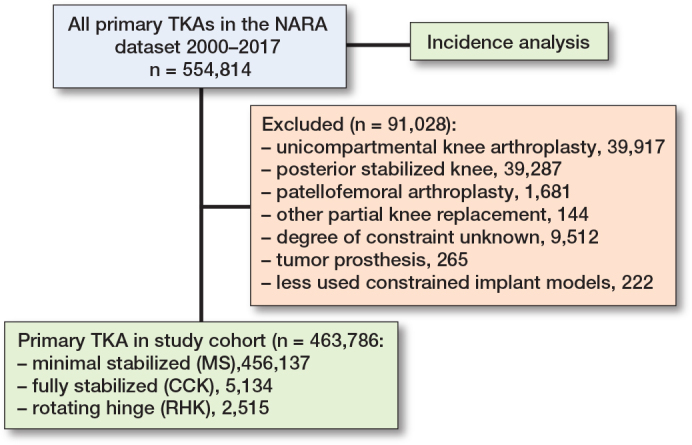
From 2000 to 2017, 5,134 CCK and 2,515 RHK primary TKAs were identified from the NARA database. Kaplan-Meier (K-M) survival and flexible parametric survival model (FPSM) analyses were performed to estimate revision risk, expressed as hazard ratio (HR) with 95% confidence intervals (CI), with minimally stabilized (MS) TKA acting as the control group (n = 456,137).
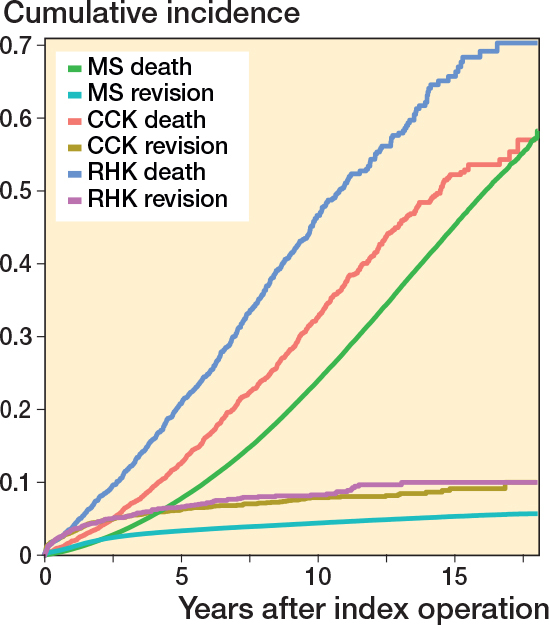
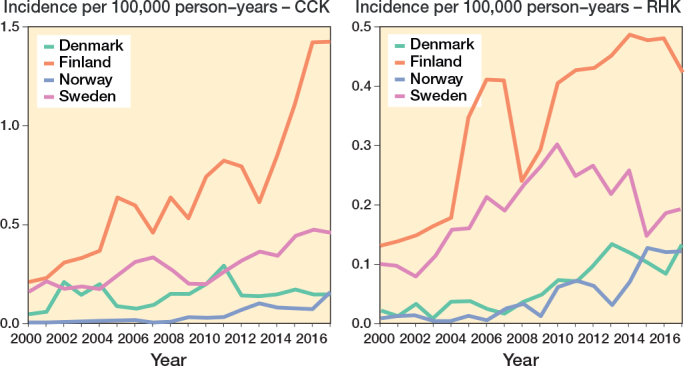
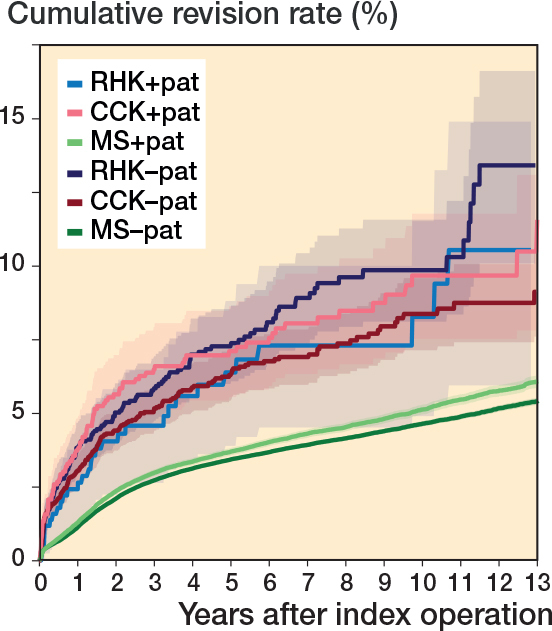
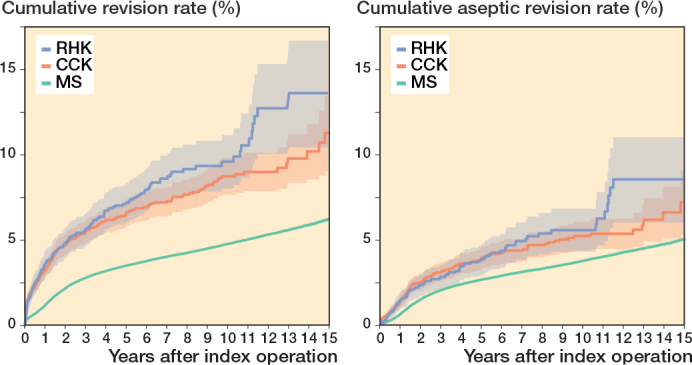
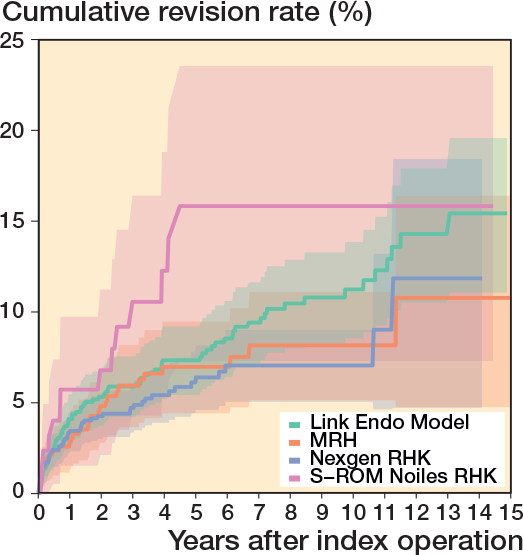
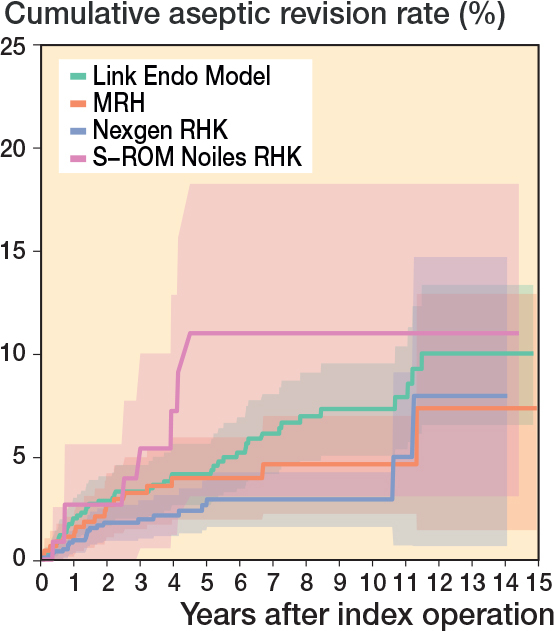
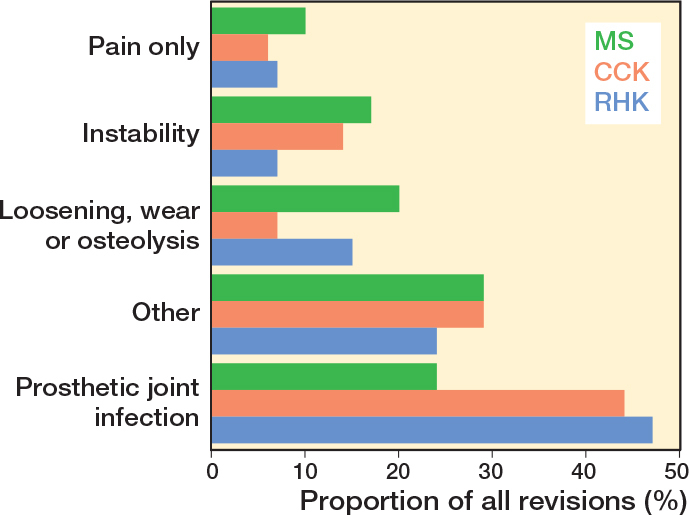
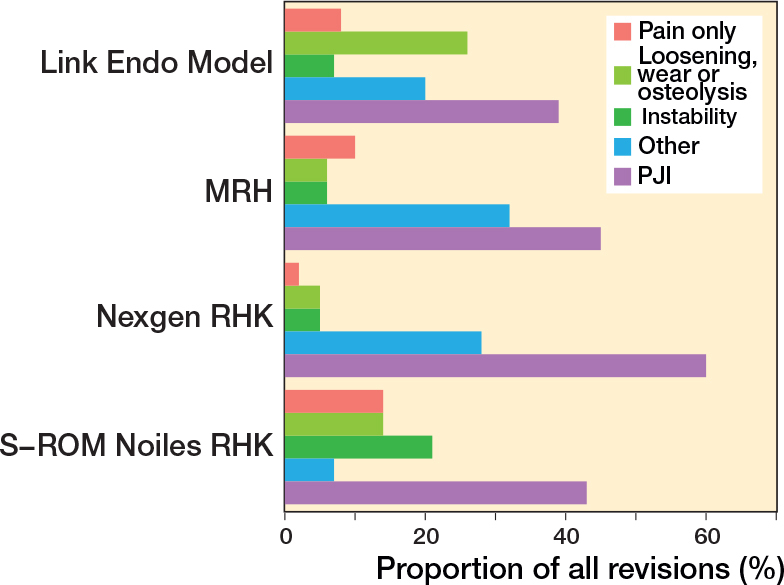
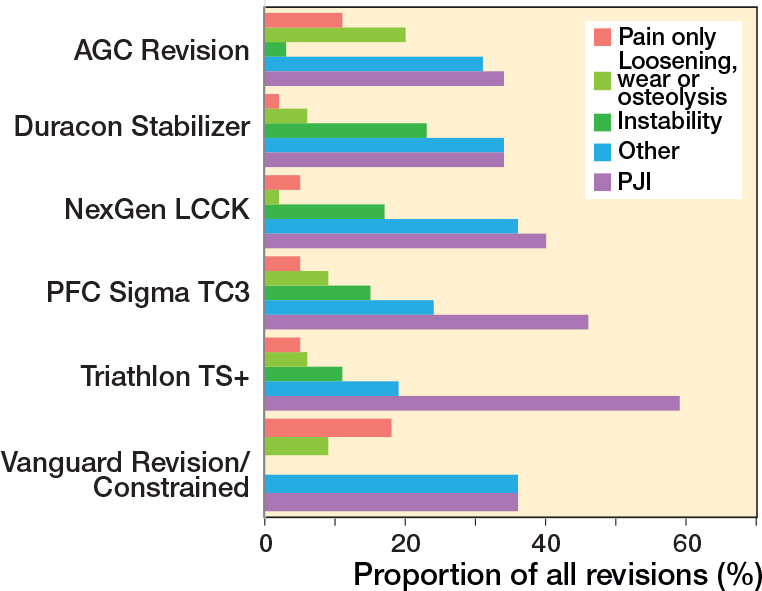
The incidence of CCK and RHK implants increased significantly in Finland, while it was moderate in Denmark, Norway, and Sweden. With revision for any reason as the endpoint the 15-year K-M cumulative revision risk for RHK was 13.6% (CI 10.4-16.7) and for CCK it was 11.3% (CI 9.1-13.5). Compared with MS TKA, the hazard ratio for revision was 2.1 (CI 1.8-2.3) for CCK and 2.5 (CI 2.1-2.8) for RHK. Periprosthetic joint infection (PJI) was the most common reason for revision, accounting for 44% of CCK and 47% of RHK cases. After excluding revisions for PJI, the hazard ratio remained high for both designs, at 1.5 (CI 1.3-1.7) for CCK and 1.6 (CI 1.3-2.0) for RHK compared with MS.
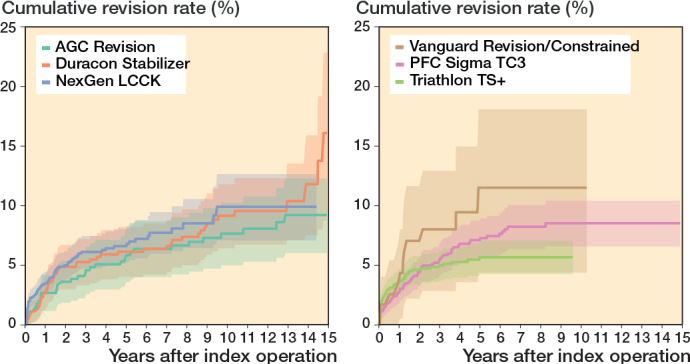
The incidence of CCK and RHK increased during the study period. Both designs showed consistent 15-year revision risks of 11-14%, with no major differences between them. The higher revision risk compared with MS TKAs may reflect the complexity of the surgeries.
在复杂的初次全膝关节置换术(TKA)中,可能需要采用限制性髁型膝关节(CCK)或旋转铰链膝关节(RHK)设计来提供稳定性或解决骨缺损问题。我们分析了这些设计在初次TKA中的发生率趋势,并评估了4个北欧国家CCK和RHK的中长期生存率。
从2000年到2017年,从NARA数据库中识别出5134例CCK初次TKA和2515例RHK初次TKA。进行了Kaplan-Meier(K-M)生存分析和灵活参数生存模型(FPSM)分析,以估计翻修风险,用风险比(HR)表示,并给出95%置信区间(CI),以最小稳定型(MS)TKA作为对照组(n = 456,137)。
CCK和RHK植入物的发生率在芬兰显著增加,而在丹麦、挪威和瑞典则为中等水平。以任何原因翻修为终点,RHK的15年K-M累积翻修风险为13.6%(CI 10.4-16.7),CCK为11.3%(CI 9.1-13.5)。与MS TKA相比,CCK翻修的风险比为2.1(CI 1.8-2.3),RHK为2.5(CI 2.1-2.8)。假体周围关节感染(PJI)是最常见的翻修原因,占CCK病例的44%和RHK病例的47%。排除因PJI进行的翻修后,两种设计的风险比仍然很高,与MS相比,CCK为1.5(CI 1.3-1.7),RHK为1.6(CI 1.3-2.0)。
在研究期间,CCK和RHK的发生率增加。两种设计的15年翻修风险均为11%-14%,且两者之间无重大差异。与MS TKA相比,较高的翻修风险可能反映了手术的复杂性。