Rattanapanadda Porjai, Ramsay Dana, Butters Alyssa, Booker Calvin W, Hannon Sherry J, Hendrick Steve, Van Donkersgoed Joyce, Warr Brian N, Gow Sheryl P, Morley Paul S
Department of Veterinary Medicine, College of Veterinary Medicine, National Chung Hsing University, Taichung, Taiwan.
Department of Livestock Development, Ministry of Agriculture and Cooperatives, Bangkok, Thailand.
Front Microbiol. 2025 Jan 28;16:1497402. doi: 10.3389/fmicb.2025.1497402. eCollection 2025.
The purpose of this study was to characterize the prevalence of antimicrobial resistance in , , and isolated from healthy feedlot cattle over 2 years, and investigate factors potentially associated with recovery of resistant isolates.
Deep-guarded nasopharyngeal (NP) swabs were used to sample feedlot cattle in multiple randomly selected feedlots (2019 = 21, 2020 = 26) at 2 timepoints. NP swabs were collected from 16 animals in each enrolled group upon entry processing and later in the feeding period. Cattle from the same groups (not necessarily the same animals) were sampled at both timepoints. Susceptibility testing was performed using the broth microdilution.
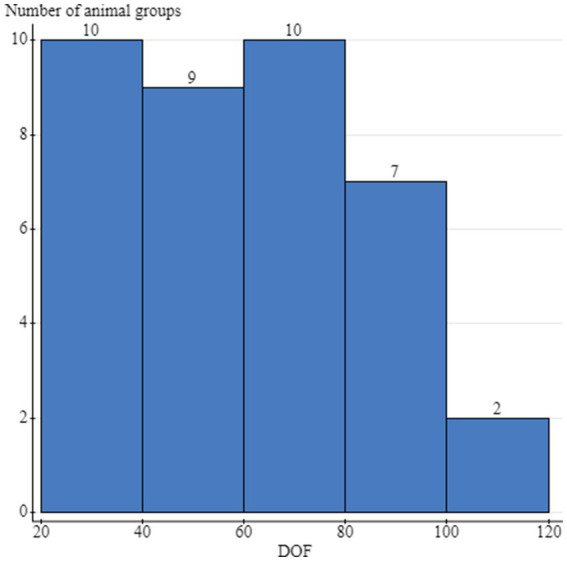
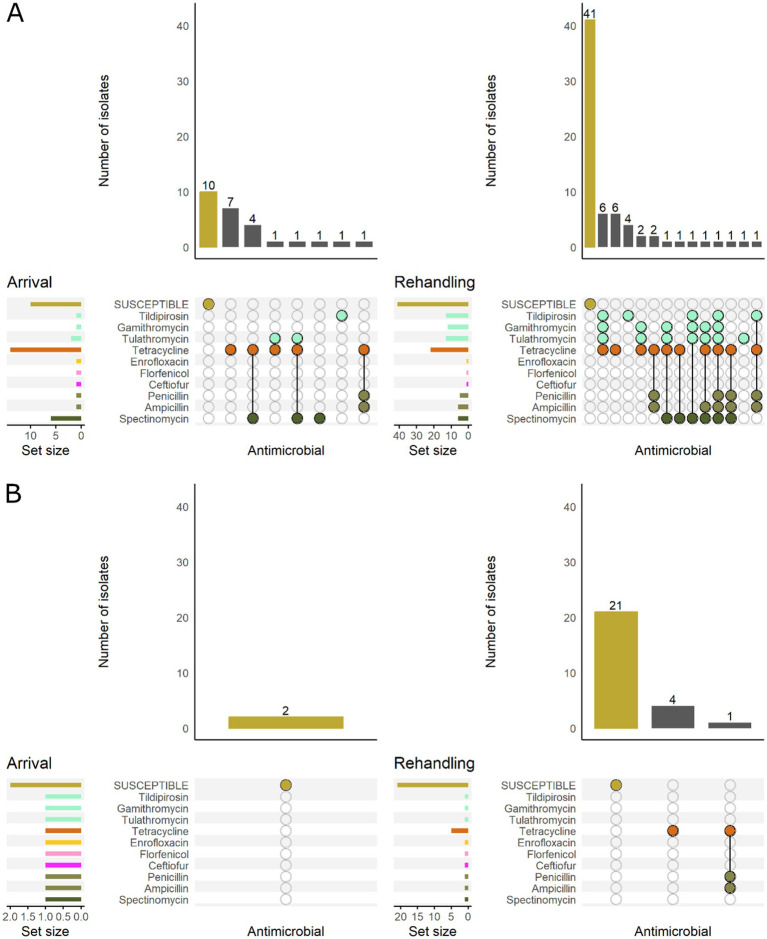
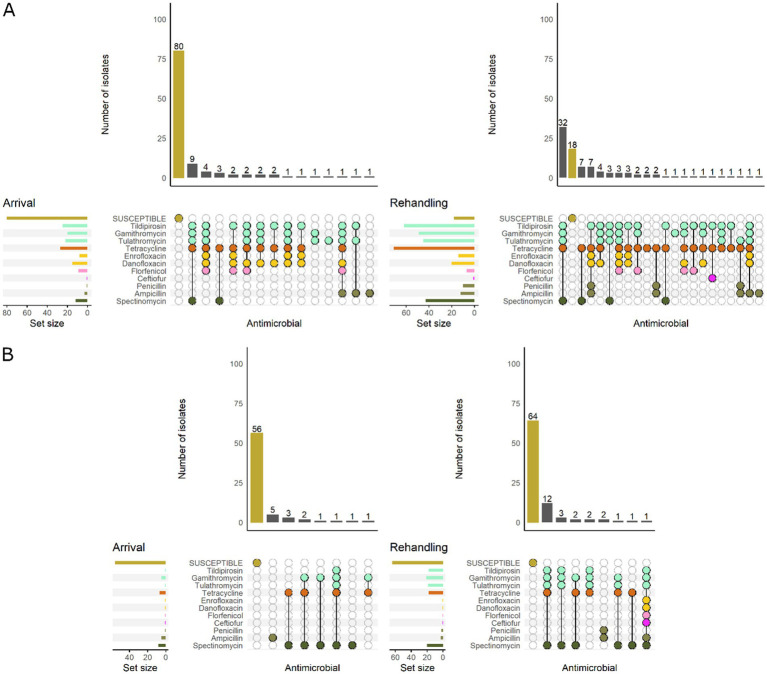
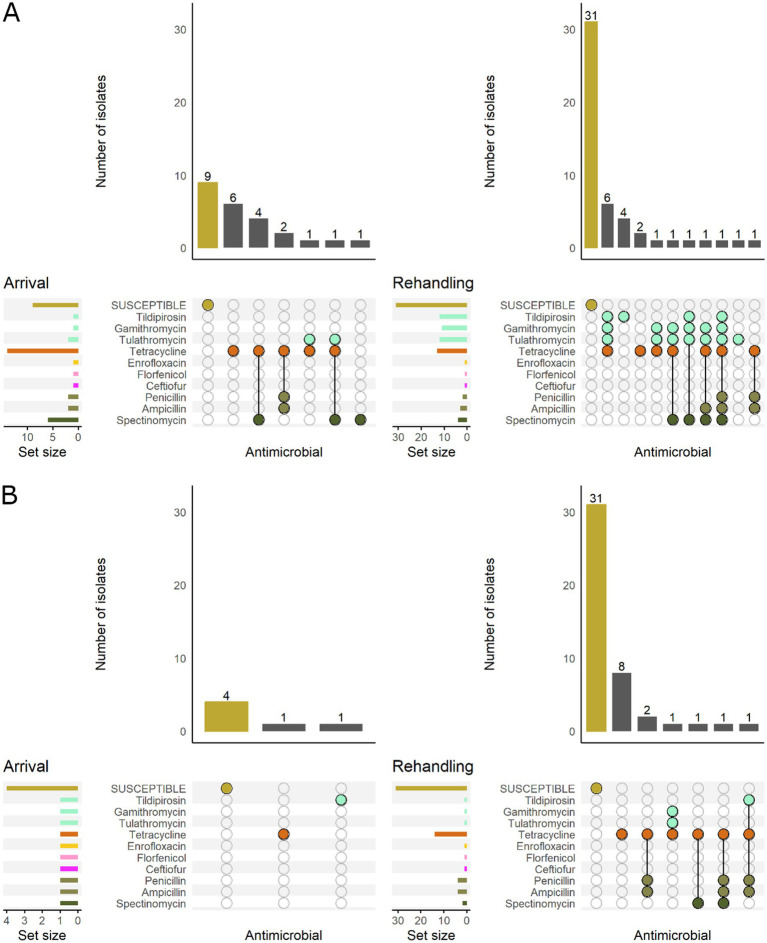
A total of 1,392 cattle within 47 housing groups were sampled over 2 years, providing 625 bacterial isolates for investigation. (27.4%) was the most frequently isolated BRD organism, followed by (9%) and (8.5%). Resistance to ≥3 antimicrobial classes was detected in 2.4% of , 3.4% of , and 21.3% of isolates. Potential associations were investigated between recovery of resistant organisms and time of year at sampling (quarter), sampling timepoint (arrival or second sample), days on feed (DOF) at sampling, animal age categories, and BRD risk categories. There was a significant ( 0.05) increase in resistance prevalence after arrival for macrolide drugs in , and for ampicillin, danofloxacin, enrofloxacin, spectinomycin, gamithromycin, tildipirosin, tulathromycin and tetracycline in isolates. Resistance was higher in calves than in yearlings for tulathromycin in , and for gamithromycin, spectinomycin, tulathromycin, tildipirosin, and tetracycline for ( < 0.05) Resistance to tetracycline, tildipirosin, and tulathromycin decreased between 61-80 DOF and 81-100 DOF when compared to 20-40 DOF, whereas for spectinomycin, resistance was lower in cattle sampled between 61-80 DOF than those sampled at 20-40 DOF for .
The diversity of AMR profiles and associated risk factors between the BRD pathogens studied, underscores the importance of including all three organisms in future AMR studies in beef cattle.
本研究旨在描述2年期间从健康饲养场牛中分离出的[具体细菌名称1]、[具体细菌名称2]和[具体细菌名称3]的抗菌药物耐药性流行情况,并调查与耐药菌株恢复相关的潜在因素。
使用深部保护鼻咽拭子在2个时间点对多个随机选择的饲养场(2019年=21个,2020年=26个)的饲养场牛进行采样。在入栏处理时和饲养期后期,从每个入组的16头牛中采集鼻咽拭子。同一组(不一定是同一头牛)的牛在两个时间点均进行采样。采用肉汤微量稀释法进行药敏试验。
在2年期间,对47个畜舍组中的1392头牛进行了采样,共提供625株细菌分离株用于调查。[具体细菌名称1](27.4%)是最常分离出的牛呼吸道疾病(BRD)病原体,其次是[具体细菌名称2](9%)和[具体细菌名称3](8.5%)。在[具体细菌名称1]分离株中,2.4%对≥3类抗菌药物耐药;在[具体细菌名称2]分离株中,3.4%耐药;在[具体细菌名称3]分离株中,21.3%耐药。调查了耐药菌恢复与采样年份季度、采样时间点(到达时或第二次采样)、采样时的饲养天数(DOF)、动物年龄类别和BRD风险类别之间的潜在关联。对于[具体细菌名称1],大环内酯类药物在到达后耐药率显著(P<0.05)增加;对于[具体细菌名称3]分离株,氨苄西林、达氟沙星、恩诺沙星、壮观霉素、加米霉素、替地罗星、图拉霉素和四环素的耐药率显著增加。对于图拉霉素,[具体细菌名称1]中小牛的耐药率高于一岁牛;对于加米霉素、壮观霉素、图拉霉素、替地罗星和四环素,[具体细菌名称3]中小牛的耐药率更高(P<0.05)。与20-40天饲养天数相比,[具体细菌名称3]在61-80天饲养天数和81-100天饲养天数时对四环素、替地罗星和图拉霉素的耐药率降低;而对于壮观霉素,[具体细菌名称2]在61-80天饲养天数时采样的牛的耐药率低于在20-40天饲养天数时采样的牛。
所研究的BRD病原体之间抗菌药物耐药性谱和相关风险因素的多样性,强调了在未来肉牛抗菌药物耐药性研究中纳入所有三种病原体的重要性。