• 文献检索
  • 文档翻译
  • 深度研究
  • 学术资讯
  • Suppr Zotero 插件Zotero 插件
  • 邀请有礼
  • 套餐&价格
  • 历史记录
应用&插件
Suppr Zotero 插件Zotero 插件浏览器插件Mac 客户端Windows 客户端微信小程序
定价
高级版会员购买积分包购买API积分包
服务
文献检索文档翻译深度研究API 文档MCP 服务
关于我们
关于 Suppr公司介绍联系我们用户协议隐私条款
关注我们

Suppr 超能文献

核心技术专利:CN118964589B侵权必究
粤ICP备2023148730 号-1Suppr @ 2026

文献检索

告别复杂PubMed语法,用中文像聊天一样搜索,搜遍4000万医学文献。AI智能推荐,让科研检索更轻松。

立即免费搜索

文件翻译

保留排版,准确专业,支持PDF/Word/PPT等文件格式,支持 12+语言互译。

免费翻译文档

深度研究

AI帮你快速写综述,25分钟生成高质量综述,智能提取关键信息,辅助科研写作。

立即免费体验

基于开源惯性测量单元(IMU)数据的下肢关节运动学学习估计

Learning based lower limb joint kinematic estimation using open source IMU data.

作者信息

Hur Benjamin, Baek Sunin, Kang Inseung, Kim Daekyum

机构信息

Korea University, School of Mechanical Engineering, 02841, Seoul, South Korea.

Department of Mechanical Engineering, Carnegie Mellon University, Pittsburgh, PA, 15213, USA.

出版信息

Sci Rep. 2025 Feb 12;15(1):5287. doi: 10.1038/s41598-025-89716-4.

DOI:10.1038/s41598-025-89716-4
PMID:39939380
原文链接:https://pmc.ncbi.nlm.nih.gov/articles/PMC11822032/
Abstract

This study introduces a deep learning framework for estimating lower-limb joint kinematics using inertial measurement units (IMUs). While deep learning methods avoid sensor drift, extensive calibration, and complex setup procedures, they require substantial data. To meet this demand, we leveraged an open-source dataset to develop and evaluate three training approaches. The first involved training a model exclusively on data from a single user, resulting in high accuracy for that individual only. The second approach trained a model on data from multiple users to generalize across individuals; however, demonstrated lower accuracy due to variations in gait patterns across users. The third approach added transfer learning to the second, improving estimation accuracy for new users through fine-tuning with a small portion of their data. This model overcame the limitations of the previous methods' dependency on extensive data collection, and achieved comparable performance to inverse kinematics, making it an effective solution for diverse populations. Additionally, our analysis on IMU combinations suggests that IMUs placed on the femur and calcaneus are the best for most cases. This framework not only reduces the need for extensive data collection but also enhances personalized gait analysis, enabling more efficient and accessible applications in both clinical assessments and real-world environments for broader use.

摘要

本研究介绍了一种用于使用惯性测量单元(IMU)估计下肢关节运动学的深度学习框架。虽然深度学习方法避免了传感器漂移、大量校准和复杂的设置程序,但它们需要大量数据。为满足这一需求,我们利用一个开源数据集来开发和评估三种训练方法。第一种方法是仅根据单个用户的数据训练模型,这只会为该个体带来高精度。第二种方法是根据多个用户的数据训练模型,以实现跨个体的泛化;然而,由于不同用户步态模式的差异,其准确性较低。第三种方法是在第二种方法的基础上增加迁移学习,通过使用新用户的一小部分数据进行微调来提高对新用户的估计准确性。该模型克服了先前方法对大量数据收集的依赖,并且实现了与逆运动学相当的性能,使其成为适用于不同人群的有效解决方案。此外,我们对IMU组合的分析表明,在大多数情况下,放置在股骨和跟骨上的IMU是最佳选择。该框架不仅减少了对大量数据收集的需求,还增强了个性化步态分析,从而在临床评估和现实环境中实现更高效、更便捷的应用,以供更广泛地使用。
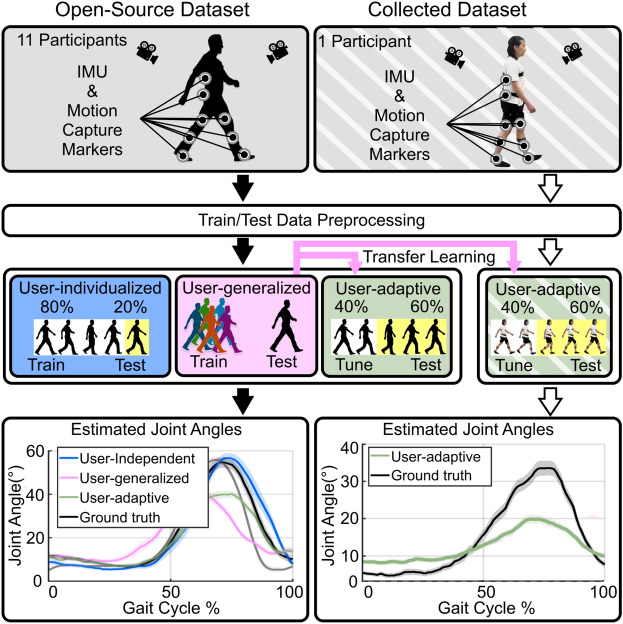
https://cdn.ncbi.nlm.nih.gov/pmc/blobs/e53c/11822032/7c975dfcb824/41598_2025_89716_Fig7_HTML.jpg
https://cdn.ncbi.nlm.nih.gov/pmc/blobs/e53c/11822032/1715777b364d/41598_2025_89716_Fig1_HTML.jpg
https://cdn.ncbi.nlm.nih.gov/pmc/blobs/e53c/11822032/38f360df25c1/41598_2025_89716_Fig2_HTML.jpg
https://cdn.ncbi.nlm.nih.gov/pmc/blobs/e53c/11822032/a6c616dba395/41598_2025_89716_Fig3_HTML.jpg
https://cdn.ncbi.nlm.nih.gov/pmc/blobs/e53c/11822032/c1f6d9392b56/41598_2025_89716_Fig4_HTML.jpg
https://cdn.ncbi.nlm.nih.gov/pmc/blobs/e53c/11822032/bb7e3459b6ed/41598_2025_89716_Fig5_HTML.jpg
https://cdn.ncbi.nlm.nih.gov/pmc/blobs/e53c/11822032/94f961188b20/41598_2025_89716_Fig6_HTML.jpg
https://cdn.ncbi.nlm.nih.gov/pmc/blobs/e53c/11822032/7c975dfcb824/41598_2025_89716_Fig7_HTML.jpg
https://cdn.ncbi.nlm.nih.gov/pmc/blobs/e53c/11822032/1715777b364d/41598_2025_89716_Fig1_HTML.jpg
https://cdn.ncbi.nlm.nih.gov/pmc/blobs/e53c/11822032/38f360df25c1/41598_2025_89716_Fig2_HTML.jpg
https://cdn.ncbi.nlm.nih.gov/pmc/blobs/e53c/11822032/a6c616dba395/41598_2025_89716_Fig3_HTML.jpg
https://cdn.ncbi.nlm.nih.gov/pmc/blobs/e53c/11822032/c1f6d9392b56/41598_2025_89716_Fig4_HTML.jpg
https://cdn.ncbi.nlm.nih.gov/pmc/blobs/e53c/11822032/bb7e3459b6ed/41598_2025_89716_Fig5_HTML.jpg
https://cdn.ncbi.nlm.nih.gov/pmc/blobs/e53c/11822032/94f961188b20/41598_2025_89716_Fig6_HTML.jpg
https://cdn.ncbi.nlm.nih.gov/pmc/blobs/e53c/11822032/7c975dfcb824/41598_2025_89716_Fig7_HTML.jpg

相似文献

1
Learning based lower limb joint kinematic estimation using open source IMU data.基于开源惯性测量单元(IMU)数据的下肢关节运动学学习估计
Sci Rep. 2025 Feb 12;15(1):5287. doi: 10.1038/s41598-025-89716-4.
2
A machine learning approach to real-time calculation of joint angles during walking and running using self-placed inertial measurement units.一种使用自行放置的惯性测量单元对步行和跑步过程中的关节角度进行实时计算的机器学习方法。
Gait Posture. 2025 May;118:85-91. doi: 10.1016/j.gaitpost.2025.01.028. Epub 2025 Jan 26.
3
Optimal control simulations tracking wearable sensor signals provide comparable running gait kinematics to marker-based motion capture.跟踪可穿戴传感器信号的最优控制模拟可提供与基于标记的运动捕捉相当的跑步步态运动学。
PeerJ. 2025 Mar 6;13:e19035. doi: 10.7717/peerj.19035. eCollection 2025.
4
Optimization of IMU Sensor Placement for the Measurement of Lower Limb Joint Kinematics.优化 IMU 传感器放置位置以测量下肢关节运动学。
Sensors (Basel). 2020 Oct 22;20(21):5993. doi: 10.3390/s20215993.
5
Estimation of Ankle Joint Power during Walking Using Two Inertial Sensors.使用两个惯性传感器估算行走时踝关节的功率。
Sensors (Basel). 2019 Jun 21;19(12):2796. doi: 10.3390/s19122796.
6
The Use of Synthetic IMU Signals in the Training of Deep Learning Models Significantly Improves the Accuracy of Joint Kinematic Predictions.在深度学习模型的训练中使用合成 IMU 信号可显著提高关节运动学预测的准确性。
Sensors (Basel). 2021 Aug 31;21(17):5876. doi: 10.3390/s21175876.
7
Estimating Lower Extremity Running Gait Kinematics with a Single Accelerometer: A Deep Learning Approach.利用单个加速度计估计下肢跑步步态运动学:深度学习方法。
Sensors (Basel). 2020 May 22;20(10):2939. doi: 10.3390/s20102939.
8
OpenSense: An open-source toolbox for inertial-measurement-unit-based measurement of lower extremity kinematics over long durations.OpenSense:一个基于惯性测量单元的开源工具包,用于长时间测量下肢运动学。
J Neuroeng Rehabil. 2022 Feb 20;19(1):22. doi: 10.1186/s12984-022-01001-x.
9
Lower body kinematics estimation from wearable sensors for walking and running: A deep learning approach.基于可穿戴传感器的步行和跑步下肢运动学估计:深度学习方法。
Gait Posture. 2021 Jan;83:185-193. doi: 10.1016/j.gaitpost.2020.10.026. Epub 2020 Oct 27.
10
Estimation of Lower Limb Joint Angles and Joint Moments during Different Locomotive Activities Using the Inertial Measurement Units and a Hybrid Deep Learning Model.基于惯性测量单元和混合深度学习模型估计不同运动活动时下肢关节角度和关节力矩。
Sensors (Basel). 2023 Nov 8;23(22):9039. doi: 10.3390/s23229039.

引用本文的文献

1
Multi-Modal Sensing for Propulsion Estimation in People Post-Stroke Across Speeds.用于中风后人群不同速度下推进力估计的多模态传感
IEEE Trans Neural Syst Rehabil Eng. 2025;33:2273-2285. doi: 10.1109/TNSRE.2025.3577961.
2
Use of Technologies for the Acquisition and Processing Strategies for Motion Data Analysis.用于运动数据分析的采集与处理策略的技术应用
Biomimetics (Basel). 2025 May 20;10(5):339. doi: 10.3390/biomimetics10050339.
3
Learning-based 3D human kinematics estimation using behavioral constraints from activity classification.

本文引用的文献

1
3D Knee and Hip Angle Estimation With Reduced Wearable IMUs via Transfer Learning During Yoga, Golf, Swimming, Badminton, and Dance.基于迁移学习的可穿戴 IMU 减少磨损的瑜伽、高尔夫、游泳、羽毛球和舞蹈中的 3D 膝关节和髋关节角度估计。
IEEE Trans Neural Syst Rehabil Eng. 2024;32:325-338. doi: 10.1109/TNSRE.2024.3349639.
2
A human lower-limb biomechanics and wearable sensors dataset during cyclic and non-cyclic activities.一个关于人体下肢在周期性和非周期性活动期间的生物力学及可穿戴传感器的数据集。
Sci Data. 2023 Dec 21;10(1):924. doi: 10.1038/s41597-023-02840-6.
3
High-density EMG, IMU, kinetic, and kinematic open-source data for comprehensive locomotion activities.
基于学习的三维人体运动学估计,利用活动分类中的行为约束条件。
Nat Commun. 2025 Apr 11;16(1):3454. doi: 10.1038/s41467-025-58624-6.
高密度肌电图、惯性测量单元、动力学和运动学的开源数据,用于全面的运动活动。
Sci Data. 2023 Nov 10;10(1):789. doi: 10.1038/s41597-023-02679-x.
4
OpenCap: Human movement dynamics from smartphone videos.OpenCap:从智能手机视频中获取人类运动动力学。
PLoS Comput Biol. 2023 Oct 19;19(10):e1011462. doi: 10.1371/journal.pcbi.1011462. eCollection 2023 Oct.
5
Challenges and advances in the use of wearable sensors for lower extremity biomechanics.可穿戴传感器在下肢生物力学中应用的挑战与进展。
J Biomech. 2023 Aug;157:111714. doi: 10.1016/j.jbiomech.2023.111714. Epub 2023 Jul 4.
6
Design and evaluation of an independent 4-week, exosuit-assisted, post-stroke community walking program.独立的 4 周、外骨骼辅助、中风后社区行走计划的设计和评估。
Ann N Y Acad Sci. 2023 Jul;1525(1):147-159. doi: 10.1111/nyas.14998. Epub 2023 May 30.
7
A diverse and multi-modal gait dataset of indoor and outdoor walks acquired using multiple cameras and sensors.一个使用多种摄像机和传感器获取的室内和室外行走的多样化和多模态步态数据集。
Sci Data. 2023 May 26;10(1):320. doi: 10.1038/s41597-023-02161-8.
8
Open-source software library for real-time inertial measurement unit data-based inverse kinematics using OpenSim.基于 OpenSim 使用实时惯性测量单元数据的反向运动学的开源软件库。
PeerJ. 2023 Apr 5;11:e15097. doi: 10.7717/peerj.15097. eCollection 2023.
9
A comparison of machine learning models' accuracy in predicting lower-limb joints' kinematics, kinetics, and muscle forces from wearable sensors.比较机器学习模型从可穿戴传感器预测下肢关节运动学、动力学和肌肉力量的准确性。
Sci Rep. 2023 Mar 28;13(1):5046. doi: 10.1038/s41598-023-31906-z.
10
Wearable Sensor Systems for Fall Risk Assessment: A Review.用于跌倒风险评估的可穿戴传感器系统:综述
Front Digit Health. 2022 Jul 14;4:921506. doi: 10.3389/fdgth.2022.921506. eCollection 2022.