Piedimonte Sabrina, Mohamed Mariam, Rosa Gabriela, Gerstl Brigit, Vicus Danielle
Division of Gynecologic Oncology, Hospital Maisonneuve Rosemont, University of Montreal, Montreal, QC H3T 1J4, Canada.
Faculty of Medicine, University of Montreal, Montreal, QC H3T 1J4, Canada.
Cancers (Basel). 2025 Jan 21;17(3):336. doi: 10.3390/cancers17030336.
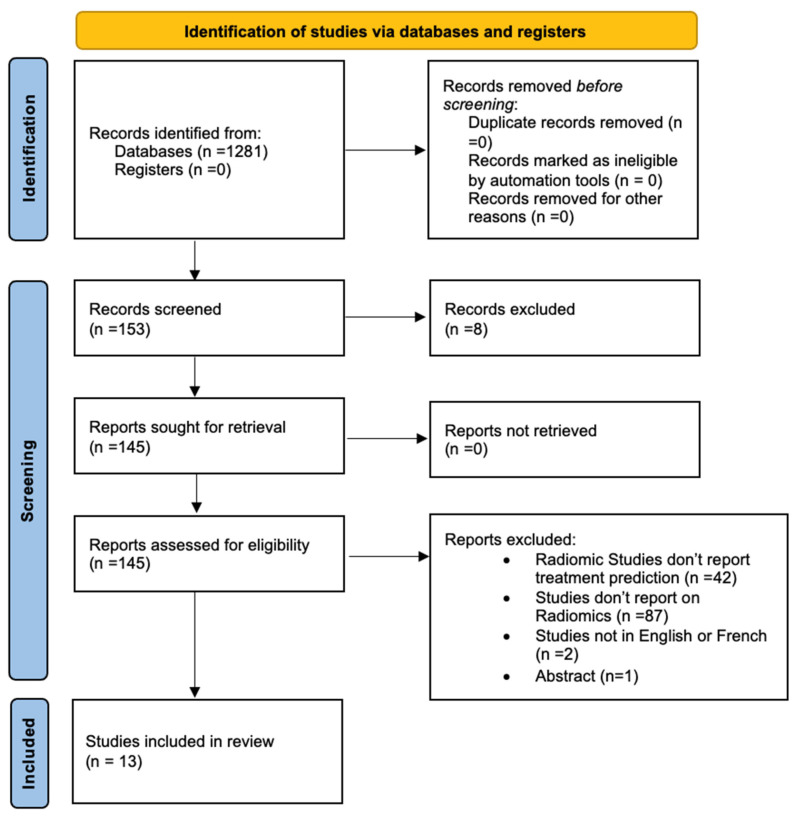
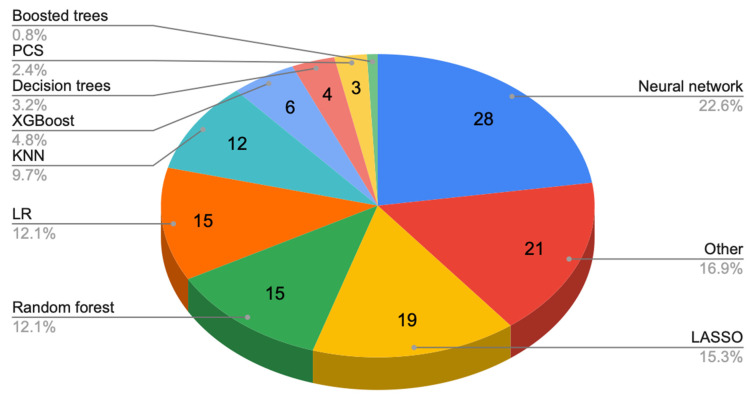
Machine learning and radiomics (ML/RM) are gaining interest in ovarian cancer (OC) but only a few studies have used these methods to predict treatment response. The objective of this study was to review the literature on the applications of ML/RM in OC assessments, specifically focusing on studies describing algorithms to predict treatment response and survival. This is a systematic review of the published literature from January 1985 to December 2023 on the use of ML/RM in OC An extensive search of electronic library databases was conducted. Two independent reviewers screened the articles initially by title then by full text. Quality was assessed using the MINORS criteria. -values were generated using the Pearson's Chi-squared (x) test to compare the performances of ML/RM models with traditional statistics. Of the 5576 screened articles, 225 studies were included. Between 2021 and 2023, 49 studies were published, highlighting the rapidly growing interest in ML/RM. Median-quality scores using the MINORS scale were similar between studies published between 1985-2021 and 2021-2023 (both 8). Neural Networks (22.6%) and LASSO (15.3%) were the most common ML/RM algorithms in OC. Among these studies, 13 focused specifically on prediction of treatment response using radiomics. A total of 5113 patients were analyzed. The most common algorithms were Random Forest (4/13) followed by Neural Networks (3/13) and Support Vectors (3/13). Radiomic analysis was used to predict response to neoadjuvant chemotherapy in seven studies, with a median AUC of 0.77 (range 0.72-0.93), while the median AUC was 0.82 (range 0.77-0.89) in the six studies assessing the prediction of optimal or complete cytoreduction. Median model accuracy reported in 7/13 studies was 73% (range 66-98%). Additionally, four studies investigated the use of ML/RM for survival prediction for OC. The XGBoost model had 80.9% accuracy in predicting 5-year survival compared to linear regression, which achieved 79% accuracy. The Random Forest model has 93.7% accuracy in predicting 12-month progression-free survival, compared to 82% for linear regression. In conclusion, we found that the use of ML/RM algorithms is becoming a more frequent method to predict responses to treatment of OC. These models should be validated in a prospective multicenter trial prior to integration into clinical use.
机器学习和放射组学(ML/RM)在卵巢癌(OC)领域正逐渐受到关注,但仅有少数研究使用这些方法来预测治疗反应。本研究的目的是回顾关于ML/RM在OC评估中的应用的文献,特别关注描述预测治疗反应和生存的算法的研究。这是一项对1985年1月至2023年12月发表的关于在OC中使用ML/RM的文献的系统综述。我们对电子图书馆数据库进行了广泛搜索。两名独立评审员首先按标题然后按全文筛选文章。使用MINORS标准评估质量。使用Pearson卡方(x)检验生成P值,以比较ML/RM模型与传统统计方法的性能。在筛选的5576篇文章中,纳入了225项研究。在2021年至2023年期间,发表了49项研究,突出了对ML/RM的兴趣迅速增长。1985 - 2021年和2021 - 2023年发表的研究之间,使用MINORS量表的中位质量得分相似(均为8分)。神经网络(22.6%)和LASSO(15.3%)是OC中最常见的ML/RM算法。在这些研究中,有13项专门关注使用放射组学预测治疗反应。共分析了5113名患者。最常见的算法是随机森林(4/13),其次是神经网络(3/13)和支持向量(3/13)。在七项研究中,放射组学分析用于预测新辅助化疗的反应,中位AUC为0.77(范围0.72 - 0.93),而在评估最佳或完全细胞减灭术预测的六项研究中,中位AUC为0.82(范围0.77 - 0.89)。13项研究中有7项报告的中位模型准确率为73%(范围66 - 98%)。此外,四项研究调查了ML/RM在OC生存预测中的应用。与线性回归相比,XGBoost模型在预测5年生存方面的准确率为80.9%,线性回归的准确率为79%。随机森林模型在预测12个月无进展生存方面的准确率为93.7%,而线性回归为82%。总之,我们发现使用ML/RM算法正成为预测OC治疗反应的一种更常用方法。在整合到临床应用之前,这些模型应在前瞻性多中心试验中进行验证。