Department of Oncology, University of Cambridge, Cambridge, UK.
Cancer Research UK Cambridge Centre, University of Cambridge, Cambridge, UK.
Nat Commun. 2023 Oct 24;14(1):6756. doi: 10.1038/s41467-023-41820-7.
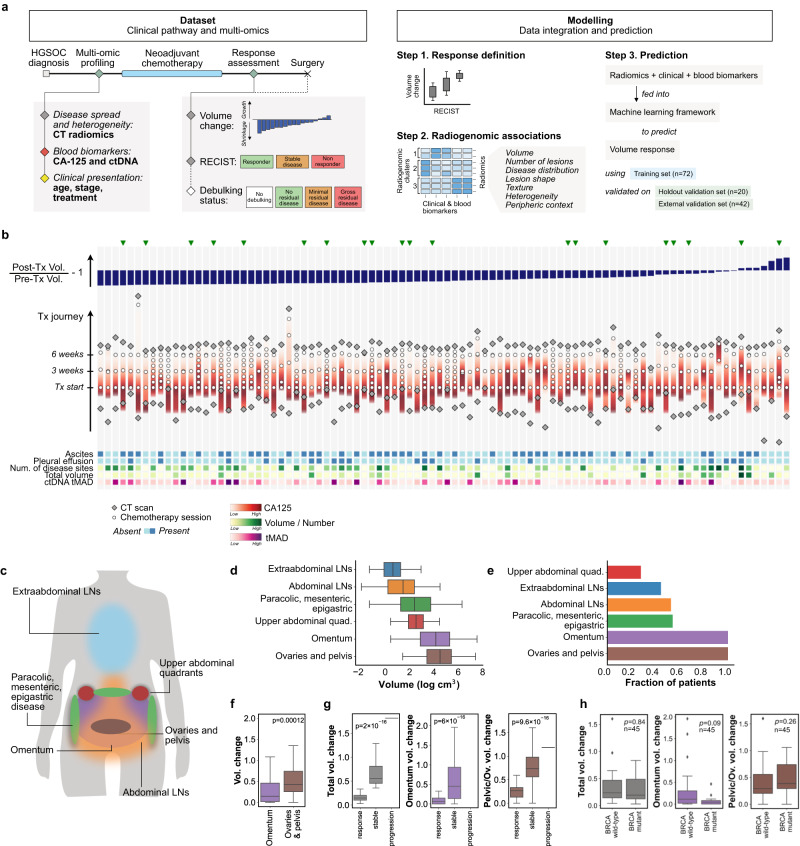
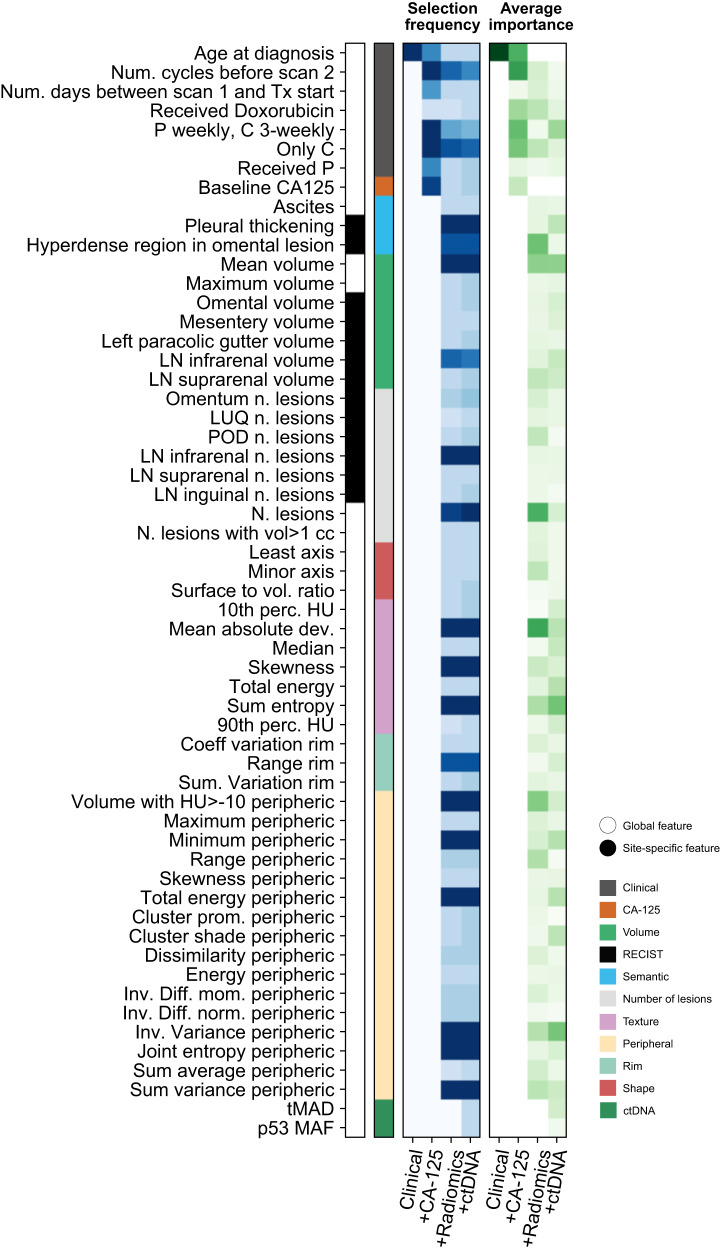
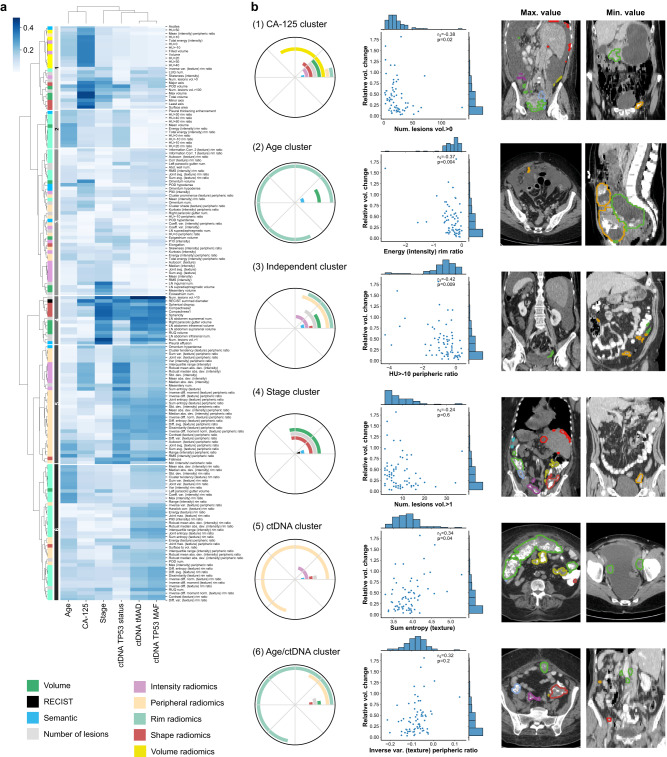
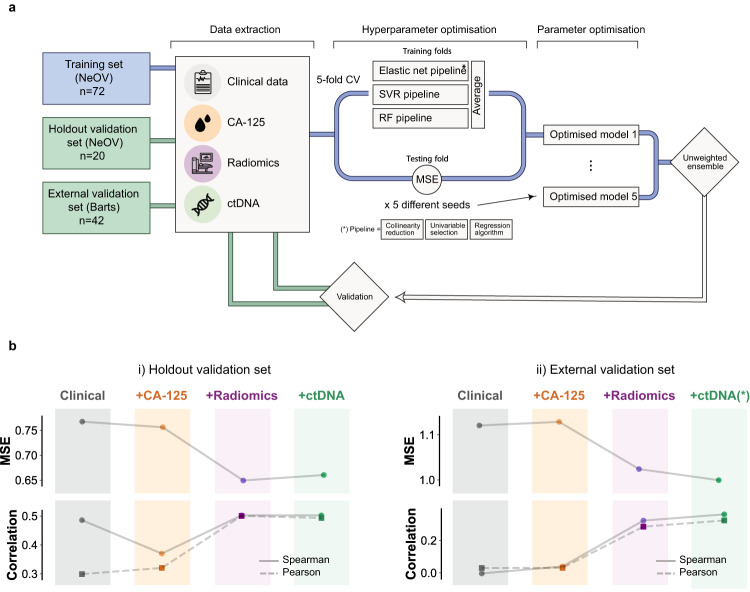
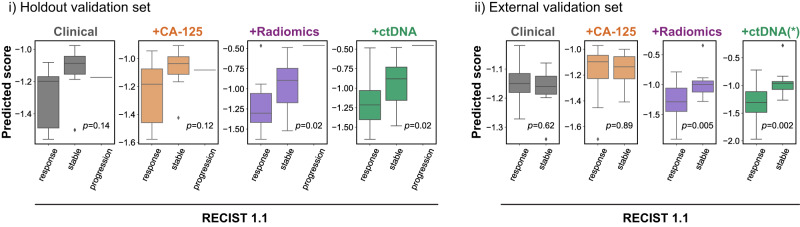
High grade serous ovarian carcinoma (HGSOC) is a highly heterogeneous disease that typically presents at an advanced, metastatic state. The multi-scale complexity of HGSOC is a major obstacle to predicting response to neoadjuvant chemotherapy (NACT) and understanding critical determinants of response. Here we present a framework to predict the response of HGSOC patients to NACT integrating baseline clinical, blood-based, and radiomic biomarkers extracted from all primary and metastatic lesions. We use an ensemble machine learning model trained to predict the change in total disease volume using data obtained at diagnosis (n = 72). The model is validated in an internal hold-out cohort (n = 20) and an independent external patient cohort (n = 42). In the external cohort the integrated radiomics model reduces the prediction error by 8% with respect to the clinical model, achieving an AUC of 0.78 for RECIST 1.1 classification compared to 0.47 for the clinical model. Our results emphasize the value of including radiomics data in integrative models of treatment response and provide methods for developing new biomarker-based clinical trials of NACT in HGSOC.
高级别浆液性卵巢癌(HGSOC)是一种高度异质性疾病,通常在晚期转移阶段出现。HGSOC 的多尺度复杂性是预测新辅助化疗(NACT)反应和理解反应关键决定因素的主要障碍。在这里,我们提出了一个框架,通过整合从所有原发和转移病灶中提取的基线临床、基于血液和放射组学生物标志物,来预测 HGSOC 患者对 NACT 的反应。我们使用一种集成机器学习模型,该模型经过训练可以使用诊断时获得的数据来预测总疾病体积的变化(n=72)。该模型在内部保留队列(n=20)和独立的外部患者队列(n=42)中进行验证。在外部队列中,与临床模型相比,集成放射组学模型将预测误差降低了 8%,实现了 RECIST 1.1 分类的 AUC 为 0.78,而临床模型为 0.47。我们的研究结果强调了在治疗反应的综合模型中纳入放射组学数据的价值,并为开发新的基于生物标志物的 HGSOC NACT 临床试验提供了方法。