Savolainen Eero H J, Ihalainen Johanna K, Walker Simon
Faculty of Sport and Health Sciences, University of Jyväskylä, Jyväskylä, Finland.
Finnish Institute of High Performance Sport KIHU, Jyväskylä, Finland.
J Hum Kinet. 2024 Dec 6;95:187-198. doi: 10.5114/jhk/189657. eCollection 2025 Jan.
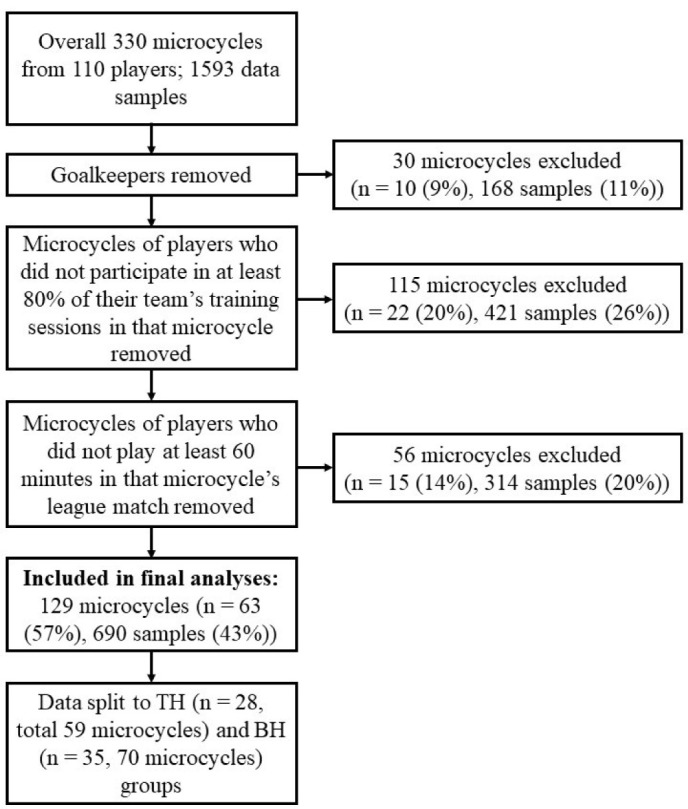
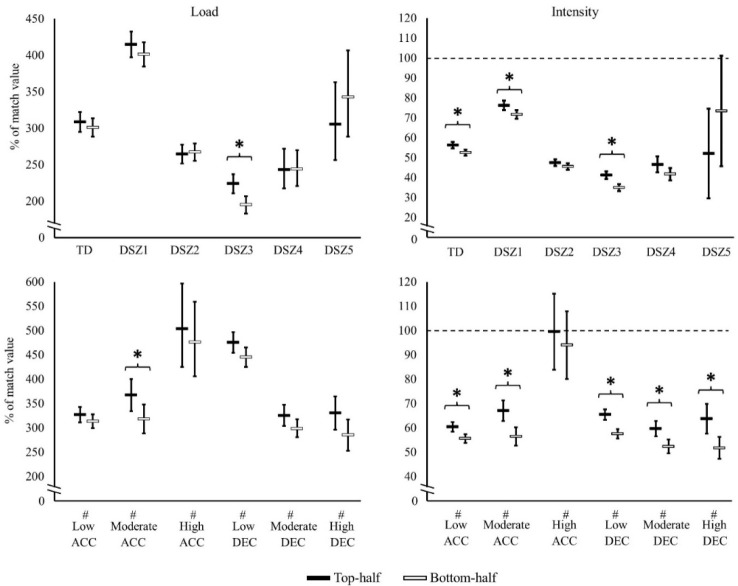
This study aimed to (1) quantify national-level female soccer players' accumulated microcycle (weekly) training load (accumulated absolute value) and intensity (value relative to duration), (2) investigate possible differences in training load and intensity between teams in the league's top- and bottom-half. Sixty-three females from six teams in the highest league participated in the study. Participants were divided into top-half (TH, n = 28) and bottom-half (BH, n = 35) groups based on their team's league ranking. Players' external and internal training load and intensity were monitored in all on-field training sessions and league matches during a three-week observation period (690 data samples) using the Polar Team Pro system. There were no differences between groups in the number of weekly training sessions or total duration. Accumulated external and internal load were highly similar between groups. Instead, the TH group reached significantly higher values than the BH group in multiple external intensity variables, such as total distance per minute and the number of low-, moderate- and high-intensity accelerations per minute (p = 0.004-0.001). There were no differences in the mean heart rate between groups. The TH group's training external intensity was also closer to match intensity in multiple variables, such as total distance and the number of low- and moderate-intensity accelerations and decelerations compared to the BH group (p = 0.029-0.001). These findings suggest that more successful teams achieved higher external intensity for the same internal response, and their average external training intensity was closer to match demands. Thus, it seems plausible that TH players had better physical qualities and their training prepared them better for matches than BH.
(1)量化国家级女子足球运动员累积的微周期(每周)训练负荷(累积绝对值)和强度(相对于持续时间的值);(2)调查联赛上半区和下半区球队之间训练负荷和强度的可能差异。来自最高级别联赛中6支球队的63名女性参与了本研究。根据球队的联赛排名,参与者被分为上半区(TH,n = 28)和下半区(BH,n = 35)两组。在为期三周的观察期(690个数据样本)内,使用Polar Team Pro系统对球员在所有场上训练课程和联赛比赛中的外部和内部训练负荷及强度进行监测。两组之间每周训练课程的数量或总时长没有差异。两组之间累积的外部和内部负荷高度相似。相反,在多个外部强度变量方面,如每分钟总距离以及每分钟低、中、高强度加速次数,TH组的值显著高于BH组(p = 0.004 - 0.001)。两组之间平均心率没有差异。与BH组相比,TH组在多个变量方面的训练外部强度也更接近比赛强度,如总距离以及低、中等强度加速和减速次数(p = 0.029 - 0.001)。这些发现表明,更成功的球队在相同的内部反应下实现了更高的外部强度,并且他们的平均外部训练强度更接近比赛要求。因此,TH组球员似乎具有更好的身体素质,并且他们的训练比BH组球员更能让他们为比赛做好准备,这似乎是合理的。