Symeou Loizos, Louca Loucas, Kavadella Argyro, Mackay James, Danidou Yianna, Raffay Violetta
European University Cyprus, Nicosia, Cyprus.
Eur J Dent Educ. 2025 May;29(2):285-303. doi: 10.1111/eje.13069. Epub 2025 Feb 13.
The introduction highlights the transformative impact of generative artificial intelligence (GenAI) on higher education (HE), emphasising its potential to enhance student learning and instructor efficiency while also addressing significant challenges such as accuracy, privacy, and ethical concerns. By exploring the benefits and risks of AI integration, the introduction underscores the urgent need for evidence-based, inclusive, and adaptable frameworks to guide universities in leveraging GenAI responsibly and effectively in academic environments.
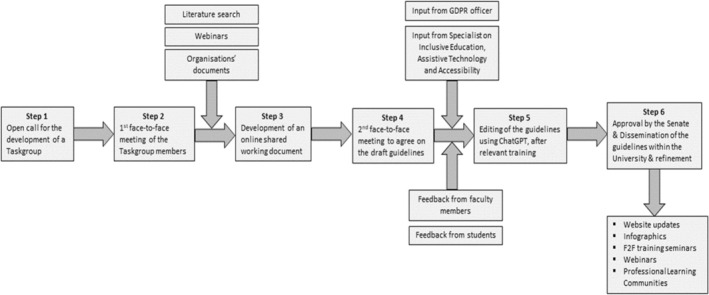
This paper presents a comprehensive process for developing cross-disciplinary and consensus-based guidelines, based on the latest evidence for the integration of GenAI at European University Cyprus (EUC). In response to the rapid adoption of AI tools such as LLMs in HE, a task group at EUC created a structured framework to guide the ethical and effective use of GenAI in academia, one that was intended to be flexible enough to incorporate new developments and not infringe on instructors' academic freedoms, while also addressing ethical and practical concerns.
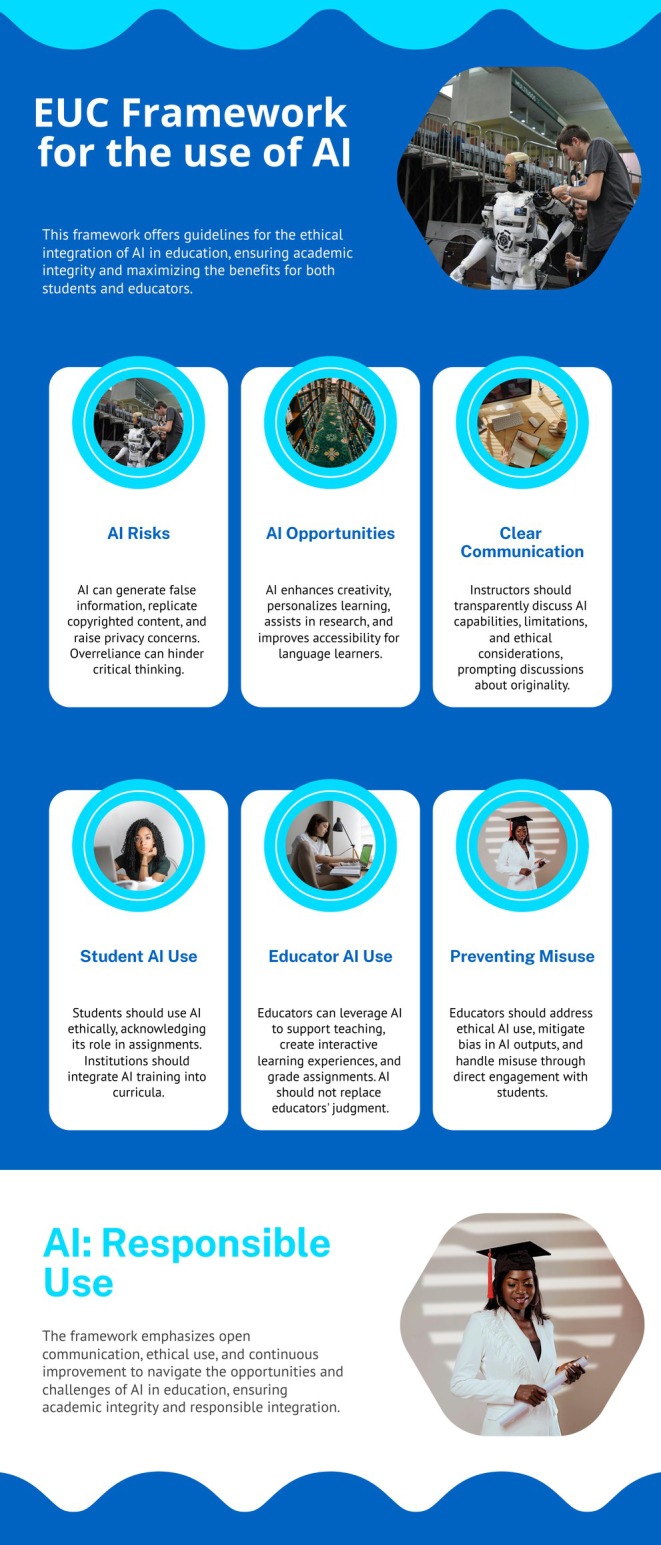
The framework development was informed by extensive literature reviews and consultations. Key pillars of the framework include: addressing the risks and opportunities presented by GenAI; promoting transparent communication; ensuring responsible use by students and educators; safeguarding academic integrity. The guidelines emphasise the balance between, on the one hand, leveraging AI to enhance educational experiences, and, on the other maintaining critical thinking and originality. The framework also includes practical recommendations for AI usage, classroom integration, and policy formulation, ensuring that AI augments rather than replaces human judgement in educational settings.
The iterative development process, including the use of GenAI tools for refining the guidelines, illustrates a hands-on approach to AI adoption in HE, and the resulting guidelines may serve as a model for other higher education institutions (HEIs) aiming to integrate AI tools while upholding educational quality and ethical standards.
引言部分强调了生成式人工智能(GenAI)对高等教育(HE)的变革性影响,着重指出其在提升学生学习效果和教师效率方面的潜力,同时也应对准确性、隐私和伦理问题等重大挑战。通过探讨人工智能整合的益处和风险,引言强调迫切需要基于证据、具有包容性且适应性强的框架,以指导大学在学术环境中负责任且有效地利用GenAI。
本文提出了一个全面的流程,用于制定基于塞浦路斯欧洲大学(EUC)整合GenAI的最新证据的跨学科且基于共识的指导方针。鉴于高等教育中诸如大语言模型等人工智能工具的迅速采用,EUC的一个任务组创建了一个结构化框架,以指导在学术界道德且有效地使用GenAI,该框架旨在足够灵活以纳入新发展且不侵犯教师的学术自由,同时也解决伦理和实际问题。
框架的制定参考了广泛的文献综述和咨询意见。该框架的关键支柱包括:应对GenAI带来的风险和机遇;促进透明沟通;确保学生和教育工作者的负责任使用;维护学术诚信。这些指导方针强调一方面利用人工智能提升教育体验,另一方面保持批判性思维和原创性之间的平衡。该框架还包括关于人工智能使用、课堂整合和政策制定的实际建议,确保在教育环境中人工智能增强而非取代人类判断。
迭代开发过程,包括使用GenAI工具来完善指导方针,展示了高等教育中采用人工智能的一种实践方法,由此产生的指导方针可能为其他旨在在坚持教育质量和伦理标准的同时整合人工智能工具的高等教育机构(HEIs)提供一个范例。