Yu Yuhua, Krebs Lindsay, Beeman Mark, Lai Vicky T
Department of Psychology, Northwestern University, Evanston, Illinois, USA.
Department of Psychology, University of Arizona, Tucson, Arizona, USA.
Psychophysiology. 2025 Feb;62(2):e70023. doi: 10.1111/psyp.70023.
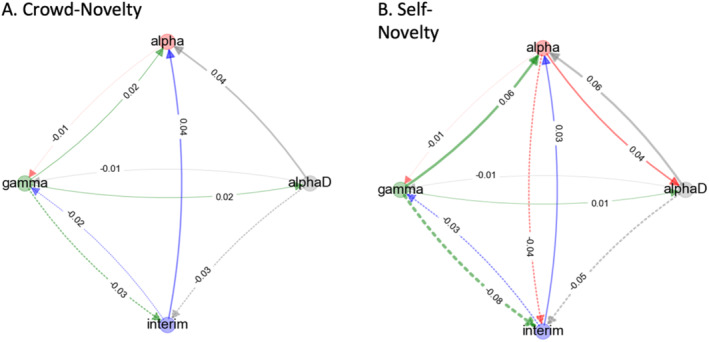
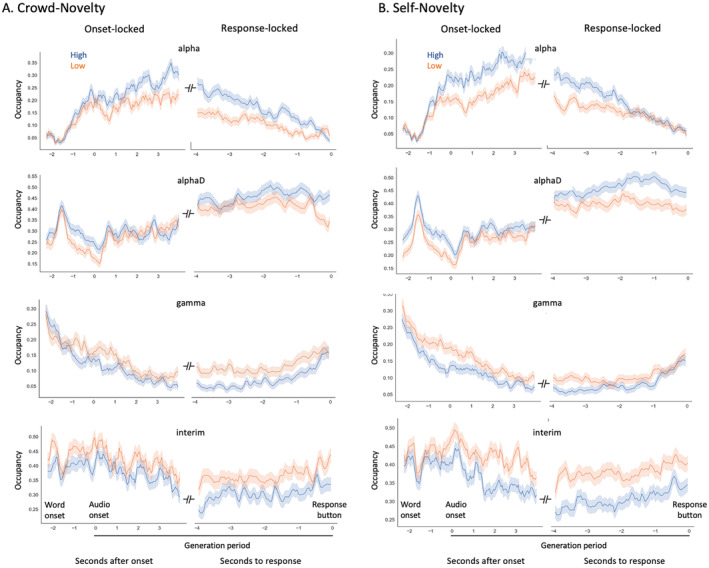
We investigated the oscillatory brain processes while people generated metaphors for science concepts. Applying a hidden Markov model, we extracted brain states, representing temporally disentangled oscillatory processes, from EEG data. By associating the trial-by-trial occupancy of brain states with the creative quality, novelty, and aptness of the generated metaphors, we identified oscillatory processes that played a role in creative ideation in a data-driven manner. Metaphor novelty was positively associated with occupancy in a state featuring widespread alpha-band synchronization during the early trial stage and occupancy in a state featuring alpha-band desynchronization during the later trial stage. In addition, metaphor novelty was negatively associated with gamma-band power. Our results not only extend previous literature on the role of oscillatory processes in creative ideation but also highlight the importance of temporal dynamics in understanding the brain mechanisms during sustained cognitive task performance.
我们研究了人们为科学概念生成隐喻时大脑的振荡过程。应用隐马尔可夫模型,我们从脑电图(EEG)数据中提取了代表时间上解缠的振荡过程的脑状态。通过将脑状态的逐次试验占有率与所生成隐喻的创造性质量、新颖性和恰当性相关联,我们以数据驱动的方式识别出了在创造性构思中发挥作用的振荡过程。隐喻新颖性与早期试验阶段广泛α波段同步特征状态的占有率以及后期试验阶段α波段去同步特征状态的占有率呈正相关。此外,隐喻新颖性与γ波段功率呈负相关。我们的结果不仅扩展了以往关于振荡过程在创造性构思中作用的文献,还强调了时间动态在理解持续认知任务执行过程中的大脑机制方面的重要性。