Rominger Christian, Papousek Ilona, Perchtold Corinna M, Benedek Mathias, Weiss Elisabeth M, Schwerdtfeger Andreas, Fink Andreas
Department of Psychology, University of Graz, Univ.-Platz 2, A-8010, Graz, Austria.
Cogn Affect Behav Neurosci. 2019 Aug;19(4):1012-1021. doi: 10.3758/s13415-019-00699-y.
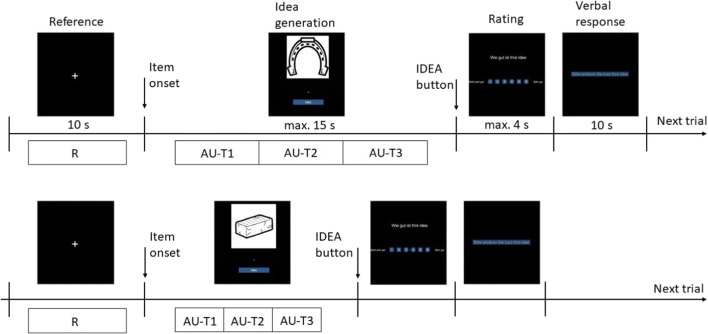
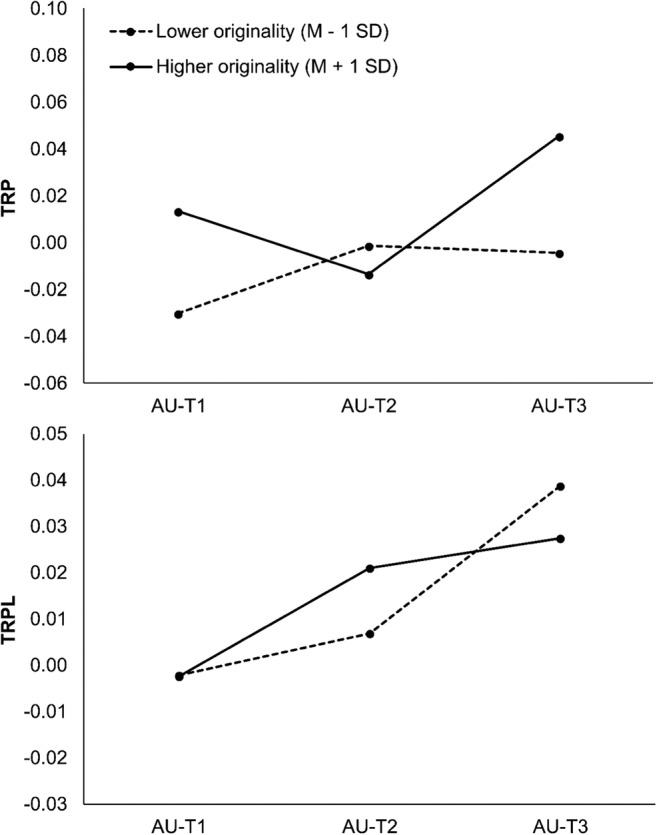
Although there exists increasing knowledge about brain correlates underlying creative ideation in general, the specific neurocognitive mechanisms implicated in different stages of the creative thinking process are still under-researched. Some recent EEG studies suggested that alpha power during creative ideation varies as a function of time, with the highest levels of alpha power after stimulus onset and at the end of the creative thinking process. The main aim of the present study was to replicate and extend this finding by applying an individual differences approach, and by investigating functional coupling between long distance cortical sites during the process of creative ideation. Eighty-six participants performed the Alternate Uses (AU) task during EEG assessment. Results revealed that more original people showed increased alpha power after stimulus onset and before finalizing the process of idea generation. This U-shaped alpha power pattern was accompanied by an early increase in functional communication between frontal and parietal-occipital sites during the creative thinking process, putatively indicating activation of top-down executive control processes. Participants with lower originality showed no significant time-related variation in alpha power and a delayed increase in long distance functional communication. These findings are in line with dual process models of creative ideation and support the idea that increased alpha power at the beginning of the creative ideation process may indicate more associative modes of thinking and memory processes, while the alpha increases at later stages may indicate executive control processes, associated with idea elaboration/evaluation.
尽管人们对一般创造性思维背后的大脑关联的认识日益增加,但创造性思维过程不同阶段所涉及的具体神经认知机制仍未得到充分研究。最近的一些脑电图研究表明,创造性思维过程中的阿尔法波功率随时间变化,在刺激开始后和创造性思维过程结束时阿尔法波功率水平最高。本研究的主要目的是通过采用个体差异方法,并研究创造性思维过程中远距离皮质部位之间的功能耦合,来复制和扩展这一发现。八十六名参与者在脑电图评估期间执行了替代用途(AU)任务。结果显示,更具创造性的人在刺激开始后和想法产生过程结束前阿尔法波功率增加。这种U形阿尔法波功率模式伴随着创造性思维过程中额叶与顶枕叶部位之间功能交流的早期增加,推测这表明自上而下的执行控制过程被激活。创造性较低的参与者在阿尔法波功率方面没有显著的时间相关变化,且远距离功能交流的增加出现延迟。这些发现与创造性思维的双过程模型一致,并支持这样一种观点,即创造性思维过程开始时阿尔法波功率增加可能表明更多的联想思维和记忆过程模式,而后期阿尔法波增加可能表明与想法细化/评估相关的执行控制过程。