Department of Psychology, Northwestern University.
Department of Psychology, University of Arizona.
Cogn Sci. 2024 Aug;48(8):e13488. doi: 10.1111/cogs.13488.
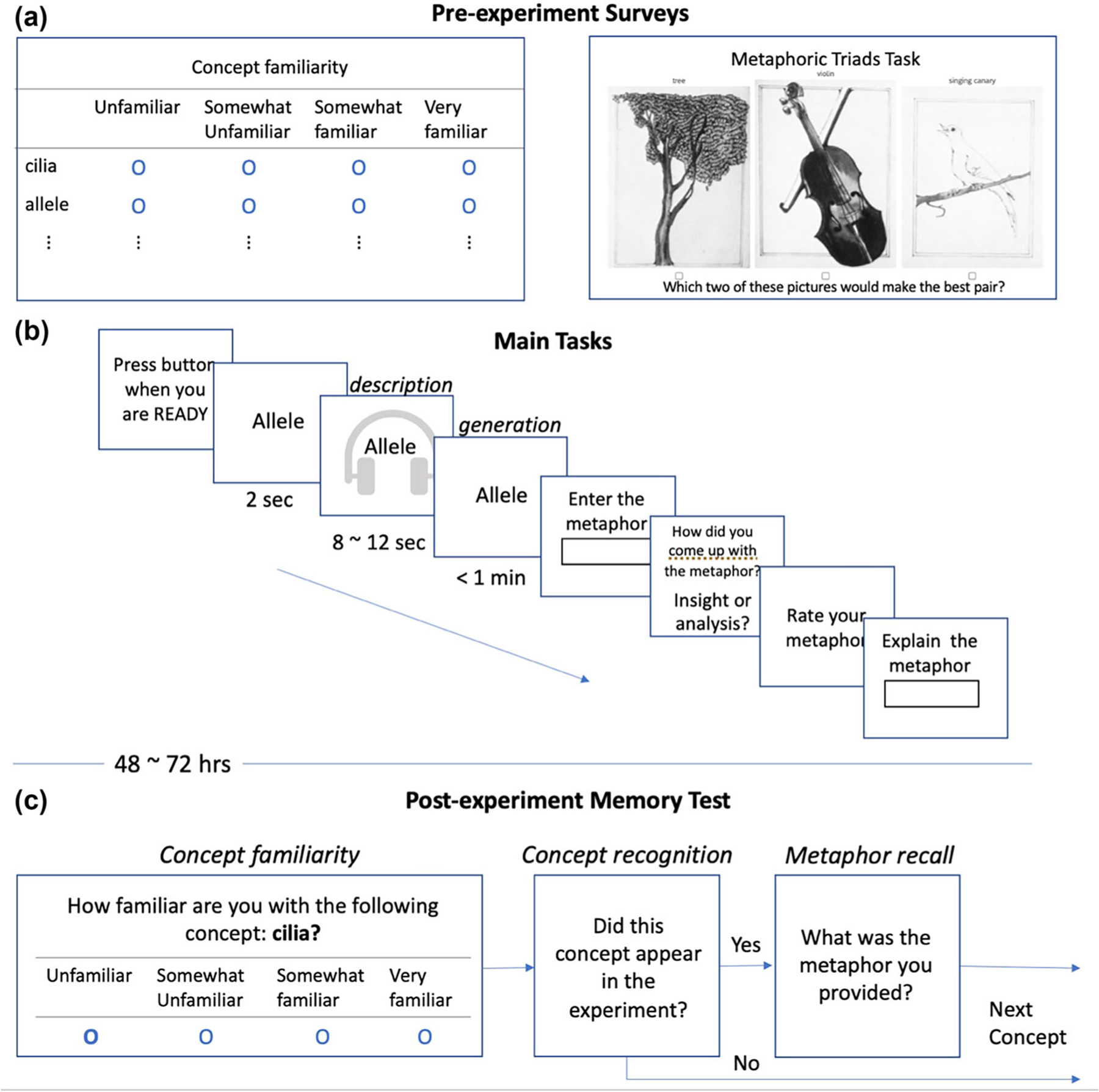
Metaphor generation is both a creative act and a means of learning. When learning a new concept, people often create a metaphor to connect the new concept to existing knowledge. Does the manner in which people generate a metaphor, via sudden insight (Aha! moment) or deliberate analysis, influence the quality of generation and subsequent learning outcomes? According to some research, deliberate processing enhances knowledge retention; hence, generation via analysis likely leads to better concept learning. However, other research has shown that solutions generated via insight are better remembered. In the current study, participants were presented with science concepts and descriptions, then generated metaphors for the concepts. They also indicated how they generated each metaphor and rated their metaphor for novelty and aptness. We assessed participants' learning outcomes with a memory test and evaluated the creative quality of the metaphors based on self- and crowd-sourced ratings. Consistent with the deliberate processing benefit, participants became more familiar with the target science concept if they previously generated a metaphor for the concept via analysis compared to via insight. We also found that metaphors generated via analysis did not differ from metaphors generated via insight in quality (aptness or novelty) nor in how well they were remembered. However, participants' self-evaluations of metaphors generated via insight showed more agreement with independent raters, suggesting the role of insight in modulating the creative ideation process. These preliminary findings have implications for understanding the nature of insight during idea generation and its impact on learning.
隐喻的产生既是一种创造性的行为,也是一种学习的手段。当人们学习新概念时,他们通常会创造一个隐喻来将新概念与现有知识联系起来。人们通过突然的顿悟(啊哈时刻)还是深思熟虑的分析来产生隐喻,这会影响生成的质量和后续的学习结果吗?根据一些研究,刻意处理会增强知识的保留;因此,通过分析产生的隐喻可能会导致更好的概念学习。然而,其他研究表明,通过顿悟产生的解决方案更容易被记住。在本研究中,参与者被呈现了科学概念和描述,然后为这些概念生成隐喻。他们还指出了他们是如何生成每个隐喻的,并对隐喻的新颖性和适当性进行了评价。我们通过记忆测试评估了参与者的学习结果,并根据自我和众包评分评估了隐喻的创造性质量。与刻意处理的好处一致,如果参与者之前通过分析而不是通过顿悟为概念生成隐喻,那么他们会更熟悉目标科学概念。我们还发现,通过分析生成的隐喻在质量(适当性或新颖性)以及记忆效果方面与通过顿悟生成的隐喻没有区别。然而,通过顿悟生成的隐喻的自我评估与独立评估者的评估更为一致,这表明顿悟在调节创造性思维过程中起到了作用。这些初步发现对于理解顿悟在创意产生过程中的本质及其对学习的影响具有重要意义。