van Buchem-Post Nicoline F, Ouwerkerk Wouter, Stalman Eileen W, van Dam Koos P J, Wieske Luuk, Bekkenk Marcel W, Wolkerstorfer Albert, Spuls Phyllis, Musters Annelie H, Bosma Angela L, Hijnen Dirk-Jan, Eftimov Filip, Luiten Rosalie M, van Kempen Zoé L E, Stalman Eileen W, Steenhuis Maurice, Kummer Laura Y L, van Dam Koos P J, Ten Brinke Anja, van Ham S Marieke, Kuijpers Taco, Rispens Theo, Eftimov Filip, Wieske Luuk, Killestein Joep, Kooi A J Vd, Raaphorst J, Zwinderman A H Koos, Löwenberg M, Volkers A G, D'Haens G R A M, Takkenberg R B, Tas S W, Hilhorst M L, Vegting Y, Bemelman F J, Verstegen N J M, Fernandez L, Keijzer S, Keijser J B D, Cristianawati O, Voskuyl A E, Broens B, Sanchez A P, Nejentsev S, Mirfazeli E S, Wolbink G J, Boekel L, Rutgers B A, de Leeuw K, Horváth B, Verschuuren J J G M, Ruiter A M, van Ouwerkerk L, van der Woude D, Allaart Rcf, Teng Yko, Busch M H, Brusse E, van Doorn P A, Baars Mae, Schreurs Crg, van der Pol W L, Goedee H S, van Els C A C M, de Wit J
Department of Dermatology, Netherlands Institute for Pigment Disorders, Amsterdam University Medical Centers, University of Amsterdam, Amsterdam Institute for Immunology & Infectious Diseases, Amsterdam, Netherlands.
National Heart Centre Singapore, Singapore, Singapore.
J Dermatol. 2025 Apr;52(4):624-633. doi: 10.1111/1346-8138.17664. Epub 2025 Feb 14.
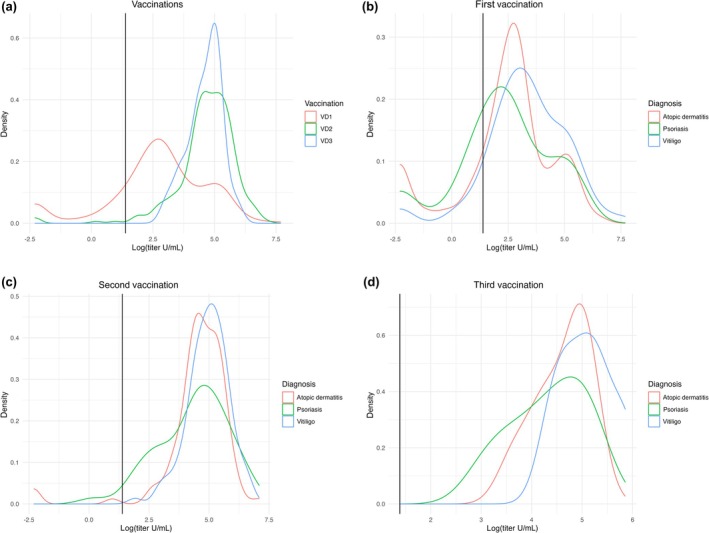
During the COVID-19 pandemic, the daily life of many patients with dermatological immune-mediated inflammatory diseases (DIMIDs), such as atopic dermatitis (AD), psoriasis, and vitiligo, was impacted by social restrictions caused by (fear of) morbidity, mortality associated with COVID-19, and vaccine hesitancy. This prospective observational, multicenter, multidisciplinary cohort study explored the impact of COVID-19 disease and vaccination on DIMIDs, specifically AD, psoriasis, and vitiligo. Data from patients with DIMIDs were collected as part of the Target2B! study (between February 2021 and October 2022). We analyzed the differences in baseline characteristics, risk of developing COVID-19, proportion of DIMIDs in patients reaching seroconversion upon vaccination per DIMID, and self-reported increase in DIMID activity by multivariable logistic regression and sensitivity analyses. A total of 424 patients with DIMID were included. COVID-19 disease commonly occurred in patients with vitiligo (51.1%), AD (42.0%), and psoriasis (34.3%) (p = 0.038). COVID-19 was not associated with the use of immunosuppressive therapy. Three patients (two with AD and one with vitiligo) were hospitalized due to COVID-19. Nearly all patients with DIMIDs exhibited effective seroconversion after regular vaccination regimens (vitiligo 100%, psoriasis 97.9%, AD 96.5%). Increased DIMID activity after COVID-19 (6.6%) or severe acute respiratory syndrome-related coronavirus (SARS-CoV-2) vaccination (12.26%) was reported in a minority of patients, with baseline progressive disease (disease activity 3 months preceding baseline survey) being the only associated risk factor (COVID-19: odds ratio [OR], 4.27 [p = 0.02]; vaccination OR, 3.45 [p = 0.002]). In conclusion, no alarming signs were shown in this study regarding (severe) COVID-19 in patients with AD, psoriasis, or vitiligo. Vaccination against COVID-19 is advised in patients with DIMIDs. Moreover, patients with DIMIDs can safely continue their immunosuppressant therapy, since this does not increase the risk of COVID-19, while vaccination-induced humoral responses are adequate. In only a minority of patients, increased DIMID activity after COVID-19 or SARS-CoV-2 vaccination occurred.
在新冠疫情期间,许多患有皮肤免疫介导性炎症性疾病(DIMIDs)的患者,如特应性皮炎(AD)、银屑病和白癜风,其日常生活受到了(对)新冠发病率、死亡率以及疫苗犹豫所导致的社会限制的影响。这项前瞻性观察性、多中心、多学科队列研究探讨了新冠疾病和疫苗接种对DIMIDs,特别是AD、银屑病和白癜风的影响。作为Target2B!研究(2021年2月至2022年10月)的一部分,收集了DIMIDs患者的数据。我们通过多变量逻辑回归和敏感性分析,分析了基线特征、感染新冠的风险、每种DIMID接种疫苗后血清转化患者中DIMIDs的比例以及自我报告的DIMID活动增加情况的差异。总共纳入了424例DIMID患者。新冠疾病常见于白癜风患者(51.1%)、AD患者(42.0%)和银屑病患者(34.3%)(p = 0.038)。新冠与免疫抑制治疗的使用无关。3例患者(2例AD患者和1例白癜风患者)因新冠住院。几乎所有DIMIDs患者在常规疫苗接种方案后均表现出有效的血清转化(白癜风100%,银屑病97.9%,AD 96.5%)。少数患者报告新冠(6.6%)或严重急性呼吸综合征相关冠状病毒(SARS-CoV-2)疫苗接种后(12.26%)DIMID活动增加,基线进展性疾病(基线调查前3个月的疾病活动)是唯一相关的危险因素(新冠:比值比[OR],4.27 [p = 0.02];疫苗接种OR,3.45 [p = 0.002])。总之,本研究未显示AD、银屑病或白癜风患者中(严重)新冠有令人担忧的迹象。建议DIMIDs患者接种新冠疫苗。此外,DIMIDs患者可以安全地继续其免疫抑制治疗,因为这不会增加感染新冠的风险,而疫苗接种诱导的体液反应是足够的。仅在少数患者中,新冠或SARS-CoV-2疫苗接种后出现了DIMID活动增加。