Aiolfi Alberto, Damiani Riccardo, Manara Michele, Cammarata Francesco, Bonitta Gianluca, Biondi Antonio, Bona Davide, Bonavina Luigi
Division of General Surgery, Department of Biomedical Science for Health, I.R.C.C.S. Ospedale Galeazzi- Sant'Ambrogio, University of Milan, Via C. Belgioioso, 173, 20157, Milan, Italy.
Department of General Surgery and Medical Surgical Specialties, Surgical Division, G. Rodolico Hospital, University of Catania, Catania, 95131, Italy.
Langenbecks Arch Surg. 2025 Feb 17;410(1):75. doi: 10.1007/s00423-025-03648-1.
The surgical treatment for esophageal achalasia has evolved over the years, with laparoscopic Heller myotomy (LHM) and partial fundoplication becoming widely used worldwide. More recently, an increased interest in the robotic Heller myotomy (RHM) has arisen.
Compare short-term and functional outcomes of RHM vs. LHM.
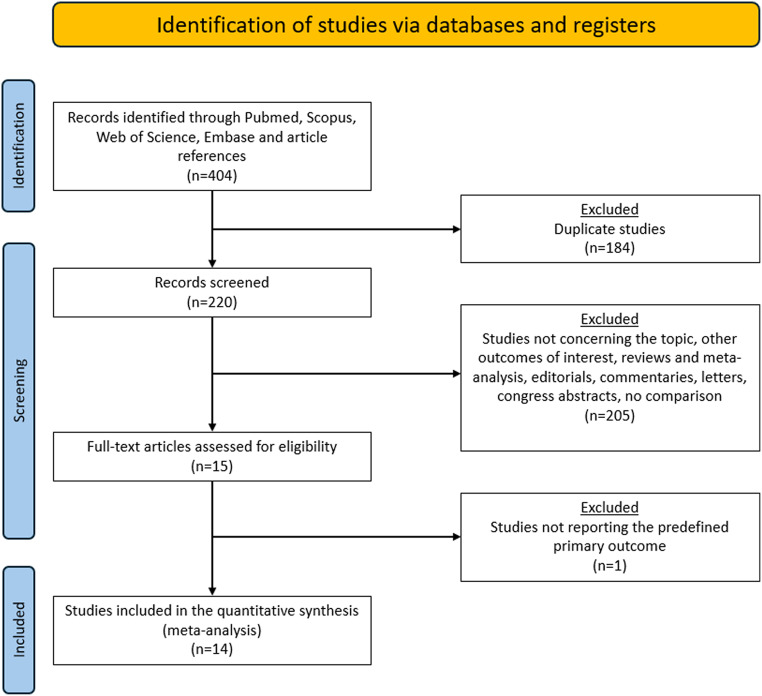
Systematic review and meta-analysis. PubMed, MEDLINE, Scopus, Web of Science, Cochrane Central Library, and ClinicalTrials.gov were queried. Primary outcome was esophageal perforation (EP). Risk ratio (RR), standardized mean difference (SMD), and 95% confidence intervals (95% CI) were effect size and relative inference measures. PROSPERO Registration Number: CRD42024512644.
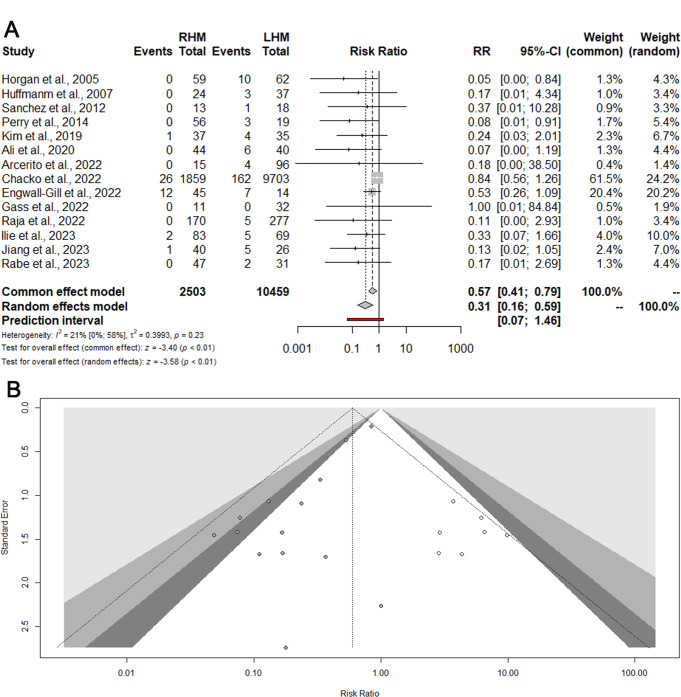
Fourteen observational studies (12962 patients) were included. Of those, 2503 (19.3%) underwent RHM. The patient age ranged from 34 to 66 years and 51.7% were males. EP occurred in 259 patients (1.99%). The cumulative incidence of EP was 1.67% for RHM and 2.07% for LHM. Compared to LHM, RHM was associated with a reduced risk of EP (RR: 0.31; 95% CI 0.16-0.59). No differences were found in term of dysphagia requiring reoperation or additional endoscopic procedures (RR: 0.47; 95% CI 0.20-1.09) and postoperative Eckardt score (SMD: -0.42; 95% CI -0.94, 0.11). Blood loss, conversion to open, operative time, and hospital length of stay were comparable.
RHM may be associated with a reduced risk of EP compared to LHM. However, because of selection bias, diverse surgeon expertise, variations in surgical technique, and prior endoscopic procedures these findings should not be viewed as conclusive while the superiority of one approach over the other remains to be established.
多年来,食管贲门失弛缓症的外科治疗方法不断发展,腹腔镜下Heller肌切开术(LHM)和部分胃底折叠术在全球范围内得到广泛应用。最近,人们对机器人辅助Heller肌切开术(RHM)的兴趣日益增加。
比较RHM与LHM的短期和功能结局。
系统评价和荟萃分析。检索了PubMed、MEDLINE、Scopus、Web of Science、Cochrane中央图书馆和ClinicalTrials.gov。主要结局是食管穿孔(EP)。风险比(RR)、标准化均数差(SMD)和95%置信区间(95%CI)是效应量和相对推断指标。PROSPERO注册号:CRD42024512644。
纳入14项观察性研究(12962例患者)。其中,2503例(19.3%)接受了RHM。患者年龄在34至66岁之间,51.7%为男性。259例患者(1.99%)发生EP。RHM的EP累积发生率为1.67%,LHM为2.07%。与LHM相比,RHM发生EP的风险降低(RR:0.31;95%CI 0.16-0.59)。在需要再次手术或额外内镜治疗的吞咽困难方面(RR:0.47;95%CI 0.20-1.09)以及术后埃卡德特评分方面(SMD:-0.42;95%CI -0.94,0.11)未发现差异。失血量、转为开放手术、手术时间和住院时间相当。
与LHM相比,RHM可能与降低EP风险相关。然而,由于存在选择偏倚、外科医生专业知识差异、手术技术变化以及既往内镜治疗等因素,在一种方法优于另一种方法的优势尚未确立之前,这些发现不应被视为定论。