Eghtedarian Reyhane, Tervi Anniina M, Jones Samuel E, Partinen Markku, Viippola Essi, Ollila Hanna M
Institute for Molecular Medicine Finland, FIMM, HiLIFE, University of Helsinki, Helsinki, Finland.
Helsinki Sleep Clinic, Terveystalo Healthcare, Helsinki, Finland.
Transl Psychiatry. 2025 Feb 17;15(1):55. doi: 10.1038/s41398-025-03259-w.
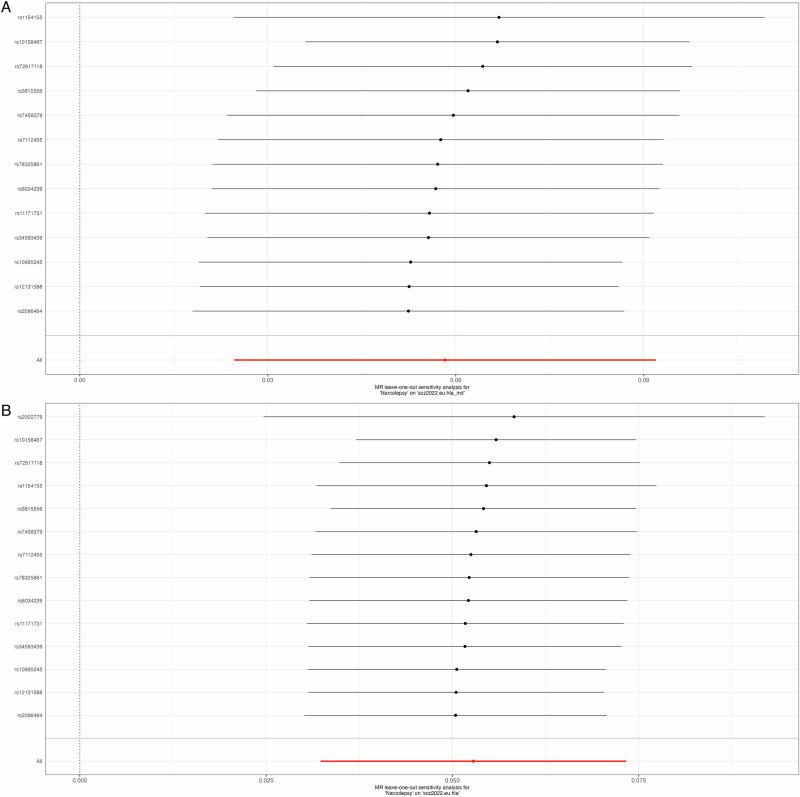
Narcolepsy is a severe sleep disorder with characteristics of fatigue, fragmented sleep, cataplexy and hypnagogic hallucinations. Earlier clinical studies have reported the onset of schizophrenia after narcolepsy but the causality behind narcolepsy and schizophrenia is unknown. Our goal was to understand the causality between narcolepsy and schizophrenia. To estimate the comorbidity between narcolepsy and schizophrenia, we employed data from the FinRegistry that contains data for the total population of Finland in total 7.2 million individuals (N = 1664 individuals with narcolepsy and 55,372 with schizophrenia). We then used Mendelian randomization and previously published genome-wide association data to test the causality between narcolepsy and schizophrenia. We observed a robust causal association from narcolepsy to schizophrenia using the HLA-independent lead variants (P-value = 6.0 × 10), which was accentuated when including the HLA locus (P-value = 4.48 × 10). Furthermore, we observed a modest bidirectional causality from schizophrenia to narcolepsy (P-value = 0.015). There was no evidence of pleiotropy. Our findings indicate a causal relationship where narcolepsy may increase the risk for schizophrenia, and a bidirectional causality from schizophrenia to narcolepsy. Additionally, our results clarify the psychiatric burden in narcolepsy.
发作性睡病是一种严重的睡眠障碍,其特征包括疲劳、睡眠碎片化、猝倒和入睡前幻觉。早期的临床研究报告了发作性睡病后精神分裂症的发病情况,但发作性睡病和精神分裂症之间的因果关系尚不清楚。我们的目标是了解发作性睡病和精神分裂症之间的因果关系。为了估计发作性睡病和精神分裂症之间的共病情况,我们使用了芬兰人口登记处的数据,该数据包含芬兰总人口共720万人的数据(发作性睡病患者1664人,精神分裂症患者55372人)。然后,我们使用孟德尔随机化和先前发表的全基因组关联数据来检验发作性睡病和精神分裂症之间的因果关系。我们使用不依赖于人类白细胞抗原(HLA)的主要变异观察到从发作性睡病到精神分裂症的强烈因果关联(P值 = 6.0×10),当纳入HLA基因座时这种关联更加明显(P值 = 4.48×10)。此外,我们观察到从精神分裂症到发作性睡病存在适度的双向因果关系(P值 = 0.015)。没有多效性的证据。我们的研究结果表明存在一种因果关系,即发作性睡病可能会增加患精神分裂症的风险,以及从精神分裂症到发作性睡病的双向因果关系。此外,我们的结果阐明了发作性睡病中的精神负担。