Wen Xiang-Mei, Xu Zi-Jun, Ma Ji-Chun, Zhang Min-Jie, Jin Ye, Lin Jiang, Qian Jun, Fang Yuan-Yuan, Luo Shu-Yu, Mao Zhen-Wei
Laboratory Center, Affiliated People's Hospital of Jiangsu University, Zhejiang, Jiangsu, China.
Zhenjiang Clinical Research Center of Hematology, Affiliated People's Hospital of Jiangsu University, Zhenjiang, Jiangsu, China.
Front Immunol. 2025 Feb 5;16:1477100. doi: 10.3389/fimmu.2025.1477100. eCollection 2025.
Stimulator of interferon response cGAMP interactor (STING) is essential for both innate and adaptive immunity. However, a comprehensive molecular characterization of STING expression across hematological malignancies is lacking.
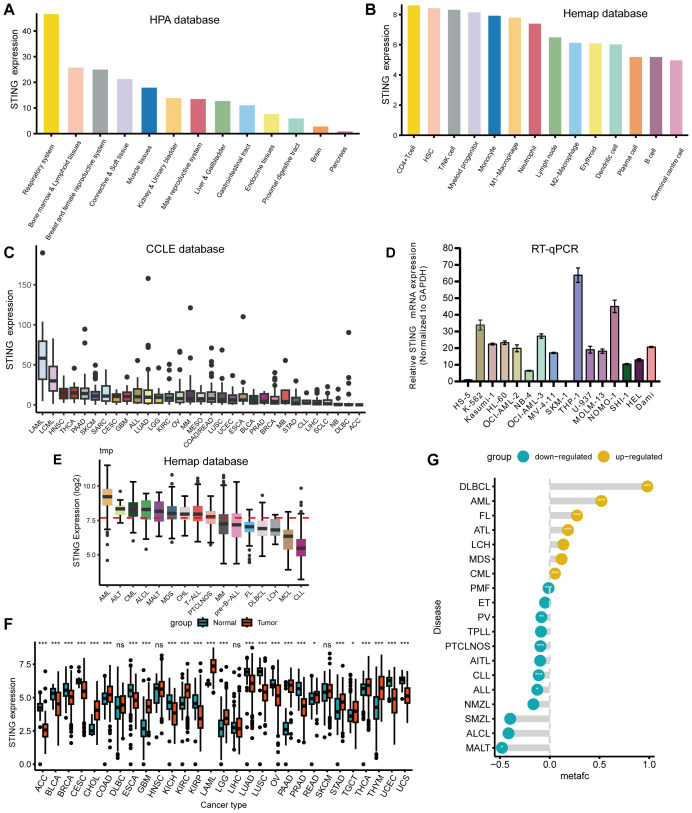
In this study, the pan-blood-cancer landscape related to STING expression was identified using the GTEx, CCLE, Hemap, and TCGA databases, and the potential value for predicting prognosis was investigated. The relationship between STING expression and immune cell enrichment was assessed in the Hemap database. Moreover, the value of STING in predicting the efficacy of immunotherapy was validated using tumor immune dysfunction and exclusion (TIDE) biomarkers and real-world immunotherapy datasets.
STING was found to be relatively highly expressed in acute myeloid leukemia (AML) and chronic myeloid leukemia, with higher STING expression correlated with poorer prognosis in AML. STING expression was positively correlated with immune-related pathways such as IFN-gamma response, IFN-alpha response, and inflammatory response. Cytolytic score and STING expression were positively correlated in some hematological tumors, especially chronic lymphocytic leukemia and mantle cell lymphoma. Interestingly, STING expression was negatively correlated with TIDE biomarkers in AML, suggesting that AML patients with a high STING expression level may benefit from immunologic treatment. Our findings contribute a molecular characterization of STING across hematological malignancies, facilitating the development of individualized prognosis and treatment strategies.
干扰素反应刺激因子环状GMP-AMP相互作用分子(STING)对先天性免疫和适应性免疫均至关重要。然而,目前缺乏对血液系统恶性肿瘤中STING表达的全面分子特征描述。
在本研究中,利用基因型组织表达(GTEx)、癌症细胞系百科全书(CCLE)、血液肿瘤图谱(Hemap)和癌症基因组图谱(TCGA)数据库确定了与STING表达相关的泛血液肿瘤格局,并研究了其预测预后的潜在价值。在Hemap数据库中评估了STING表达与免疫细胞富集之间的关系。此外,利用肿瘤免疫功能障碍和排除(TIDE)生物标志物及真实世界的免疫治疗数据集验证了STING在预测免疫治疗疗效方面的价值。
发现STING在急性髓系白血病(AML)和慢性髓系白血病中相对高表达,在AML中,较高的STING表达与较差的预后相关。STING表达与免疫相关通路如γ干扰素反应、α干扰素反应和炎症反应呈正相关。在一些血液肿瘤中,尤其是慢性淋巴细胞白血病和套细胞淋巴瘤中,细胞溶解评分与STING表达呈正相关。有趣的是,在AML中STING表达与TIDE生物标志物呈负相关,这表明STING表达水平高的AML患者可能从免疫治疗中获益。我们的研究结果提供了血液系统恶性肿瘤中STING的分子特征,有助于制定个性化的预后和治疗策略。