Abouammoh Noura, Alhasan Khalid, Aljamaan Fadi, Raina Rupesh, Malki Khalid H, Altamimi Ibraheem, Muaygil Ruaim, Wahabi Hayfaa, Jamal Amr, Alhaboob Ali, Assiri Rasha Assad, Al-Tawfiq Jaffar A, Al-Eyadhy Ayman, Soliman Mona, Temsah Mohamad-Hani
College of Medicine, King Saud University, Riyadh, Saudi Arabia.
Department of Family and Community Medicine, King Saud University Medical City, King Saud University, Riyadh, Saudi Arabia.
JMIR Med Educ. 2025 Feb 20;11:e63400. doi: 10.2196/63400.
With the rapid development of artificial intelligence technologies, there is a growing interest in the potential use of artificial intelligence-based tools like ChatGPT in medical education. However, there is limited research on the initial perceptions and experiences of faculty and students with ChatGPT, particularly in Saudi Arabia.
This study aimed to explore the earliest knowledge, perceived benefits, concerns, and limitations of using ChatGPT in medical education among faculty and students at a leading Saudi Arabian university.
A qualitative exploratory study was conducted in April 2023, involving focused meetings with medical faculty and students with varying levels of ChatGPT experience. A thematic analysis was used to identify key themes and subthemes emerging from the discussions.
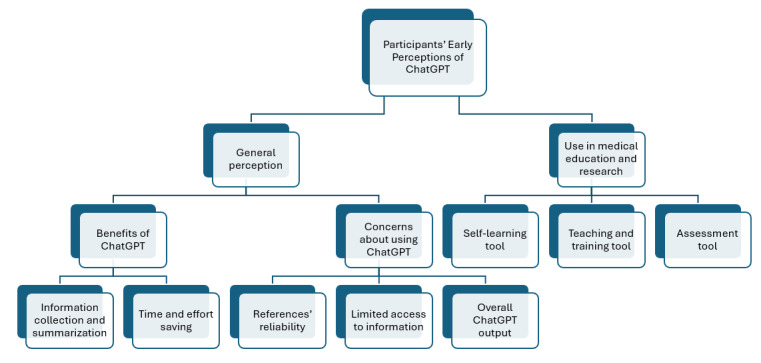
Participants demonstrated good knowledge of ChatGPT and its functions. The main themes were perceptions of ChatGPT use, potential benefits, and concerns about ChatGPT in research and medical education. The perceived benefits included collecting and summarizing information and saving time and effort. However, concerns and limitations centered around the potential lack of critical thinking in the information provided, the ambiguity of references, limitations of access, trust in the output of ChatGPT, and ethical concerns.
This study provides valuable insights into the perceptions and experiences of medical faculty and students regarding the use of newly introduced large language models like ChatGPT in medical education. While the benefits of ChatGPT were recognized, participants also expressed concerns and limitations requiring further studies for effective integration into medical education, exploring the impact of ChatGPT on learning outcomes, student and faculty satisfaction, and the development of critical thinking skills.
随着人工智能技术的快速发展,人们对在医学教育中潜在使用像ChatGPT这样基于人工智能的工具的兴趣日益浓厚。然而,关于教师和学生对ChatGPT的初步认知和体验的研究有限,尤其是在沙特阿拉伯。
本研究旨在探索沙特阿拉伯一所顶尖大学的教师和学生在医学教育中使用ChatGPT的最早知识、感知到的益处、担忧和局限性。
2023年4月进行了一项定性探索性研究,涉及与具有不同ChatGPT使用经验水平的医学教师和学生进行重点会议。采用主题分析来识别讨论中出现的关键主题和子主题。
参与者对ChatGPT及其功能表现出良好的了解。主要主题包括对ChatGPT使用的认知、潜在益处以及在研究和医学教育中对ChatGPT的担忧。感知到的益处包括收集和汇总信息以及节省时间和精力。然而,担忧和局限性集中在提供的信息中可能缺乏批判性思维、参考文献的模糊性、获取的局限性、对ChatGPT输出的信任以及伦理问题。
本研究为医学教师和学生对在医学教育中使用像ChatGPT这样新引入的大语言模型的认知和体验提供了有价值的见解。虽然ChatGPT的益处得到了认可,但参与者也表达了担忧和局限性,需要进一步研究以有效融入医学教育,探索ChatGPT对学习成果、学生和教师满意度以及批判性思维技能发展的影响。