Karlsson Linda, Vogel Jacob, Arvidsson Ida, Åström Kalle, Strandberg Olof, Seidlitz Jakob, Bethlehem Richard A I, Stomrud Erik, Ossenkoppele Rik, Ashton Nicholas J, Zetterberg Henrik, Blennow Kaj, Palmqvist Sebastian, Smith Ruben, Janelidze Shorena, La Joie Renaud, Rabinovici Gil D, Binette Alexa Pichet, Mattsson-Carlgren Niklas, Hansson Oskar
Clinical Memory Research Unit, Department of Clinical Sciences Malmö, Lund University, Lund, Sweden.
Department of Clinical Sciences, SciLifeLab, Lund University, Lund, Sweden.
Alzheimers Dement. 2025 Feb;21(2):e14600. doi: 10.1002/alz.14600.
Tau positron emission tomography (PET) is a reliable neuroimaging technique for assessing regional load of tau pathology in the brain, but its routine clinical use is limited by cost and accessibility barriers.
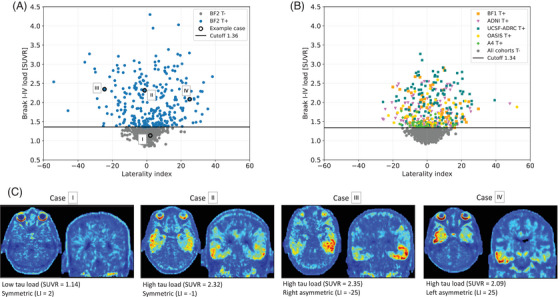
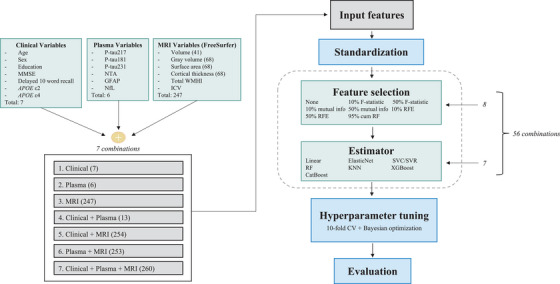
We thoroughly investigated the ability of various machine learning models to predict clinically useful tau-PET composites (load and laterality index) from low-cost and non-invasive features, for example, clinical variables, plasma biomarkers, and structural magnetic resonance imaging (MRI).
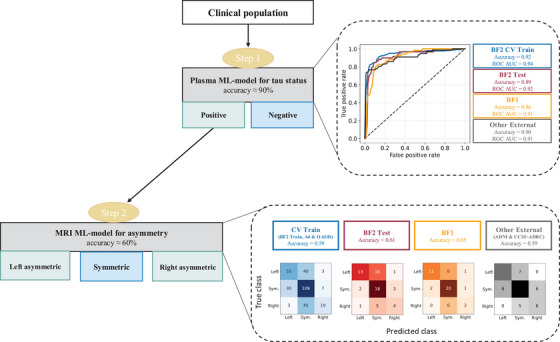
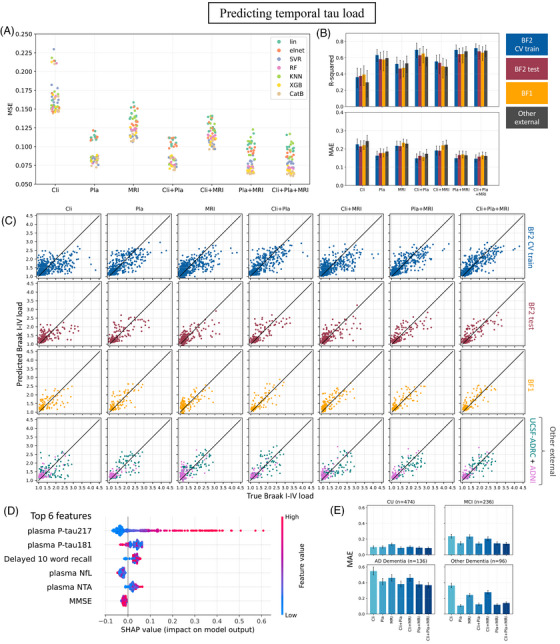
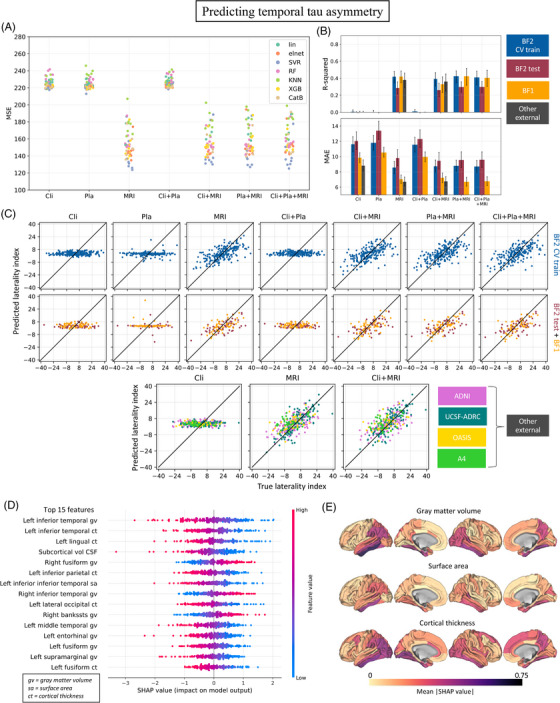
Models including plasma biomarkers yielded the most accurate predictions of tau-PET burden (best model: R-squared = 0.66-0.69), with especially high contribution from plasma phosphorylated tau-217 (p-tau217). MRI variables were the best predictors of asymmetric tau load between the two hemispheres (best model: R-squared = 0.28-0.42). The models showed high generalizability to external test cohorts with data collected at multiple sites. Through a proof-of-concept two-step classification workflow, we also demonstrated possible model translations to a clinical setting.
This study highlights the promising and limiting aspects of using machine learning to predict tau-PET from scalable cost-effective variables, with findings relevant for clinical settings and future research.
Accessible variables showed potential in estimating tau tangle load and distribution. Plasma phosphorylated tau-217 (p-tau217) and magnetic resonance imaging (MRI) were the best predictors of different tau-PET (positron emission tomography) composites. Machine learning models demonstrated high generalizability across AD cohorts.
tau正电子发射断层扫描(PET)是一种可靠的神经成像技术,用于评估大脑中tau病理的区域负荷,但其常规临床应用受到成本和可及性障碍的限制。
我们全面研究了各种机器学习模型从低成本和非侵入性特征(例如临床变量、血浆生物标志物和结构磁共振成像(MRI))预测临床上有用的tau-PET复合指标(负荷和偏侧指数)的能力。
包括血浆生物标志物的模型对tau-PET负荷的预测最为准确(最佳模型:决定系数R² = 0.66 - 0.69),其中血浆磷酸化tau-217(p-tau217)的贡献尤为突出。MRI变量是两个半球之间不对称tau负荷的最佳预测指标(最佳模型:决定系数R² = 0.28 - 0.42)。这些模型对在多个地点收集数据的外部测试队列具有很高的通用性。通过一个概念验证的两步分类工作流程,我们还展示了将模型转化到临床环境的可能性。
本研究突出了使用机器学习从可扩展的具有成本效益的变量预测tau-PET的前景和局限性,研究结果与临床环境和未来研究相关。
可获取的变量在估计tau缠结负荷和分布方面显示出潜力。血浆磷酸化tau-217(p-tau217)和磁共振成像(MRI)是不同tau-PET(正电子发射断层扫描)复合指标的最佳预测指标。机器学习模型在阿尔茨海默病队列中表现出很高的通用性。