Hooshangnejad Hamed, Lee Jina, Bell Leslie, Hales Russell K, Voong Khinh Ranh, Han-Oh Sarah, Ding Kai, Farjam Reza
Department of Biomedical Engineering, Johns Hopkins University, Baltimore, Maryland, USA.
Carnegie Center for Surgical Innovation, Johns Hopkins University, Baltimore, Maryland, USA.
J Appl Clin Med Phys. 2025 Apr;26(4):e70029. doi: 10.1002/acm2.70029. Epub 2025 Feb 22.
To quantify beam optimization for stereotactic body radiotherapy (SBRT) of peripheral lung lesions.
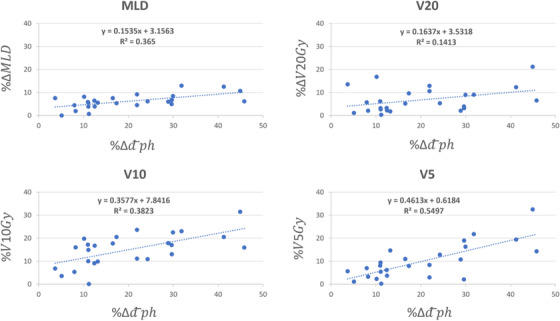
The new beam optimization approach was based on maximizing the therapeutic gain (TG) of the beam set by minimizing the average physical depth of the lesion with respect to the beam's eye view (BEV). The new approach was evaluated by replanning the 25 SBRT lesions retrospectively to assess if a better plan is achievable in all aspects. Difference in 25 Gy isodose line volume (IDLV ), IDLV , IDLV , IDLV , and IDLV between the two plan cohorts were calculated as a measure of plan size and fitted in a linear regression model against the changes in the lesion depth with respect to the BEV to assess the relationship between the changes in the treatment depth and that of the plan size.
Beam optimization achieved a better plan in all cases by lowering the depth of treatment with an average of % 20.03 ± 12.30 (3.66%-45.78%). As the depth of treatment decreases, the size of the plan also decreases. We observed a reduction of % 4.64 ± 4.55 (0.02%-21.58%, p < 3.8 × 10), %5.16 ± 5.54 (0.03%-24.68%, p < 0.005), %6.46 ± 6.95 (-1.35%-29.05%, p < 0.009), %12.83 ± 9.06 (0.89%-37.65%, p < 0.0001), and %14.01 ± 9.87 (1.43%-41.84%, p < 4.5 × 10) in IDLV , IDLV , IDLV , IDLV , and IDLV , respectively.
Physical depth of the lesion with respect to the BEV is inversely proportional to the TG of a beam-set and can be used as a robust and standard metric to select an appropriate beam-set for SBRT of the peripheral lung lesions. Further evaluation warrants the utility of such concept in routine clinical use.
对外周型肺病变立体定向体部放疗(SBRT)的射束优化进行量化。
新的射束优化方法基于通过相对于射束视场(BEV)最小化病变的平均物理深度来最大化射束组的治疗增益(TG)。通过对25例SBRT病变进行回顾性重新计划来评估新方法,以评估是否能在各方面实现更好的计划。计算两个计划队列之间25 Gy等剂量线体积(IDLV)、IDLV、IDLV、IDLV和IDLV的差异,作为计划大小的度量,并将其拟合到线性回归模型中,以分析相对于BEV的病变深度变化与计划大小变化之间的关系。
射束优化在所有病例中均通过降低治疗深度实现了更好的计划,平均降低了20.03%±12.30%(3.66%-45.78%)。随着治疗深度的降低,计划大小也减小。我们观察到IDLV、IDLV、IDLV、IDLV和IDLV分别降低了4.64%±4.55%(0.02%-21.58%,p<3.8×10)%、5.16%±5.54%(0.03%-24.68%,p<0.005)%、6.46%±6.95%(-1.35%-29.05%,p<0.009)%、12.83%±9.06%(0.89%-37.65%,p<0.0001)%和14.01%±9.87%(1.43%-41.8