Sipos Krisztina, Joensuu Katriina, Kauhanen Susanna, Ojala Kaisu
Department of Musculoskeletal and Plastic Surgery, University of Helsinki, and Helsinki University Hospital, Finland.
Department of Plastic Surgery, Tampere University Hospital, Finland.
JPRAS Open. 2025 Jan 10;43:458-469. doi: 10.1016/j.jpra.2025.01.002. eCollection 2025 Mar.
Postoperative hematoma requiring intervention occurs more frequently in chest masculinization surgeries than in other types of breast surgeries, with incidences ranging from 0.7% to 13.2% per patient. Although there is increasing evidence that topically applied tranexamic acid (TXA) effectively reduces postoperative bleeding in breast surgeries, its impact on masculinization surgeries is understudied.
Examining the significance of topical TXA in reducing postoperative hematoma in chest masculinization surgeries.
This retrospective cohort comprises female-to-male transgender and non-binary patients who underwent chest masculinization at Helsinki or Tampere University hospitals between 2018 and 2024. Topical TXA (20 mg/ml, 25 ml per breast) was incorporated into routine use in October 2022, replacing the previous practices; Helsinki mainly operated without TXA, whereas Tampere routinely used intravenous (i.v.) TXA.
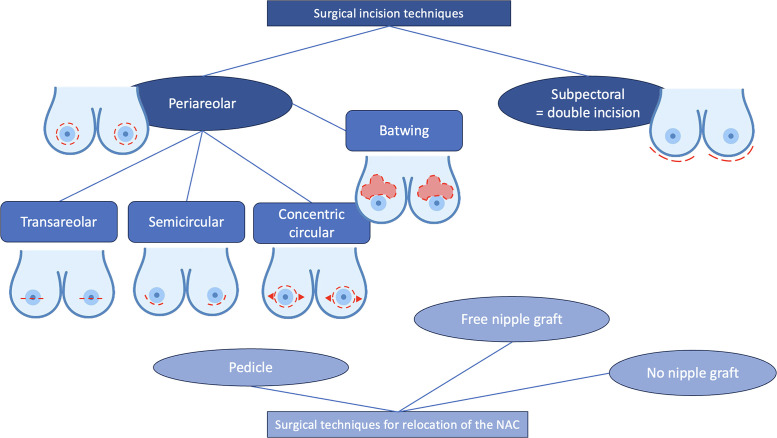
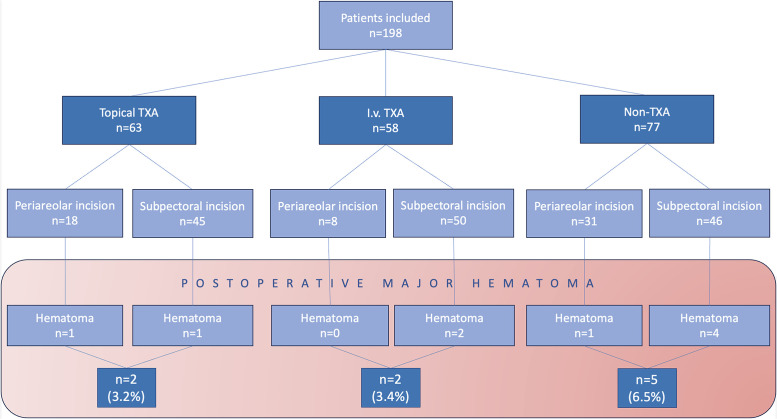
A total of 198 patients undergoing chest masculinization surgery were included. Among them, 9 (4.5%) major hematomas occurred. The need for reoperation due to postoperative hematoma was lower in the topical TXA (3.2%, 2 out of 63 patients) and i.v. TXA (3.4%, 2 out of 58 patients) groups compared to the non-TXA group (6.5%, 5 out of 77 patients). Subpectoral incisions (71.2%, 141 patients) resulted in a 5.0% hematoma rate, whereas periareolar incisions (28.8%, 57 cases) had a 3.5% hematoma rate.
Our study suggests that topical and i.v. TXA effectively reduce postoperative bleeding in chest masculinization surgeries, with similar outcomes between the 2 methods. Albeit our results lack statistical significance and they support the potential benefit of prophylactic TXA use in hematoma reduction.
与其他类型的乳房手术相比,需要干预的术后血肿在胸部男性化手术中更为常见,每位患者的发生率在0.7%至13.2%之间。尽管越来越多的证据表明局部应用氨甲环酸(TXA)可有效减少乳房手术中的术后出血,但其对男性化手术的影响仍未得到充分研究。
研究局部应用TXA在减少胸部男性化手术术后血肿方面的意义。
这项回顾性队列研究纳入了2018年至2024年间在赫尔辛基或坦佩雷大学医院接受胸部男性化手术的女性转男性跨性别者和非二元性别患者。2022年10月,局部TXA(20mg/ml,每侧乳房25ml)被纳入常规使用,取代了先前的做法;赫尔辛基的手术主要在不使用TXA的情况下进行,而坦佩雷则常规使用静脉注射(i.v.)TXA。
共纳入198例接受胸部男性化手术的患者。其中,发生了9例(4.5%)严重血肿。与非TXA组(6.5%,77例中有5例)相比,局部TXA组(3.2%,63例中有2例)和静脉注射TXA组(3.4%,58例中有2例)因术后血肿需要再次手术的情况较少。胸肌下切口(71.2%,141例患者)的血肿发生率为5.0%,而乳晕周围切口(28.8%,57例)的血肿发生率为3.5%。
我们的研究表明,局部和静脉注射TXA可有效减少胸部男性化手术中的术后出血,两种方法的效果相似。尽管我们的结果缺乏统计学意义,但它们支持预防性使用TXA在减少血肿方面的潜在益处。