Novika Revi Gama Hatta, Sari Atriany Nilam, Nurhidayati Siti, Maulina Rufidah, Maulida Luluk Fajria, Wahidah Nurul Jannatul, Ilyas Muhana Fawwazy, Sumarno Lanjar, Prastowo Sigit, Jevitt Cecilia M
Midwifery Study Program, Faculty of Medicine, Universitas Sebelas Maret, Surakarta, Indonesia.
Faculty of Medicine, Universitas Sebelas Maret, Surakarta, Indonesia.
Ann Pediatr Endocrinol Metab. 2025 Jun;30(3):119-126. doi: 10.6065/apem.2448158.079. Epub 2025 Feb 25.
Previous studies have suggested that milk consumption can promote growth in children. However, limited studies have been performed on the effects of cow milk varieties, especially β-casein A2 milk. This study aims to investigate the effect of β-casein A2 cow milk supplementation on physical growth, inflammation, and growth-related hormone and nutritional biomarker profiles in growth-stunted children.
This is a quasi-experimental study with only one group and a pre-and posttest design. This research is divided into 3 stages: allele testing in the β-casein gene, processing into ready-to-drink milk, and a clinical trial. The participants were children aged 12-36 months who were given 200-mL β-casein A2 cow milk supplementation once a day for 3 months. The outcome assessments were physical growth (body weight and height), inflammation (tumor necrosis factor-alpha [TNF-α] and cortisol levels), and biological markers related to growth and nutrition (insulin-like growth factor-1 [IGF-1], growth hormone [GH], and transferrin) that were measured during pre-, mid (week 6)-, and post (week 12)-intervention periods.
This study included 30 study participants. Significant body weight and height improvements were observed at week 6 and postintervention (week 12) compared to preintervention. There were significant reductions in the inflammation markers TNF-α and cortisol levels postintervention. Additionally, IGF-1 and GH levels increased significantly, and transferrin levels also rose, potentially reflecting improved nutritional status.
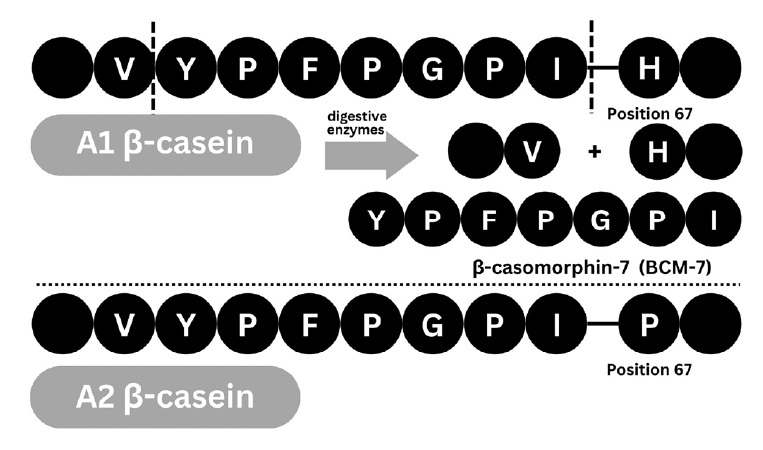
This study suggests that β-casein A2 milk supplementation was associated with improvements in physical growth and related biomarkers in stunted children. Additionally, β-casein A2 milk may produce fewer BCM-7 metabolites compared to β-casein A1 milk, which has been hypothesized to be associated with certain adverse health outcomes. However, further controlled studies are needed to confirm its efficacy as a dietary intervention.
先前的研究表明,饮用牛奶可促进儿童生长。然而,关于不同品种牛奶,尤其是β-酪蛋白A2型牛奶的影响的研究有限。本研究旨在探讨补充β-酪蛋白A2型牛奶对发育迟缓儿童身体生长、炎症反应以及与生长相关的激素和营养生物标志物谱的影响。
这是一项单组前后测设计的准实验研究。本研究分为3个阶段:β-酪蛋白基因的等位基因检测、加工成即饮型牛奶以及一项临床试验。参与者为12至36个月大的儿童,每天补充200毫升β-酪蛋白A2型牛奶,为期3个月。结局评估指标包括身体生长情况(体重和身高)、炎症反应(肿瘤坏死因子-α [TNF-α] 和皮质醇水平)以及在干预前、干预中期(第6周)和干预后期(第12周)测量的与生长和营养相关的生物标志物(胰岛素样生长因子-1 [IGF-1]、生长激素 [GH] 和转铁蛋白)。
本研究纳入了30名研究参与者。与干预前相比,在第6周和干预后(第12周)观察到体重和身高有显著改善。干预后炎症标志物TNF-α和皮质醇水平显著降低。此外,IGF-1和GH水平显著升高,转铁蛋白水平也有所上升,这可能反映了营养状况的改善。
本研究表明,补充β-酪蛋白A2型牛奶与发育迟缓儿童的身体生长改善及相关生物标志物的变化有关。此外,与β-酪蛋白A1型牛奶相比,β-酪蛋白A2型牛奶可能产生较少的BCM-7代谢产物,据推测,BCM-7与某些不良健康结果有关。然而,需要进一步的对照研究来证实其作为饮食干预措施的有效性。