Akseer Nadia, Tasic Hana, Nnachebe Onah Michael, Wigle Jannah, Rajakumar Ramraj, Sanchez-Hernandez Diana, Akuoku Jonathan, Black Robert E, Horta Bernardo L, Nwuneli Ndidi, Shine Ritta, Wazny Kerri, Japra Nikita, Shekar Meera, Hoddinott John
Johns Hopkins Bloomberg School of Public Health, USA.
Modern Scientist Global, Canada.
EClinicalMedicine. 2022 Mar 15;45:101320. doi: 10.1016/j.eclinm.2022.101320. eCollection 2022 Mar.
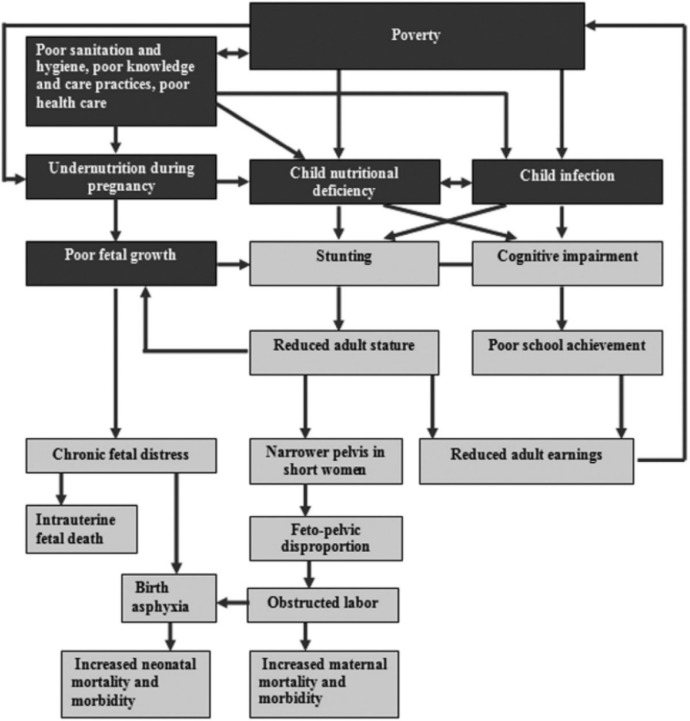
Stunting during childhood has long-term consequences on human capital, including decreased physical growth, and lower educational attainment, cognition, workforce productivity and wages. Previous research has quantified the costs of stunting to national economies however beyond a few single-country datasets there has been a limited number of which have used diverse datasets and have had a dedicated focus on the private sector, which employs nearly 90% of the workforce in many low- and middle-income countries (LMICs). We aimed to examine (i) the impact of childhood stunting on income loss of private sector workforce in LMICs; (ii) to quantify losses in sales to private firms in LMICs due to childhood stunting; and (iii) to estimate potential gains (benefit-cost ratios) if stunting levels are reduced in select high prevalence countries.
This multiple-methods study engaged multi-disciplinary technical advisers, executed several literature reviews, used innovative statistical methods, and implemented health and labor economic models. We analyzed data from seven longitudinal datasets (up to 30+ years of follow-up; 1982-2016; Peru, Ethiopia, India, Vietnam, Philippines, Tanzania, Brazil), 108 private firm datasets (spanning 2008-2020), and many global datasets including Joint Malnutrition Estimates, and World Development Indicators to produce estimates for 120+ LMICs (with estimates up to 2021). We studied the impact of childhood stunting on adult cognition, education, and height as pathways to wages/productivity in adulthood. We employed cloud-based artificial intelligence (AI) platforms, and conducted comparative analyses using three analytic approaches: traditional frequentist statistics, Bayesian inferential statistics and machine learning. We employed labour and health economic models to estimate wage losses to the private sector worker and firm revenue losses due to stunting. We also estimated benefit-cost ratios for countries investing in nutrition-specific interventions to prevent stunting.
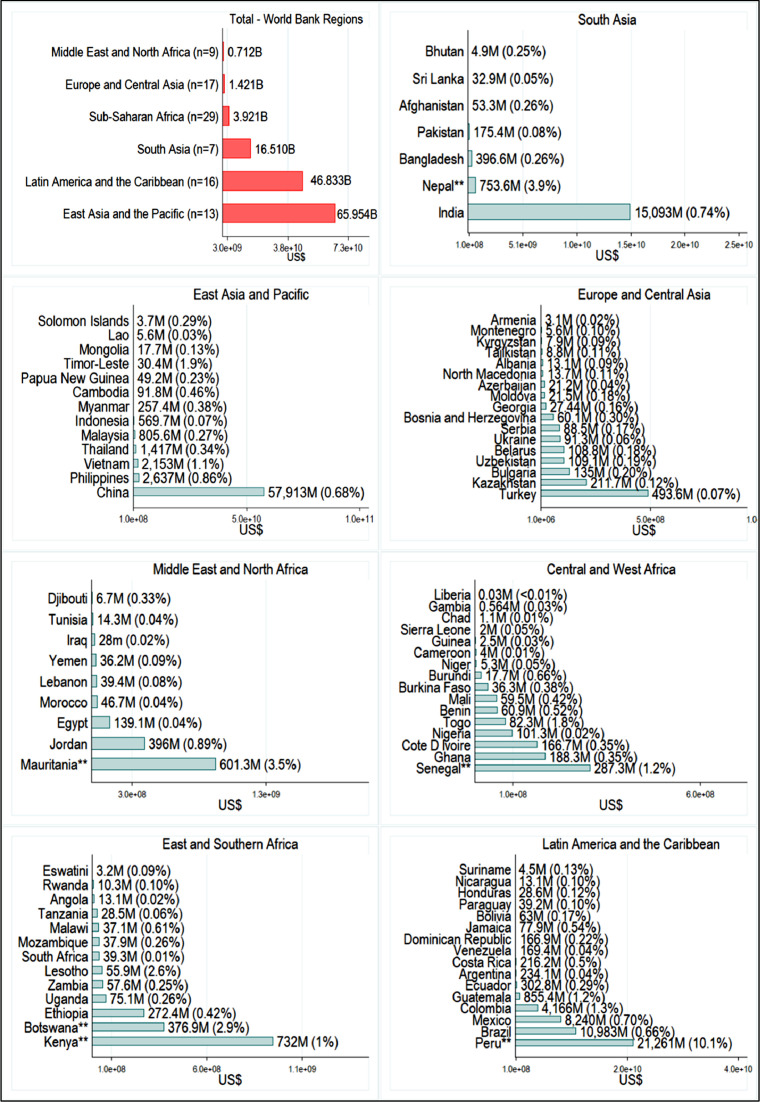
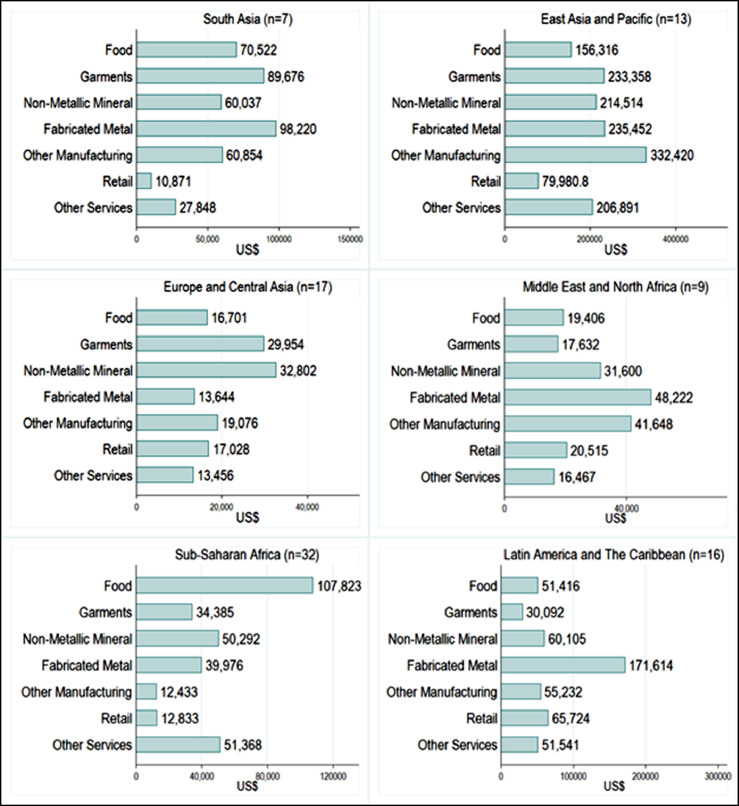
Across 95 LMICs, childhood stunting costs the private sector at least US$135.4 billion in sales annually. Firms from countries in Latin America and the Caribbean and East Asia and Pacific regions had the greatest losses. Totals sales losses to the private sector accumulated to 0.01% to 1.2% of national GDP across countries. Sectors most affected by childhood stunting were manufacturing (non-metallic mineral, fabricated metal, other), garments and food sectors. Sale losses were highest for larger sized private firms. Across regions (representing 123 LMICs), US$700 million (Middle East and North Africa) to US$16.5 billion (East Asia and Pacific) monthly income was lost among private sector workers. Investing in stunting reduction interventions yields gains from US$2 to US$81 per $1 invested annually (or 100% to 8000% across countries). Across sectors, the highest returns were in elementary occupations (US$46) and the lowest were among agricultural workers (US$8). By gender, women incurred a higher income penalty from childhood stunting and earned less than men; due to their relatively higher earnings, the returns for investing in stunting reduction were consistently higher for men across most countries studied.
Childhood stunting costs the private sector in LMICs billions of dollars in sales and earnings for the workforce annually. Returns to nutrition interventions show that there is an economic case to be made for investing in childhood nutrition, alongside a moral one for both the public and private sector. This research could be used to motivate strong public-private sector partnerships to invest in childhood undernutrition for benefits in the short and long-term.
儿童期发育迟缓对人力资本具有长期影响,包括身体发育减缓、教育程度降低、认知能力下降、劳动力生产率降低以及工资减少。以往研究已对发育迟缓给各国经济造成的成本进行了量化,但除了少数几个单一国家的数据集外,使用多样化数据集并专门关注私营部门的研究数量有限,而在许多低收入和中等收入国家(LMICs),私营部门雇佣了近90%的劳动力。我们旨在研究:(i)儿童期发育迟缓对低收入和中等收入国家私营部门劳动力收入损失的影响;(ii)量化低收入和中等收入国家因儿童期发育迟缓导致的私营企业销售损失;以及(iii)估计在选定的高流行率国家降低发育迟缓水平后的潜在收益(效益成本比)。
这项多方法研究邀请了多学科技术顾问,进行了多项文献综述,使用了创新的统计方法,并实施了健康和劳动经济模型。我们分析了来自七个纵向数据集(长达30多年的随访;1982 - 2016年;秘鲁、埃塞俄比亚、印度、越南、菲律宾、坦桑尼亚、巴西)、108个私营企业数据集(涵盖2008 - 2020年)以及包括联合营养不良估计数和世界发展指标在内的许多全球数据集的数据,以得出120多个低收入和中等收入国家的估计数(估计截至2021年)。我们研究了儿童期发育迟缓对成人认知、教育和身高的影响,将其作为成年期工资/生产率的途径。我们采用了基于云的人工智能(AI)平台,并使用三种分析方法进行比较分析:传统频率统计、贝叶斯推断统计和机器学习。我们采用劳动和健康经济模型来估计私营部门工人的工资损失以及因发育迟缓导致的企业收入损失。我们还估计了投资于特定营养干预措施以预防发育迟缓的国家的效益成本比。
在95个低收入和中等收入国家中,儿童期发育迟缓每年给私营部门造成至少1354亿美元的销售损失。拉丁美洲和加勒比地区以及东亚和太平洋地区国家的企业损失最大。各国私营部门的销售总损失累计占国内生产总值的0.01%至1.2%。受儿童期发育迟缓影响最严重的行业是制造业(非金属矿物、金属制品、其他)、服装业和食品业。规模较大的私营企业销售损失最高。在各地区(代表123个低收入和中等收入国家),私营部门工人每月损失7亿美元(中东和北非)至165亿美元(东亚和太平洋)的收入。投资于减少发育迟缓的干预措施每年每投入1美元可获得2美元至81美元的收益(或各国的收益为100%至8000%)。在各行业中,基础职业的回报最高(46美元),农业工人的回报最低(8美元)。按性别划分,女性因儿童期发育迟缓遭受的收入惩罚更高,收入低于男性;由于男性收入相对较高,在大多数研究国家中,投资于减少发育迟缓的回报对男性而言始终更高。
儿童期发育迟缓每年给低收入和中等收入国家的私营部门造成数十亿美元的销售和劳动力收入损失。营养干预措施的回报表明,投资于儿童营养不仅在道德层面上对公共和私营部门都有必要,在经济层面上也有充分的理由。这项研究可用于推动强大的公私部门伙伴关系,投资于儿童营养不良问题,以实现短期和长期的效益。