Jamróz Grzegorz, Akman Ahmet Onur, Psarou Anastasia, Varga Zoltán György, Kucharski Rafał
Faculty of Mathematics and Computer Science, Jagiellonian University, Kraków, Poland.
Jagiellonian University, Doctoral School of Exact and Natural Sciences, Kraków, Poland.
Sci Rep. 2025 Feb 25;15(1):6768. doi: 10.1038/s41598-025-90783-w.
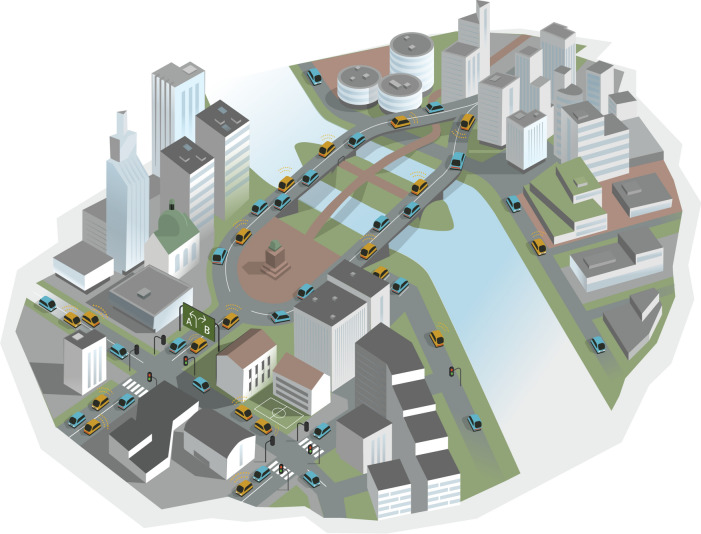
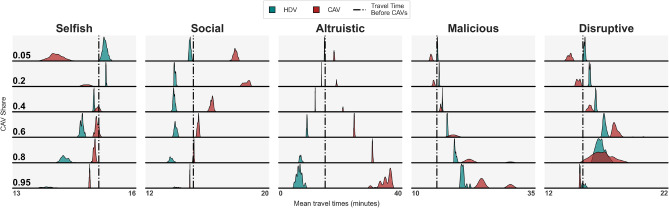
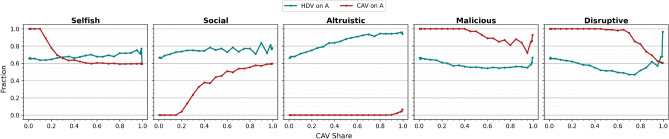
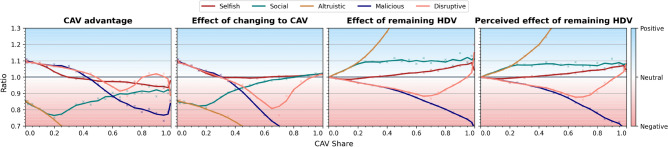
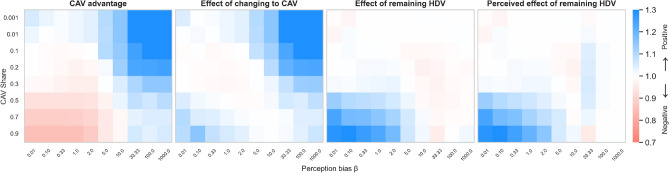
Suppose in a stable urban traffic system populated only by human driven vehicles (HDVs), a given proportion (e.g. [Formula: see text]) is replaced by a fleet of Connected and Autonomous Vehicles (CAVs), which share information and pursue a collective goal. Suppose these vehicles are centrally coordinated and differ from HDVs only by their collective capacities allowing them to make more efficient routing decisions before the travel on a given day begins. Suppose there is a choice between two routes and every day each driver makes a decision which route to take. Human drivers maximize their utility. CAVs might optimize different goals, such as the total travel time of the fleet. We show that in this plausible futuristic setting, the strategy CAVs are allowed to adopt may result in human drivers either benefitting or being systematically disadvantaged and urban networks becoming more or less optimal. Consequently, some regulatory measures might become indispensable.
假设在一个仅由人类驾驶车辆(HDV)构成的稳定城市交通系统中,给定比例(例如[公式:见原文])的车辆被联网自动驾驶车辆(CAV)车队所取代,这些车辆共享信息并追求共同目标。假设这些车辆由中央协调,并且与人类驾驶车辆的唯一区别在于它们的集体能力,这使它们能够在给定日期的行程开始前做出更高效的路线决策。假设有两条路线可供选择,并且每天每个司机都要决定走哪条路线。人类司机使他们的效用最大化。联网自动驾驶车辆可能会优化不同的目标,例如车队的总行驶时间。我们表明,在这种看似合理的未来情景中,联网自动驾驶车辆被允许采用的策略可能会导致人类司机要么受益,要么系统性地处于劣势,并且城市网络变得或多或少更优化。因此,一些监管措施可能变得不可或缺。