Çolak Serdar, Lima Antonio, González Marta C
Department of Civil and Environmental Engineering, MIT, Cambridge, Massachusetts 02139, USA.
School of Computer Science, University of Birmingham, Edgbaston B15 2TT, UK.
Nat Commun. 2016 Mar 15;7:10793. doi: 10.1038/ncomms10793.
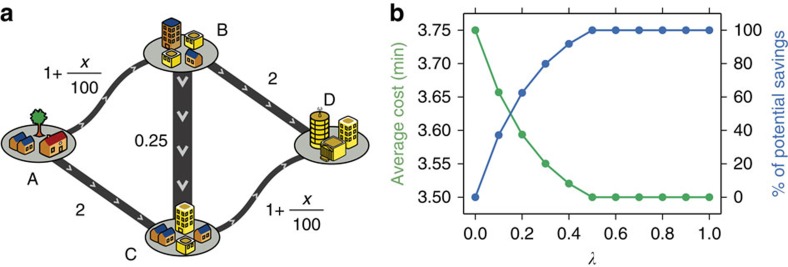
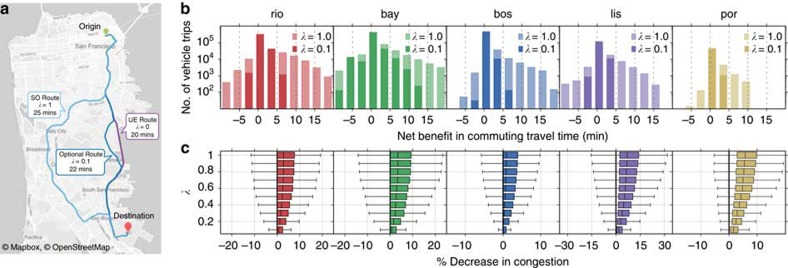
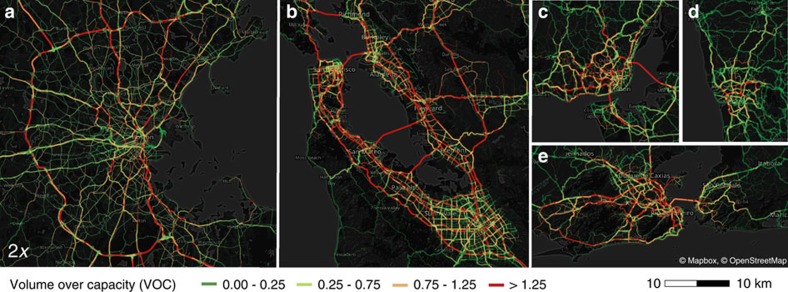
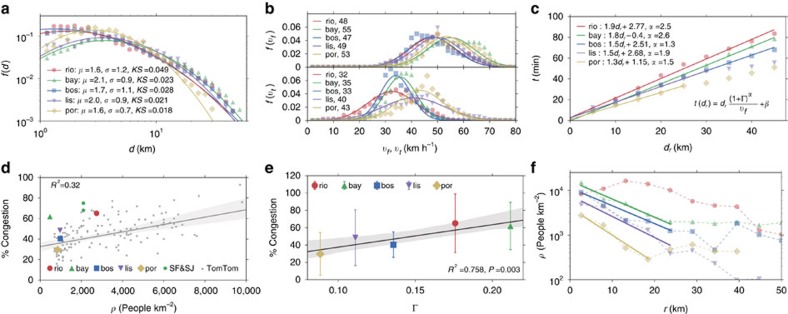
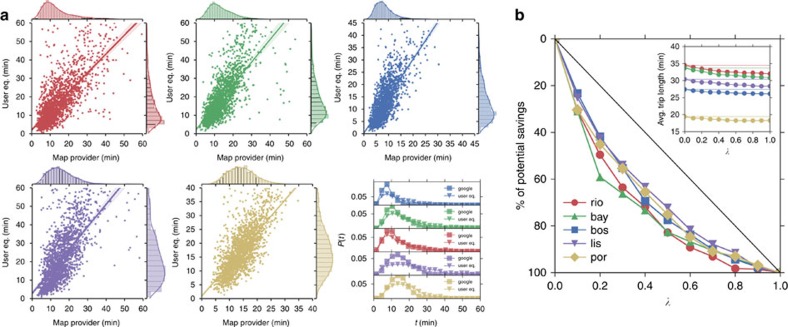
Rapid urbanization and increasing demand for transportation burdens urban road infrastructures. The interplay of number of vehicles and available road capacity on their routes determines the level of congestion. Although approaches to modify demand and capacity exist, the possible limits of congestion alleviation by only modifying route choices have not been systematically studied. Here we couple the road networks of five diverse cities with the travel demand profiles in the morning peak hour obtained from billions of mobile phone traces to comprehensively analyse urban traffic. We present that a dimensionless ratio of the road supply to the travel demand explains the percentage of time lost in congestion. Finally, we examine congestion relief under a centralized routing scheme with varying levels of awareness of social good and quantify the benefits to show that moderate levels are enough to achieve significant collective travel time savings.
快速城市化以及对交通日益增长的需求给城市道路基础设施带来了沉重负担。车辆数量与路线上可用道路容量之间的相互作用决定了拥堵程度。尽管存在改变需求和容量的方法,但仅通过改变路线选择来缓解拥堵的可能限度尚未得到系统研究。在此,我们将五个不同城市的道路网络与从数十亿条手机轨迹中获取的早高峰时段出行需求概况相结合,以全面分析城市交通。我们提出,道路供给与出行需求的无量纲比率解释了拥堵中损失的时间百分比。最后,我们研究了在具有不同社会公益意识水平的集中式路由方案下的拥堵缓解情况,并量化了其益处,结果表明适度水平足以实现显著的集体出行时间节省。