Toorang Fatemeh, Amiri Parisa, Pouraram Hamed, Takian Amirhossein
Department of Community Nutrition, School of Nutritional Sciences and Dietetics, Tehran University of Medical Sciences, Tehran, Islamic Republic of Iran.
Cancer Research Center, Cancer Institute, Tehran University of Medical Science, Tehran, Islamic Republic of Iran.
BMC Public Health. 2025 Feb 25;25(1):772. doi: 10.1186/s12889-024-21221-1.
Despite significant global efforts to control childhood obesity (CO), its prevalence continues to rise, particularly in low- and middle-income countries. This study aims to identify the determinants of CO in Iran.
This qualitative study employed a purposive snowball sampling method to interview 30 stakeholders from various specialities and disciplines. They included scientists, government and industry authorities, representatives from international organizations, and members of civil society. The data analysis was conducted using MAXQDA 2020, employing inductive content analysis. The credibility and dependability of the data were ensured by using Lincoln and Guba's criteria. We used the consolidating criteria for reporting qualitative studies.
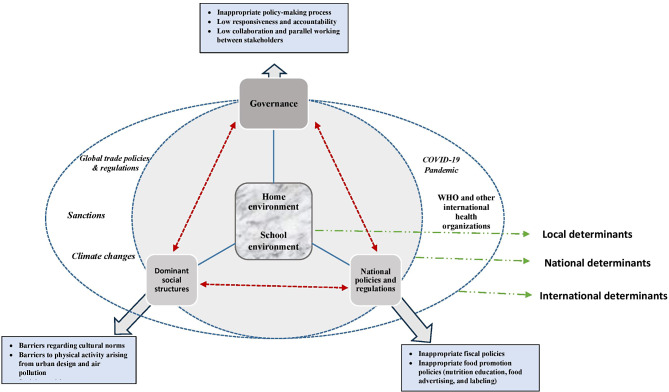
The main determinants of childhood obesity control in Iran can be categorized into three levels: local, national, and international. At the local level, home and school environments are influential in shaping unhealthy lifestyles and energy imbalances. The national determinants are the triad of governance, dominant social structure, and national policies/regulations. Governance factors such as inappropriate policy-making processes, Low responsiveness and accountability, and Low collaboration and parallel working between stakeholders; impact childhood obesity control. Dominant social structures including cultural norms, urban design, air pollution, social transitions, and inequalities also contribute to the issue. National policies and regulations exhibit shortcomings in fiscal and food promotion aspects. At the international level, the World Health Organization's approach to Ending Childhood Obesity (ECHO), trade policies, political sanctions, climate change, and the COVID-19 pandemic have significant implications for childhood obesity control.
This study provides valuable insights into the determinants of childhood obesity (CO) in Iran. It can inform evidence-based policymaking not only in Iran but also in other countries with similar socio-economic statuses.
尽管全球为控制儿童肥胖症付出了巨大努力,但其患病率仍在上升,尤其是在低收入和中等收入国家。本研究旨在确定伊朗儿童肥胖症的决定因素。
本定性研究采用目的抽样滚雪球法,采访了来自不同专业和学科的30名利益相关者。他们包括科学家、政府和行业当局、国际组织代表以及民间社会成员。使用MAXQDA 2020进行数据分析,采用归纳性内容分析。通过使用林肯和古巴的标准确保数据的可信度和可靠性。我们使用了定性研究报告的综合标准。
伊朗儿童肥胖症控制的主要决定因素可分为三个层面:地方、国家和国际。在地方层面,家庭和学校环境对塑造不健康的生活方式和能量失衡有影响。国家层面的决定因素是治理、主导社会结构和国家政策/法规这三者。治理因素,如不当的决策过程、低响应性和问责制,以及利益相关者之间的低协作和平行工作;影响儿童肥胖症的控制。包括文化规范、城市设计、空气污染、社会转型和不平等在内的主导社会结构也导致了这一问题。国家政策和法规在财政和食品推广方面存在缺陷。在国际层面,世界卫生组织的“终止儿童肥胖症”(ECHO)方法、贸易政策、政治制裁、气候变化和新冠疫情对儿童肥胖症控制有重大影响。
本研究为伊朗儿童肥胖症的决定因素提供了有价值的见解。它不仅可为伊朗,也可为其他具有类似社会经济地位的国家提供循证决策依据。