Abegaz Tadesse M, Ahmed Muktar, Ali Askal Ayalew, Bhagavathula Akshaya Srikanth
Division of Pharmacy Practice and Science, College of Pharmacy, The Ohio State University, 281 W Lane Ave, Columbus, OH 43210, USA.
Adelaide Medical School, Faculty of Health and Medical Sciences, The University of Adelaide, Adelaide, SA 5005, Australia.
Bioengineering (Basel). 2025 Feb 9;12(2):166. doi: 10.3390/bioengineering12020166.
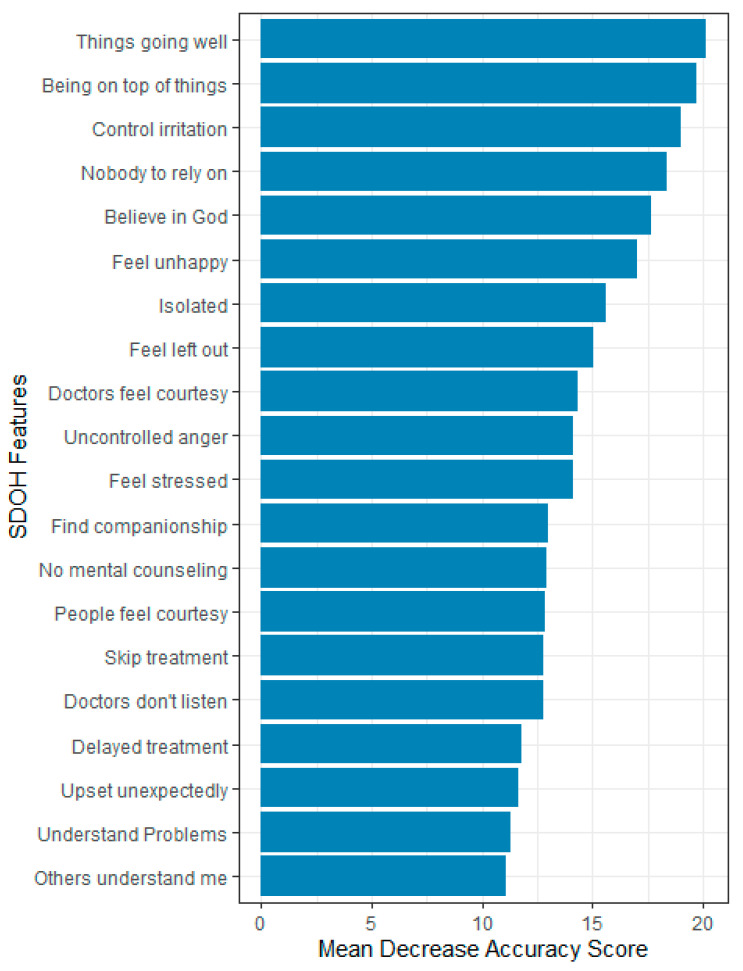
This study applied machine learning (ML) algorithms to predict health-related quality of life (HRQOL) using comprehensive social determinants of health (SDOH) features. Data from the All of Us dataset, comprising participants with complete HRQOL and SDOH records, were analyzed. The primary outcome was HRQOL, which encompassed physical and mental health components, while SDOH features included social, educational, economic, environmental, and healthcare access factors. Three ML algorithms, namely logistic regression, XGBoost, and Random Forest, were tested. The models achieved accuracy ranges of 0.73-0.77 for HRQOL, 0.70-0.71 for physical health, and 0.72-0.77 for mental health, with corresponding area under the curve ranges of 0.81-0.84, 0.74-0.76, and 0.83-0.85, respectively. Emotional stability, activity management, spiritual beliefs, and comorbidity were identified as key predictors. These findings underscore the critical role of SDOH in predicting HRQOL and suggests future research to focus on applying such models to diverse patient populations and specific clinical conditions.
本研究应用机器学习(ML)算法,利用健康的综合社会决定因素(SDOH)特征来预测与健康相关的生活质量(HRQOL)。对来自“我们所有人”数据集的数据进行了分析,该数据集包含有完整HRQOL和SDOH记录的参与者。主要结果是HRQOL,它包括身心健康组成部分,而SDOH特征包括社会、教育、经济、环境和医疗保健可及性因素。测试了三种ML算法,即逻辑回归、XGBoost和随机森林。这些模型在HRQOL方面的准确率范围为0.73 - 0.77,在身体健康方面为0.70 - 0.71,在心理健康方面为0.72 - 0.77,相应的曲线下面积范围分别为0.81 - 0.84、0.74 - 0.76和0.83 - 0.85。情绪稳定性、活动管理、精神信仰和合并症被确定为关键预测因素。这些发现强调了SDOH在预测HRQOL中的关键作用,并建议未来的研究集中于将此类模型应用于不同的患者群体和特定的临床情况。