Ottink Loes, de Haas Naomi, Doeller Christian F
Donders Institute, Radboud University, Nijmegen, The Netherlands.
Psychology Department, Max Planck Institute for Human Cognitive and Brain Sciences, Leipzig, Germany.
Sci Rep. 2025 Feb 27;15(1):7104. doi: 10.1038/s41598-025-90504-3.
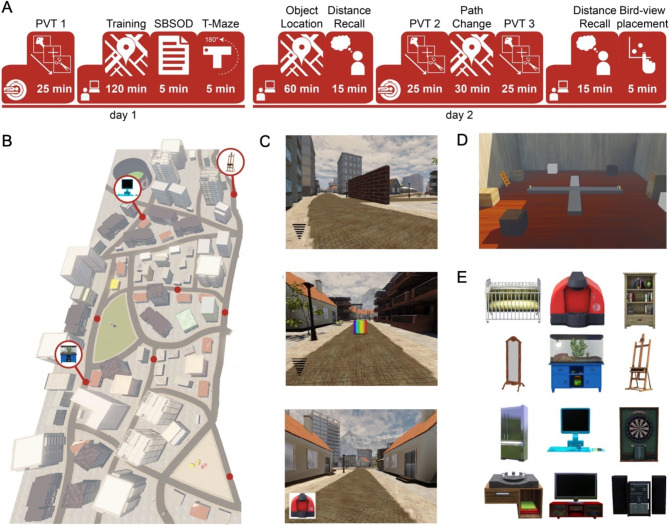
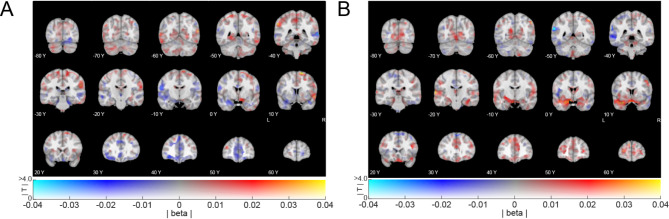
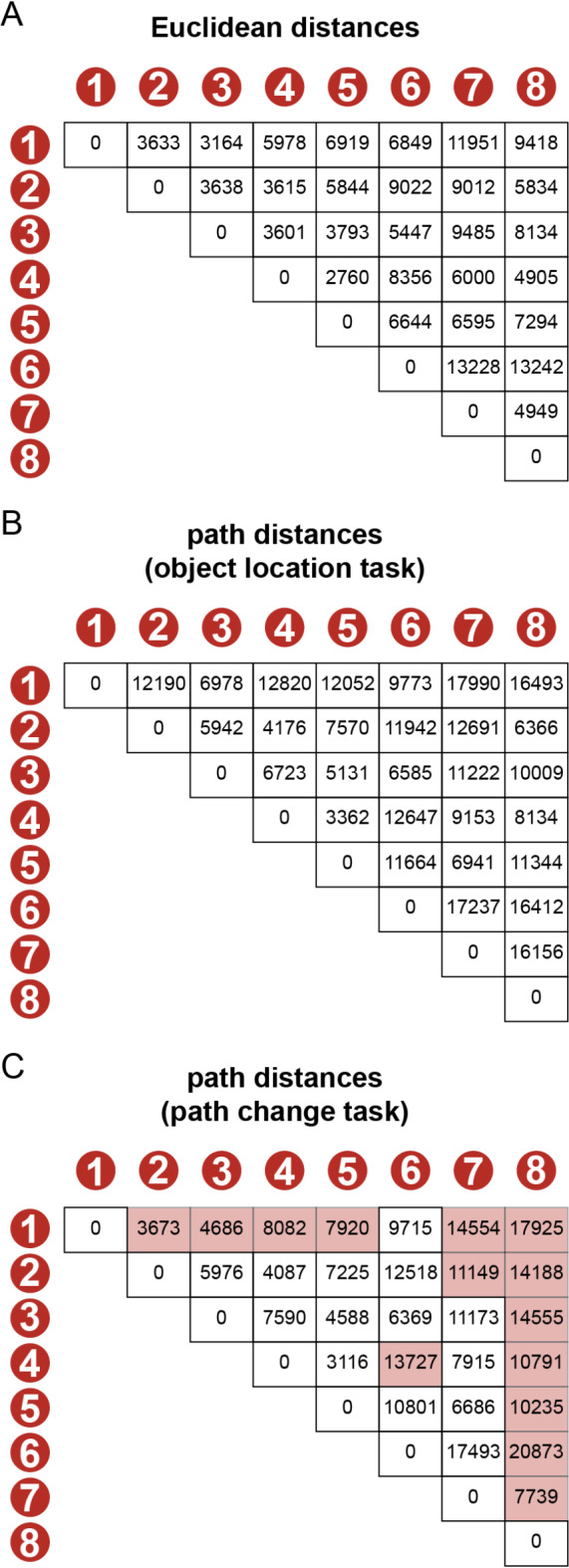
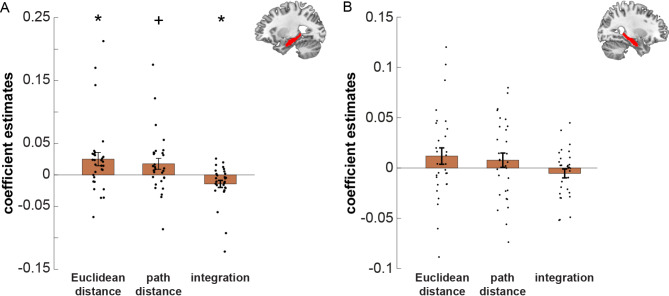
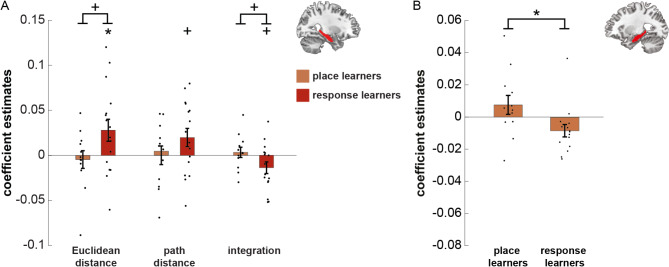
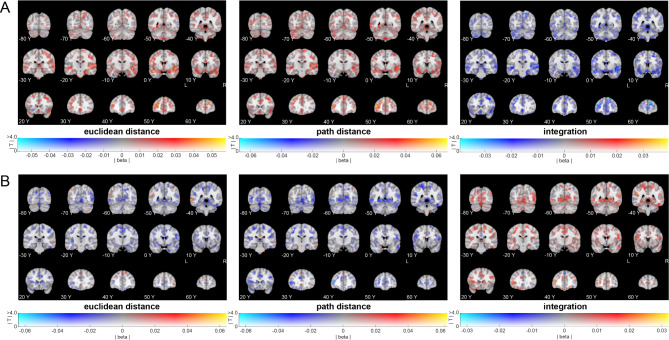
The hippocampus is a key region for forming mental maps of our environment. These maps represent spatial information such as distances between landmarks. A cognitive map can allow for flexible inference of spatial relationships that have never been directly experienced before. Previous work has shown that the human hippocampus encodes distances between locations, but it is unclear how Euclidean and path distances are distinguished. In this study, participants performed an object-location task in a virtual environment. We combined functional magnetic resonance imaging with representational similarity analysis to test how Euclidean and path distances are represented in the hippocampus. We observe that hippocampal neural pattern similarity for objects scales with distance between object locations, and suggest that the hippocampus integrates Euclidean and path distances. One key characteristic of cognitive maps is their adaptive and flexible nature. We therefore subsequently modified path distances between objects using roadblocks in the environment. We found that hippocampal pattern similarity between objects adapted as a function of these changes in path distance, selectively in route learners but not in map learners. Taken together, our study supports the idea that the hippocampus creates integrative and flexible cognitive maps.
海马体是形成我们周围环境心理地图的关键区域。这些地图代表空间信息,比如地标之间的距离。认知地图能够灵活推断从未直接体验过的空间关系。先前的研究表明,人类海马体对地点之间的距离进行编码,但尚不清楚欧几里得距离和路径距离是如何区分的。在本研究中,参与者在虚拟环境中执行物体定位任务。我们将功能磁共振成像与表征相似性分析相结合,以测试海马体中如何表征欧几里得距离和路径距离。我们观察到,物体的海马体神经模式相似性随物体位置之间的距离而变化,并表明海马体整合了欧几里得距离和路径距离。认知地图的一个关键特征是其适应性和灵活性。因此,我们随后在环境中使用路障修改了物体之间的路径距离。我们发现,物体之间的海马体模式相似性会根据这些路径距离的变化而调整,在路线学习者中具有选择性,但在地图学习者中则不然。综上所述,我们的研究支持海马体创建整合性和灵活性认知地图这一观点。