Ilani Mohsen Asghari, Shi Dingjing, Banad Yaser Mike
School of Electrical and Computer Engineering, University of Oklahoma, Norman, OK, 73019, USA.
Department of Psychology, University of Oklahoma, Norman, OK, 73019, USA.
Sci Rep. 2025 Feb 27;15(1):7010. doi: 10.1038/s41598-025-92020-w.
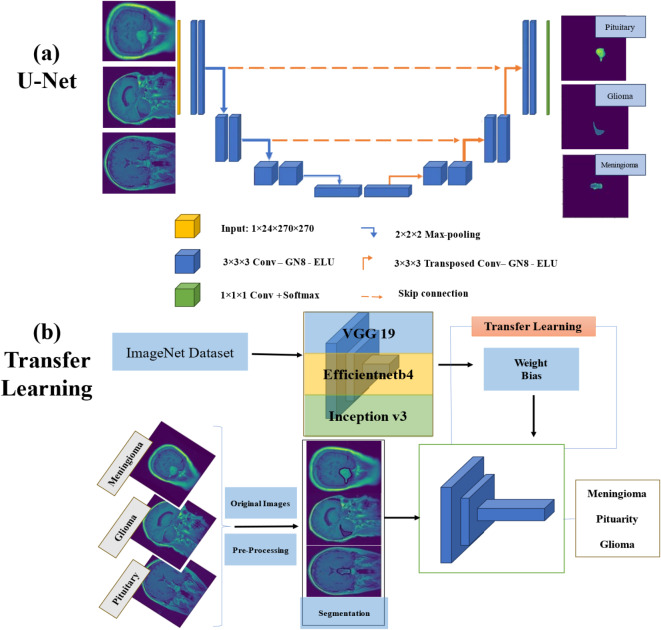
Health is fundamental to human well-being, with brain health particularly critical for cognitive functions. Magnetic resonance imaging (MRI) serves as a cornerstone in diagnosing brain health issues, providing essential data for healthcare decisions. These images represent vast datasets that are increasingly harnessed by deep learning for high-performance image processing and classification tasks. In our study, we focus on classifying brain tumors-such as glioma, meningioma, and pituitary tumors-using the U-Net architecture applied to MRI scans. Additionally, we explore the effectiveness of convolutional neural networks including Inception-V3, EfficientNetB4, and VGG19, augmented through transfer learning techniques. Evaluation metrics such as F-score, recall, precision, and accuracy were employed to assess model performance. The U-Net segmentation architecture, emerged as the top performer, achieving an accuracy of 98.56%, along with an F-score of 99%, an area under the curve of 99.8%, and recall and precision rates of 99%. This study demonstrates the effectiveness of U-Net, a convolutional neural network architecture, for accurate brain tumor segmentation in early detection and treatment planning. Achieving an accuracy of 96.01% in cross-dataset validation with an external cohort, U-Net exhibited robust performance across diverse clinical scenarios. Our findings highlight the potential of U-Net and transfer learning in enhancing diagnostic accuracy and informing clinical decision-making in neuroimaging, ultimately improving patient care and outcomes.
健康是人类幸福的基础,其中大脑健康对认知功能尤为关键。磁共振成像(MRI)是诊断大脑健康问题的基石,为医疗决策提供重要数据。这些图像代表了庞大的数据集,深度学习越来越多地利用这些数据集来执行高性能图像处理和分类任务。在我们的研究中,我们专注于使用应用于MRI扫描的U-Net架构对脑肿瘤(如神经胶质瘤、脑膜瘤和垂体瘤)进行分类。此外,我们还探索了通过迁移学习技术增强的卷积神经网络(包括Inception-V3、EfficientNetB4和VGG19)的有效性。采用F分数、召回率、精确率和准确率等评估指标来评估模型性能。U-Net分割架构表现最为出色,准确率达到98.56%,F分数为99%,曲线下面积为99.8%,召回率和精确率为99%。这项研究证明了卷积神经网络架构U-Net在早期检测和治疗规划中进行准确脑肿瘤分割的有效性。在与外部队列的跨数据集验证中,U-Net的准确率达到96.01%,在各种临床场景中均表现出强大的性能。我们的研究结果凸显了U-Net和迁移学习在提高神经影像诊断准确性和为临床决策提供依据方面的潜力,最终改善患者护理和治疗结果。