Cardoso Celso E D, Almeida Joana C, Rocha João, Pereira Eduarda
Chemistry Department and CICECO-Aveiro Institute of Materials, University of Aveiro, Campus de Santiago, 3810-193, Aveiro, Portugal.
Chemistry Department and LAQV-REQUIMTE, University of Aveiro, Campus de Santiago, 3810-193, Aveiro, Portugal.
Environ Sci Pollut Res Int. 2025 Mar;32(11):6804-6816. doi: 10.1007/s11356-025-36152-6. Epub 2025 Feb 28.
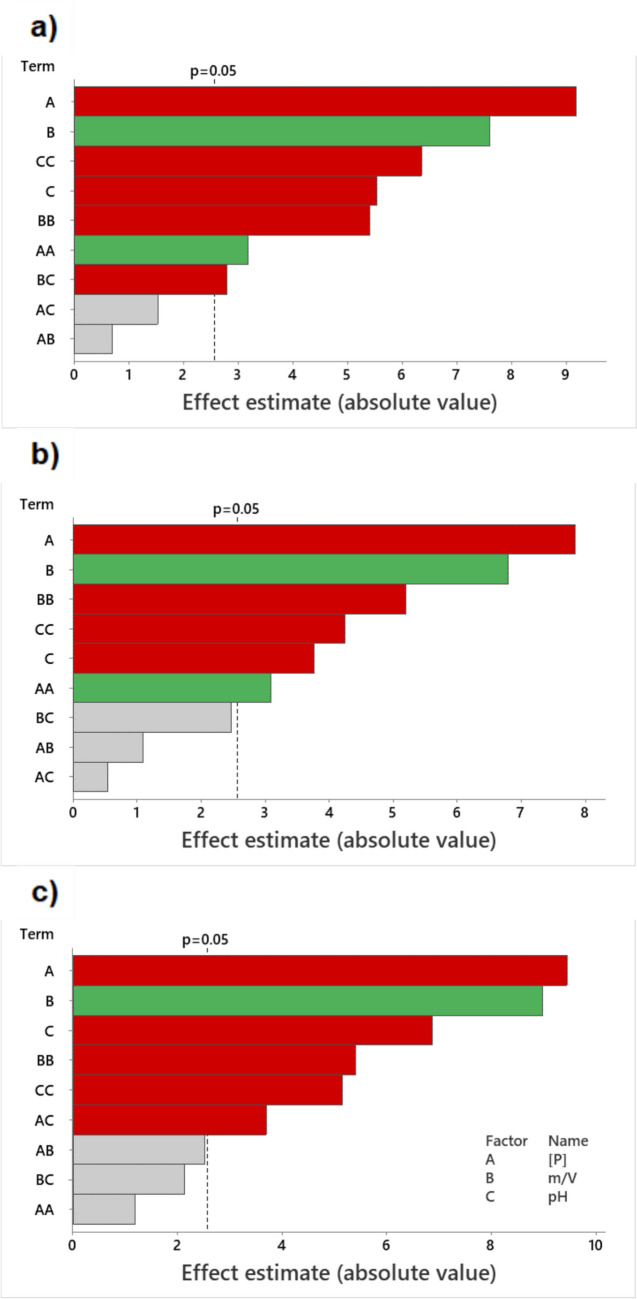
Phosphorus is essential for all living organisms and limits aquatic plant growth. Pulp mill effluents, particularly from Eucalyptus bleached kraft pulp mills, contain phosphorus concentrations that vary with operational conditions. This variability poses challenges for effective treatment and phosphorus removal. However, uncontrolled release of phosphorus-rich wastewaters causes eutrophication. This study focuses on optimizing phosphorus removal from such effluents using cobalt ferrite nanoparticles, with an emphasis on process optimization to address this variability. Minimizing phosphorus concentrations is crucial in wastewater engineering and surface water management. By employing design of experiments and response surface methodology, we aim to fine-tune the phosphorous removal process and pinpoint the key factors with the most significant impact. Optimal conditions for achieving over 90% removal from an effluent with 5 mg P/L were identified as a sorbent dose greater than 1.3 g/L and a pH range between 5 and 7, all within a contact time of only 15 min. For a contact time of 1 and 24 h, the conditions adjust to a sorbent dose greater than 0.97 and 0.83 g/L, respectively, with the pH range remaining the same. Our results highlight the effectiveness of cobalt ferrite nanoparticles as sorbents in the removal of phosphorus for water treatment purposes. This approach presents a sustainable and proficient strategy for phosphorus recovery from pulp mill effluents, thereby lessening environmental repercussions and offering a valuable resource for future use. This contributes to the maintenance of water quality and ecosystem preservation.
磷对所有生物都至关重要,并且会限制水生植物的生长。纸浆厂废水,尤其是桉木漂白硫酸盐浆厂的废水,其磷浓度会随运行条件而变化。这种变异性给有效处理和除磷带来了挑战。然而,富含磷的废水无控制排放会导致富营养化。本研究聚焦于使用钴铁氧体纳米颗粒优化此类废水中磷的去除,重点在于通过工艺优化来应对这种变异性。在废水工程和地表水管理中,将磷浓度降至最低至关重要。通过采用实验设计和响应面方法,我们旨在微调除磷过程并确定影响最为显著的关键因素。对于含磷量为5 mg P/L的废水,实现去除率超过90%的最佳条件被确定为吸附剂剂量大于1.3 g/L且pH范围在5至7之间,所有这些都只需15分钟的接触时间。对于1小时和24小时的接触时间,条件分别调整为吸附剂剂量大于0.97 g/L和0.83 g/L,pH范围保持不变。我们的结果凸显了钴铁氧体纳米颗粒作为吸附剂在水处理中去除磷的有效性。这种方法为从纸浆厂废水中回收磷提供了一种可持续且高效的策略,从而减少环境影响并为未来使用提供宝贵资源。这有助于维持水质和保护生态系统。