Gao Yuxin, Ma Xiaojun, Shi Zhiyun, Zhu Mengqi, Yang Zongqiang, Tao Zhengyong, Niu Ningkui
Department of Orthopedic, General Hospital of Ningxia Medical University, Ningxia Hui Autonomous Region, No.804 Shengli Street, Yinchuan, 750004, China.
School of Clinical Medicine, Ningxia Medical University, Ningxia Hui Autonomous Region, Yinchuan, 750004, China.
J Orthop Surg Res. 2025 Feb 27;20(1):208. doi: 10.1186/s13018-025-05622-5.
This study is designed to investigate the roles of MMP-2, MMP-9, and MMP-13 in intervertebral disc destruction resulting from different types of spinal infections and their correlations with clinical quantitative data.
Disc tissue samples were collected from 60 patients with spinal infections (20 cases each of STB, BS, and PS in the infection group) and 20 patients with intervertebral disc herniation (control group). The expressions of MMP-2, MMP-9, and MMP-13 were detected by RT-qPCR. Correlation analysis was carried out with clinical quantitative data such as preoperative erythrocyte sedimentation rate (ESR), C-reactive protein (CRP), interleukin-6 (IL-6), procalcitonin (PCT), and related blood routine indicators in the infection group.
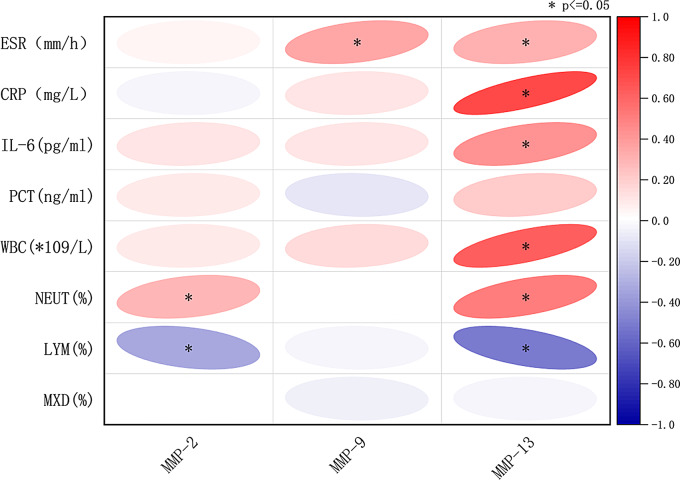
In the analysis between the infection group and the control group, MMP-13 was expressed in the diseased intervertebral disc tissue of STB patients, but the result was not statistically significant (P = 0.2172). There was a significant difference in the expression of MMP-13 in the diseased intervertebral discs of BS and PS patients. The expressions of MMP-9 and MMP-2 were markedly increased in the diseased intervertebral disc tissue of STB, BS, and PS patients (all P < 0.05). In the inter-group analysis of the infection group, the expression of MMP-13 in the diseased intervertebral disc tissue of PS patients was significantly different from that of STB and BS (P < 0.0001), while there was no significant difference between the STB and BS groups (P = 0.2393). The expression of MMP-9 in the diseased intervertebral disc tissue of STB patients was significantly different from that of BS and PS (P < 0.0001), but there was no statistically significant difference between the BS and PS groups (P = 0.9643). There was no statistically significant difference in the expression of MMP-2 among the STB, BS, and PS groups. In the correlation analysis with clinical quantitative data, MMP-13 was positively correlated with CRP, ESR, IL-6, WBC, and NEUT levels (r values were 0.7346, 0.3465, 0.3326, 0.6347, and 0.5152 respectively), and negatively correlated with LYM level (r = -0.5152, P < 0.05), and had no correlation with PCT and MXD levels. MMP-9 was positively correlated with ESR level (r = 0.3412, P < 0.05) and had no correlation with CRP, IL-6, PCT, WBC, NEUT, and LYM levels. MMP-2 was positively correlated with NEUT and LYM levels (r values were 0.3021 and 0.3306 respectively, P < 0.05) and had no correlation with ESR, CRP, IL-6, PCT, and WBC levels.
MMP-2, MMP-9, and MMP-13 play crucial roles in intervertebral disc destruction due to spinal infections. The differential expression of MMPs may be one of the reasons for the varying degrees of intervertebral disc destruction in different types of spinal infections. Moreover, when clinical indicators such as CRP, ESR, IL-6, WBC, and NEUT increase, it suggests that the expression of MMP-13 in the intervertebral disc at the lesion site significantly rises, and it may become a new target for the treatment of spinal infections in the future.
本研究旨在探讨基质金属蛋白酶-2(MMP-2)、基质金属蛋白酶-9(MMP-9)和基质金属蛋白酶-13(MMP-13)在不同类型脊柱感染导致的椎间盘破坏中的作用及其与临床定量数据的相关性。
收集60例脊柱感染患者(感染组中脊柱结核、布鲁氏菌病、化脓性脊柱炎各20例)和20例椎间盘突出症患者(对照组)的椎间盘组织样本。采用逆转录定量聚合酶链反应(RT-qPCR)检测MMP-2、MMP-9和MMP-13的表达。对感染组术前红细胞沉降率(ESR)、C反应蛋白(CRP)、白细胞介素-6(IL-6)、降钙素原(PCT)等临床定量数据及相关血常规指标进行相关性分析。
感染组与对照组分析中,脊柱结核患者病变椎间盘组织中有MMP-13表达,但差异无统计学意义(P = 0.2172)。布鲁氏菌病和化脓性脊柱炎患者病变椎间盘组织中MMP-13表达有显著差异。脊柱结核、布鲁氏菌病和化脓性脊柱炎患者病变椎间盘组织中MMP-9和MMP-2表达均明显升高(均P < 0.05)。感染组组内分析中,化脓性脊柱炎患者病变椎间盘组织中MMP-13表达与脊柱结核和布鲁氏菌病患者有显著差异(P < 0.0001),而脊柱结核组与布鲁氏菌病组之间无显著差异(P = 0.2393)。脊柱结核患者病变椎间盘组织中MMP-9表达与布鲁氏菌病和化脓性脊柱炎患者有显著差异(P < 0.0001),但布鲁氏菌病组与化脓性脊柱炎组之间无统计学差异(P = 0.9643)。脊柱结核、布鲁氏菌病和化脓性脊柱炎组之间MMP-2表达无统计学差异。与临床定量数据的相关性分析中,MMP-13与CRP、ESR、IL-6、白细胞(WBC)及中性粒细胞(NEUT)水平呈正相关(r值分别为0.7346、0.3465、0.3326、0.6347和0.5152),与淋巴细胞(LYM)水平呈负相关(r = -0.5152,P < 0.05),与PCT及单核细胞(MXD)水平无相关性。MMP-9与ESR水平呈正相关(r = 0.3412,P < 0.05),与CRP、IL-6、PCT、WBC、NEUT及LYM水平无相关性。MMP-2与NEUT和LYM水平呈正相关(r值分别为0.3021和0.3306,P < 0.05),与ESR、CRP、IL-6、PCT及WBC水平无相关性。
MMP-2、MMP-9和MMP-13在脊柱感染导致的椎间盘破坏中起关键作用。基质金属蛋白酶的差异表达可能是不同类型脊柱感染中椎间盘破坏程度不同的原因之一。此外,当CRP、ESR、IL-6、WBC和NEUT等临床指标升高时,提示病变部位椎间盘MMP-13表达显著升高,未来可能成为脊柱感染治疗的新靶点。