
盐胁迫和干旱胁迫下籽粒苋(Amaranthus hypochondriacus L.)中WRKY基因家族的全基因组鉴定与表达谱分析
Genome-wide identification and expression profiling of WRKY gene family in grain Amaranth (Amaranthus hypochondriacus L.) under salinity and drought stresses.
作者信息
Singh Akshay, Maurya Avantika, Gupta Rajat, Joshi Parampara, Rajkumar S, Singh Amit Kumar, Bhardwaj Rakesh, Singh G P, Singh Rakesh
机构信息
Division of Genomic Resources, ICAR-National Bureau of Plant Genetic Resources, Pusa, New Delhi, 110012, India.
Division of Germplasm Evaluation, ICAR-National Bureau of Plant Genetic Resources, Pusa, New Delhi, 110012, India.
出版信息
BMC Plant Biol. 2025 Feb 28;25(1):265. doi: 10.1186/s12870-025-06270-x.
BACKGROUND
The WRKY gene family plays a significant role in plant growth, development, and responses to biotic and abiotic stresses. However, the role of the WRKY gene family has not been reported in Amaranthus hypochondriacus. This study presents a comprehensive genome-wide analysis of the WRKY gene family in grain amaranth (A. hypochondriacus L.), a resilient crop known for its high nutritional value and adaptability to challenging environments.
RESULTS
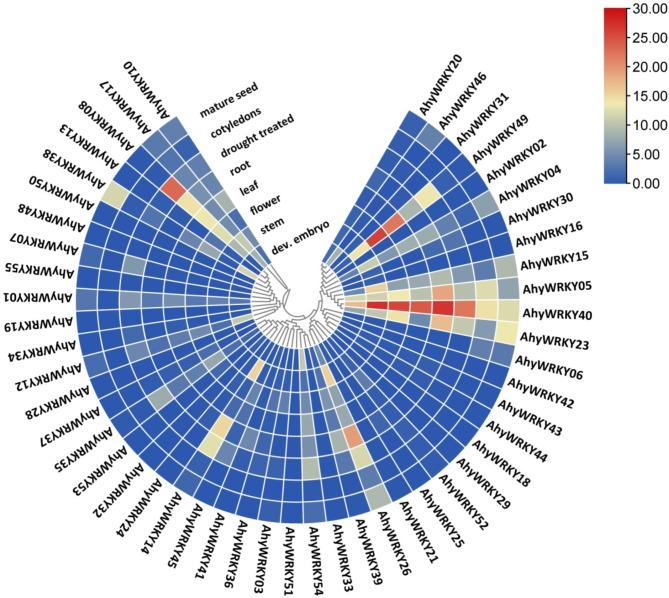
In this study, 55 WRKY genes (AhyWRKY1-55) were identified in A. hypochondriacus and distributed unevenly across 16 scaffolds. Of these, 50 contained conserved WRKY domains and were classified into three main groups. Group II was further divided into five subgroups (IIa-IIe) based on phylogenetic analysis, with each clade being well supported by conserved motifs. Additionally, the gene structure analysis revealed variations in exon-intron organization. In contrast, motif analysis showed the presence of conserved domains that were similar within the group but differed between groups, suggesting their functional diversity. Cis-acting elements related to plant growth and development and light, hormones, and stress responses were identified. Synteny analysis revealed that 34 (61.8%) of the genes originated from tandem duplication, indicating the role of tandem duplication in the expansion of the A. hypochondriacus WRKY gene family. Protein-protein interaction analysis suggested that AhyWRKY3, AhyWRKY27, AhyWRKY28, AhyWRKY36, and AhyWRKY52 were hub genes involved in the complex protein interaction network. Using in silico and real-time quantitative PCR, expression analysis revealed tissue- and condition-specific expression patterns of AhyWRKY genes. Notably, under drought stress, AhyWRKY39, AhyWRKY40, AhyWRKY54, and AhyWRKY01 showed increased expression, while under salt stress, AhyWRKY40, AhyWRKY54, AhyWRKY39, AhyWRKY49, and AhyWRKY8 were upregulated at 30 days, suggesting that these genes may play key role in response to salinity stress.
CONCLUSIONS
The present study provides valuable insights into the organization and evolutionary patterns of the WRKY gene family in amaranth. It also identifies putative candidate WRKY genes that may play a role in conferring drought and salt tolerance. Overall, this study lays a foundation for further functional validation of these WRKY candidate genes, facilitating their exploitation in the amaranth genetic improvement programs to develop stress-resilient varieties.
背景
WRKY基因家族在植物生长、发育以及对生物和非生物胁迫的响应中发挥着重要作用。然而,WRKY基因家族在皱果苋中的作用尚未见报道。本研究对籽粒苋(A. hypochondriacus L.)中的WRKY基因家族进行了全面的全基因组分析,籽粒苋是一种具有高营养价值且能适应恶劣环境的韧性作物。
结果
在本研究中,在皱果苋中鉴定出55个WRKY基因(AhyWRKY1 - 55),它们不均匀地分布在16个支架上。其中,50个含有保守的WRKY结构域,并被分为三个主要组。基于系统发育分析,第二组进一步分为五个亚组(IIa - IIe),每个进化枝都有保守基序的有力支持。此外,基因结构分析揭示了外显子 - 内含子组织的变化。相比之下,基序分析表明存在保守结构域,这些结构域在组内相似但组间不同,表明它们具有功能多样性。鉴定出了与植物生长发育以及光、激素和胁迫响应相关的顺式作用元件。共线性分析表明,34个(61.8%)基因起源于串联重复,表明串联重复在皱果苋WRKY基因家族扩展中的作用。蛋白质 - 蛋白质相互作用分析表明,AhyWRKY3、AhyWRKY27、AhyWRKY28、AhyWRKY36和AhyWRKY52是参与复杂蛋白质相互作用网络的枢纽基因。通过电子分析和实时定量PCR,表达分析揭示了AhyWRKY基因的组织和条件特异性表达模式。值得注意的是,在干旱胁迫下,AhyWRKY39、AhyWRKY40、AhyWRKY54和AhyWRKY01表达增加,而在盐胁迫下,AhyWRKY40、AhyWRKY54,AhyWRKY39、AhyWRKY49和AhyWRKY8在30天时上调,表明这些基因可能在应对盐胁迫中起关键作用。
结论
本研究为苋属植物中WRKY基因家族的组织和进化模式提供了有价值的见解。它还鉴定出了可能在赋予耐旱和耐盐性方面发挥作用的假定候选WRKY基因。总体而言,本研究为进一步对这些WRKY候选基因进行功能验证奠定了基础,有助于在苋属植物遗传改良计划中利用它们来培育抗逆品种。



 Zotero 插件