Murugesu Sughashini, Linton-Reid Kristofer, Braun Emily, Barcroft Jennifer, Cooper Nina, Pikovsky Margaret, Novak Alex, Parker Nina, Stalder Catriona, Al-Memar Maya, Saso Srdjan, Aboagye Eric O, Bourne Tom
Queen Charlotte's and Chelsea Hospital, Imperial College, London, W12 0HS, UK.
Department of Metabolism, Digestion and Reproduction, Imperial College London, Du Cane Road, London, W12 0NN, UK.
BMC Pregnancy Childbirth. 2025 Feb 28;25(1):225. doi: 10.1186/s12884-025-07283-y.
To determine whether readily available patient, ultrasound and treatment outcome data can be used to develop, validate and externally test two machine learning (ML) models for predicting the success of expectant and medical management of miscarriage respectively.
A retrospective, multi-site study of patients opting for expectant or medical management of miscarriage was undertaken. A total of 1075 patients across two hospital early pregnancy units were eligible for inclusion. Data pre-processing derived 14 features for predictive modelling. A combination of eight linear, Bayesian, neural-net and tree-based machine learning algorithms were applied to ten different feature sets. The area under the receiver operating characteristic curve (AUC) scores were the metrics used to demonstrate the performance of the best performing model and feature selection combination for the training, validation and external data set for expectant and medical management separately.
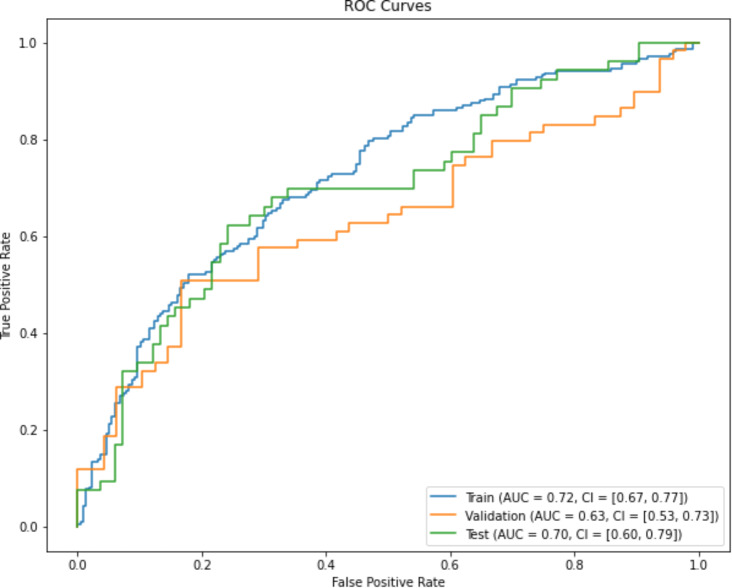
Parameters were in the majority well matched across training, validation and external test sets. The respective optimum training, validation and external test set AUC scores were as follows in the expectant management cohort: 0.72 (95% CI 0.67,0.77), 0.63 (95% CI 0.53,0.73) and 0.70 (95% CI 0.60,0.79) (Logistic Regression in combination with Least Absolute Shrinkage and Selection Operator (LASSO)). The AUC scores in the medical management cohort were 0.64 (95% CI 0.56,0.72), 0.62 (95% CI 0.45,0.77) and 0.71 (95% CI 0.58,0.83) (Logistic Regression in combination with Recursive Feature Elimination (RFE)).
Performance of our expectant and medical miscarriage management ML models demonstrate consistency across validation and external test sets. These ML methods, validated and externally tested, have the potential to offer personalised prediction outcome of expectant and medical management of miscarriage.
确定现有的患者、超声及治疗结果数据能否用于开发、验证并外部测试两个机器学习(ML)模型,分别预测自然转归和药物治疗流产的成功率。
对选择自然转归或药物治疗流产的患者进行一项回顾性多中心研究。两家医院早期妊娠科室的1075例患者符合纳入标准。数据预处理得出14个用于预测建模的特征。将8种线性、贝叶斯、神经网络和基于树的机器学习算法组合应用于10个不同的特征集。采用受试者操作特征曲线(AUC)下面积得分作为指标,分别展示最佳表现模型及特征选择组合在自然转归和药物治疗训练集、验证集及外部数据集上的性能。
参数在训练集、验证集和外部测试集之间大多匹配良好。自然转归管理队列中,各自的最佳训练集、验证集和外部测试集AUC得分如下:0.72(95%CI 0.67,0.77)、0.63(95%CI 0.53,0.73)和0.70(95%CI 0.60,0.79)(逻辑回归结合最小绝对收缩和选择算子(LASSO))。药物治疗队列中的AUC得分分别为0.64(95%CI 0.56,0.72)、0.62(95%CI 0.45,0.77)和0.71(95%CI 0.58,0.83)(逻辑回归结合递归特征消除(RFE))。
我们的自然转归和药物治疗流产管理ML模型在验证集和外部测试集上的性能表现出一致性。这些经过验证和外部测试的ML方法有潜力为自然转归和药物治疗流产提供个性化预测结果。