Lung Unit, The Royal Marsden NHS Foundation Trust, Fulham Road, London SW36JJ, UK; AI for Healthcare Centre for Doctoral Training, Imperial College London, Exhibition Road, London SW7 2BX, UK; Department of Clinical Oncology, Institute of Cancer Research NIHR Biomedical Research Centre, London, UK; Cancer Imaging Centre, Department of Surgery and Cancer, Imperial College London, Du Cane Road, London W12 0NN, UK; Early Diagnosis and Detection Centre, National Institute for Health Research (NIHR) Biomedical Research Centre at The Royal Marsden NHS Foundation Trust and the Institute of Cancer Research, London.
Guy's Cancer Centre, Guy's and St Thomas' NHS Foundation Trust, Great Maze Pond, London SE19RT UK.
EBioMedicine. 2022 Mar;77:103911. doi: 10.1016/j.ebiom.2022.103911. Epub 2022 Mar 3.
Surveillance is universally recommended for non-small cell lung cancer (NSCLC) patients treated with curative-intent radiotherapy. High-quality evidence to inform optimal surveillance strategies is lacking. Machine learning demonstrates promise in accurate outcome prediction for a variety of health conditions. The purpose of this study was to utilise readily available patient, tumour, and treatment data to develop, validate and externally test machine learning models for predicting recurrence, recurrence-free survival (RFS) and overall survival (OS) at 2 years from treatment.
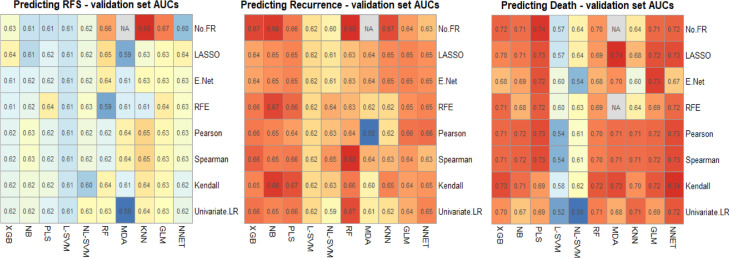
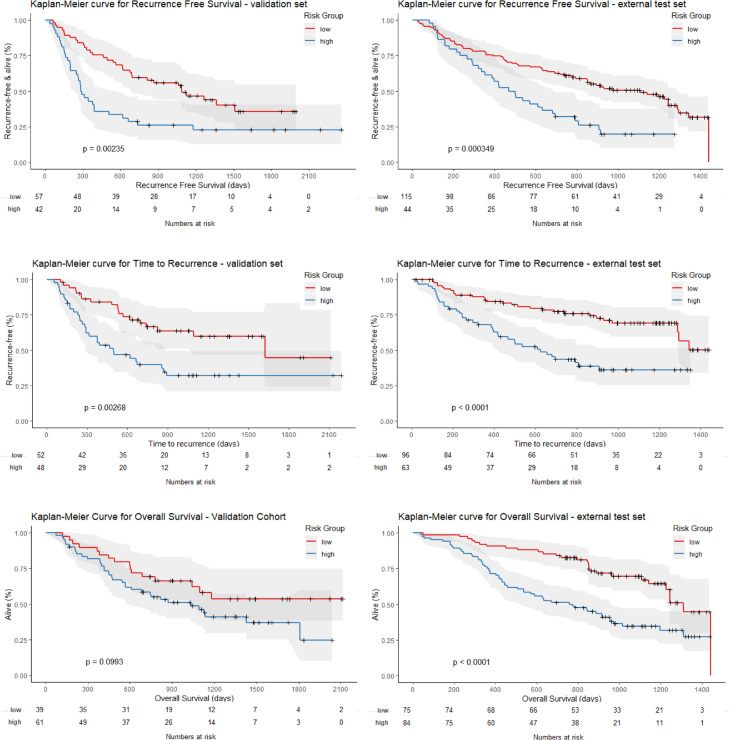
A retrospective, multicentre study of patients receiving curative-intent radiotherapy for NSCLC was undertaken. A total of 657 patients from 5 hospitals were eligible for inclusion. Data pre-processing derived 34 features for predictive modelling. Combinations of 8 feature reduction methods and 10 machine learning classification algorithms were compared, producing risk-stratification models for predicting recurrence, RFS and OS. Models were compared with 10-fold cross validation and an external test set and benchmarked against TNM-stage and performance status. Youden Index was derived from validation set ROC curves to distinguish high and low risk groups and Kaplan-Meier analyses performed.
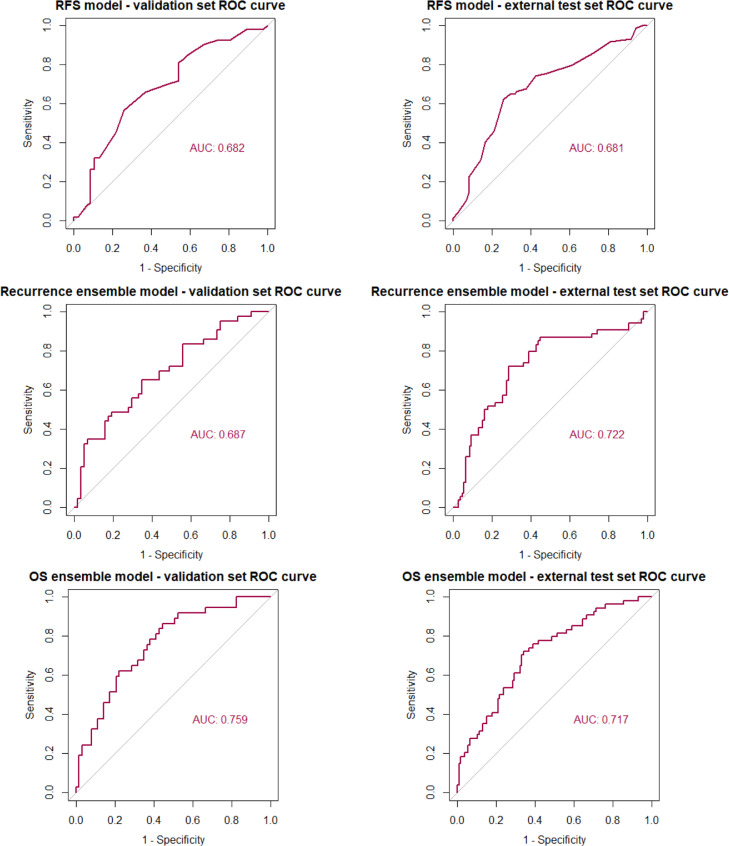
Median follow-up time was 852 days. Parameters were well matched across training-validation and external test sets: Mean age was 73 and 71 respectively, and recurrence, RFS and OS rates at 2 years were 43% vs 34%, 54% vs 47% and 54% vs 47% respectively. The respective validation and test set AUCs were as follows: 1) RFS: 0·682 (0·575-0·788) and 0·681 (0·597-0·766), 2) Recurrence: 0·687 (0·582-0·793) and 0·722 (0·635-0·81), and 3) OS: 0·759 (0·663-0·855) and 0·717 (0·634-0·8). Our models were superior to TNM stage and performance status in predicting recurrence and OS.
This robust and ready to use machine learning method, validated and externally tested, sets the stage for future clinical trials entailing quantitative personalised risk-stratification and surveillance following curative-intent radiotherapy for NSCLC.
A full list of funding bodies that contributed to this study can be found in the Acknowledgements section.
对于接受根治性放疗的非小细胞肺癌 (NSCLC) 患者,普遍推荐进行监测。但缺乏高质量的证据来为最佳监测策略提供信息。机器学习在准确预测各种健康状况的结果方面显示出了前景。本研究的目的是利用患者、肿瘤和治疗的相关数据,开发、验证和外部测试用于预测治疗后 2 年内复发、无复发生存率 (RFS) 和总生存率 (OS) 的机器学习模型。
本研究为回顾性、多中心研究,纳入了 5 家医院接受根治性放疗的 NSCLC 患者。共有 657 名患者符合纳入标准。数据预处理得到了 34 个预测模型特征。比较了 8 种特征降维方法和 10 种机器学习分类算法的组合,为预测复发、RFS 和 OS 生成风险分层模型。模型通过 10 倍交叉验证和外部测试集进行了比较,并与 TNM 分期和表现状态进行了比较。验证集 ROC 曲线的约登指数用于区分高风险和低风险组,并进行了 Kaplan-Meier 分析。
中位随访时间为 852 天。培训-验证和外部测试集的参数匹配良好:年龄分别为 73 岁和 71 岁,2 年时的复发率、RFS 和 OS 率分别为 43%比 34%、54%比 47%和 54%比 47%。相应的验证和测试集 AUC 如下:1) RFS:0.682(0.575-0.788)和 0.681(0.597-0.766),2) 复发:0.687(0.582-0.793)和 0.722(0.635-0.81),3) OS:0.759(0.663-0.855)和 0.717(0.634-0.8)。我们的模型在预测复发和 OS 方面优于 TNM 分期和表现状态。
本研究通过验证和外部测试,建立了一个稳健且易于使用的机器学习方法,为未来涉及定量个体化风险分层和 NSCLC 根治性放疗后监测的临床试验奠定了基础。
可在Acknowledgements 部分找到为本研究做出贡献的所有资助机构的完整列表。