Melton Rebecca, Jimenez Sara, Elison Weston, Tucciarone Luca, Howell Abigail, Wang Gaowei, Berti Denise, Beebe Elisha, Miller Michael, Zeng Chun, McGrail Carolyn, VanderStel Kennedy, Korgaonkar Katha, Elgamal Ruth, Mummey Hannah, Chiou Joshua, Griffin Emily, Kusmartseva Irina, Atkinson Mark, Preissl Sebastian, Theis Fabian J, Sander Maike, Gaulton Kyle J
Biomedical sciences program, University of California San Diego, La Jolla CA.
Department of Computational Health, Institute of Computational Biology, Helmholtz, Munich, Germany.
bioRxiv. 2025 Mar 17:2025.02.13.637721. doi: 10.1101/2025.02.13.637721.
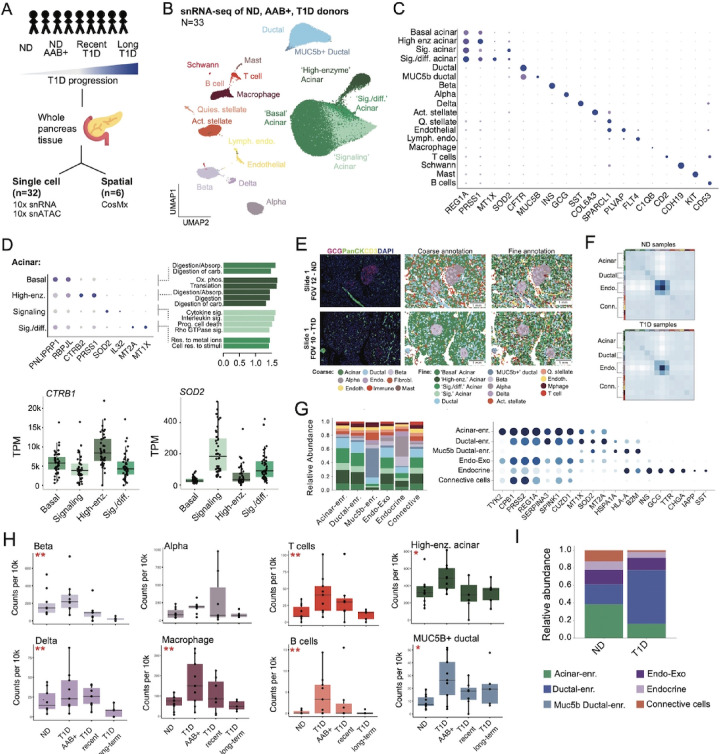
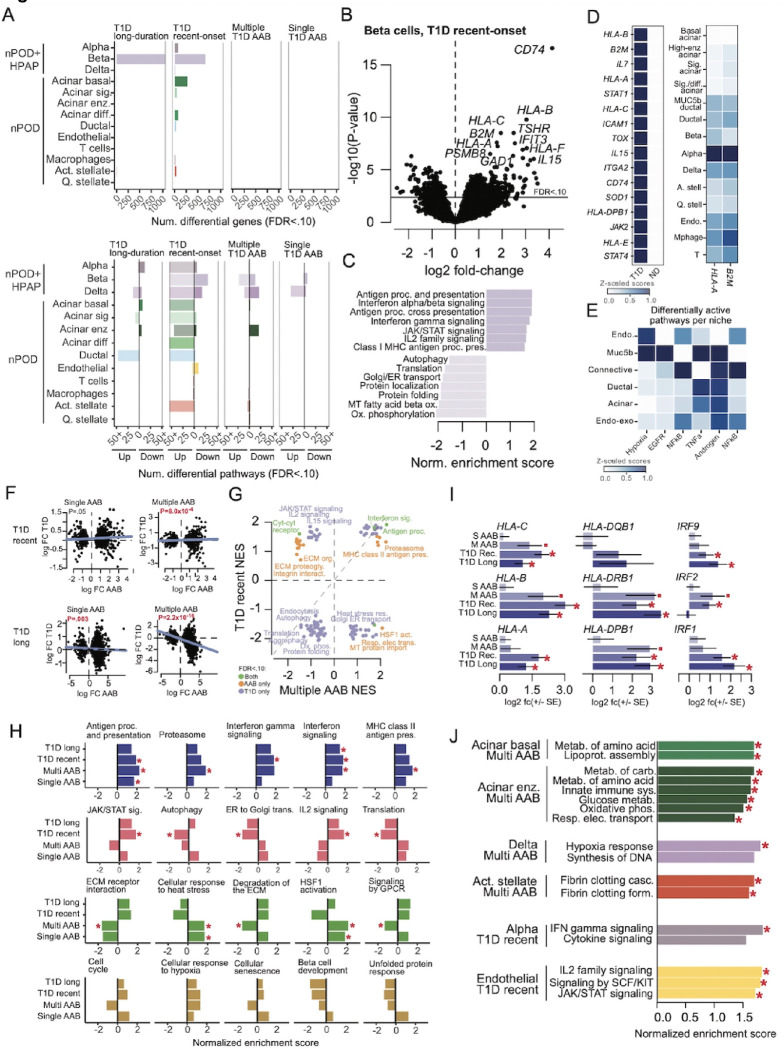
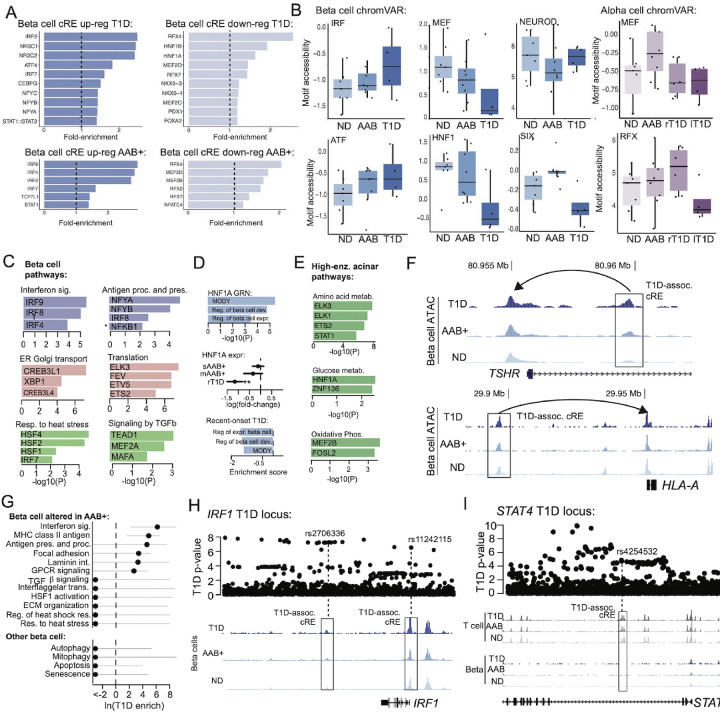
Cell type-specific regulatory programs that drive type 1 diabetes (T1D) in the pancreas are poorly understood. Here we performed single nucleus multiomics and spatial transcriptomics in up to 32 non-diabetic (ND), autoantibody-positive (AAB+), and T1D pancreas donors. Genomic profiles from 853,005 cells mapped to 12 pancreatic cell types, including multiple exocrine sub-types. Beta, acinar, and other cell types, and related cellular niches, had altered abundance and gene activity in T1D progression, including distinct pathways altered in AAB+ compared to T1D. We identified epigenomic drivers of gene activity in T1D and AAB+ which, combined with genetic association, revealed causal pathways of T1D risk including antigen presentation in beta cells. Finally, single cell and spatial profiles together revealed widespread changes in cell-cell signaling in T1D including signals affecting beta cell regulation. Overall, these results revealed drivers of T1D progression in the pancreas, which form the basis for therapeutic targets for disease prevention.
驱动胰腺1型糖尿病(T1D)的细胞类型特异性调控程序目前还知之甚少。在此,我们对多达32名非糖尿病(ND)、自身抗体阳性(AAB+)和T1D胰腺供体进行了单核多组学和空间转录组学研究。来自853,005个细胞的基因组图谱映射到12种胰腺细胞类型,包括多种外分泌亚型。在T1D进展过程中,β细胞、腺泡细胞和其他细胞类型以及相关的细胞微环境的丰度和基因活性发生了改变,包括与T1D相比,AAB+中改变的不同途径。我们确定了T1D和AAB+中基因活性的表观基因组驱动因素,结合遗传关联,揭示了T1D风险的因果途径,包括β细胞中的抗原呈递。最后,单细胞和空间图谱共同揭示了T1D中细胞间信号传导的广泛变化,包括影响β细胞调节的信号。总体而言,这些结果揭示了胰腺中T1D进展的驱动因素,为疾病预防的治疗靶点奠定了基础。